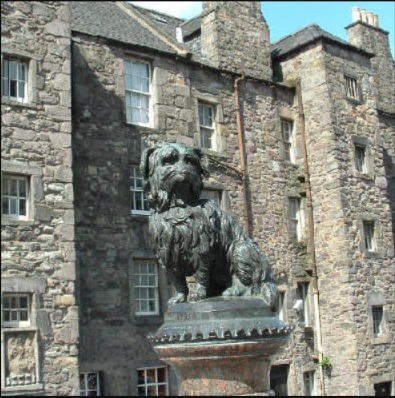
In the heart of Edinburgh, Scotland, there is a story that has captured the imagination and admiration of people around the world for more than a century — the story of Greyfriars Bobby, a little dog whose loyalty transcended life and death.
It is a story of unwavering devotion, quiet resilience, and the bond between humans and their animal companions that still resonates today.
Bobby was reportedly a Skye Terrier — though some researchers now suggest he may have been a Dandie Dinmont Terrier — who lived in the mid‑19th century. He first became known when he belonged to John Gray, a night watchman for the Edinburgh City Police.
Gray brought Bobby along on his nightly patrols through the cobbled streets of Old Town, and the pair quickly became a familiar sight. Bobby was more than just a pet; he was a loyal companion who never left his master’s side.
Tragedy struck in 1858, when John Gray succumbed to tuberculosis and was buried in Greyfriars Kirkyard, a historic churchyard in the heart of Edinburgh. Bobby’s reaction to his master’s death would be the beginning of a legend.
According to the traditional telling, Bobby returned to the kirkyard the morning after the burial and lay beside Gray’s grave. What happened next would astonish everyone who heard the tale: Bobby remained there every day for the next 14 years, rain or shine, summer and winter, watching over the resting place of the man he loved.
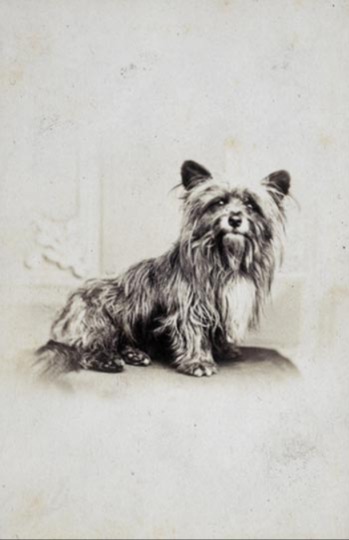
In those days, stray or unaccompanied dogs were not always welcome inside Greyfriars Kirkyard. Cemetery groundskeepers, at first unsure what to make of Bobby’s vigil, attempted to remove him on several occasions. Ultimately, however, they yielded to his devotion.
They even provided a makeshift shelter of sacking so that Bobby could lie nearby, protected from the worst of the elements.
Bobby’s presence did not go unnoticed. Local residents grew to admire the little dog who refused to leave his master’s side. A curious ritual emerged: every day around one o’clock, the firing of the One o’Clock Gun — a tradition from nearby Edinburgh Castle — signaled Bobby’s next move.
Visitors and locals alike would gather at the gates of the kirkyard to see him rise from Gray’s grave and make his way to a nearby coffee house where he had once accompanied his owner. There, a friend of the dog would share a meal with Bobby, just as John Gray might have done in years past.
In 1867, a new city bylaw required all dogs in Edinburgh to be licensed or face destruction. Bobby, of course, had no owner to claim him, and his future was uncertain. But the community’s affection for him was powerful. Sir William Chambers, then Lord Provost of Edinburgh and a director of the Scottish Society for Prevention of Cruelty to Animals, stepped in.
He paid Bobby’s license fee and presented him with an inscribed collar reading “Greyfriars Bobby from the Lord Provost 1867, licensed.” That collar survives today on display at the Museum of Edinburgh, a tangible symbol of the city’s recognition of the little terrier’s loyalty.
Bobby remained at the kirkyard for the remainder of his life, occasionally venturing out but always returning to watch over his master’s grave. When he died in 1872, at about sixteen years old, the people of Edinburgh honored him with burial just inside the gates of Greyfriars Kirkyard — close to the grave he had guarded for so long.
His legacy, however, would not be confined to the graveyard. In 1873, a year after Bobby’s death, Baroness Angela Burdett‑Coutts — a philanthropist and president of the Ladies Committee of the RSPCA — commissioned a granite fountain topped with a life‑size statue of Bobby.
Sculpted by William Brodie, the monument stands opposite Greyfriars Kirkyard on George IV Bridge and has become one of Edinburgh’s most beloved landmarks.
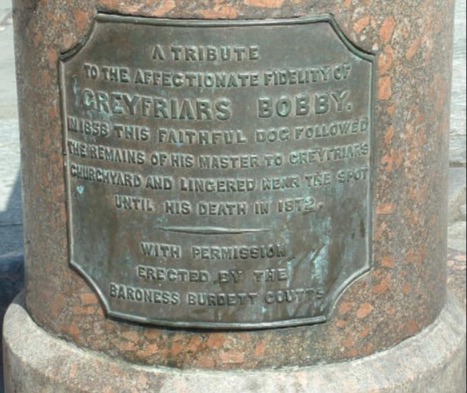
The statue serves not just as a tribute to Bobby himself, but as a reminder of the timeless values of loyalty and devotion. His headstone, erected much later by The Dog Aid Society of Scotland, aptly reads: “Greyfriars Bobby — died 14th January 1872 — Let his loyalty and devotion be a lesson to us all.”
Over the years, Bobby’s story has spread far beyond Edinburgh. It has inspired numerous books, films, plays, and even musical references celebrating the little dog whose loyalty would not be deterred by the cold or the passing years.
Tourists from around the world come to see the statue, touch its nose for good luck, and reflect on a bond between a man and his dog that defied death itself.
Yet, as with many legends, some historians note that certain details of Bobby’s story may have been embellished over time, and similar graveyard dogs were documented in 19th‑century Europe.
Despite such debates, the symbolic power of Bobby’s vigil — and what it says about the relationship between humans and their dogs — remains deeply moving.
In a world where modern life often pulls us in a hundred directions at once, the story of Greyfriars Bobby stands as a poignant reminder of the depth of loyalty possible between species.
Whether fact, folklore, or somewhere in between, Bobby’s vigil beneath the Scottish sky continues to inspire — a testament to love, faithfulness, and the little dog who waited.
[6053]p898 Login & Register: Official Philippines Slot Gaming. Access p898 Download & p898 Link Alternatif for the Best Slot Experience. Join p898, the official Philippines slot gaming hub! Quick p898 login & p898 register. Access p898 download & p898 link alternatif for the ultimate p898 slot experience today. visit: p898
[1141]77pub: Premier Philippines Online Slot & Casino Games. Easy 77pub Login, Register, and App Download to Win Big Today! Experience the best at 77pub, the premier Philippines online slot and casino platform. Fast 77pub login, easy 77pub register, and 77pub app download to win big today! visit: 77pub
[1028]PITO777: Philippines’ Top Slot Gacor – Official Login, Register & App Download Link Alternatif Experience PITO777, the Philippines’ top slot gacor site. Fast PITO777 login & register. Get the PITO777 app download and latest link alternatif for non-stop winning! visit: PITO777
[4369]u888abc Philippines: Best Online Casino & Slots. Quick u888abc Login, Register, and App Download for Legit Gaming Fun. Join u888abc Philippines, the best online casino for premium slots! Quick u888abc login and register process. Get the u888abc download for legit gaming. Play u888abc slot and u888abc casino games today for big wins! visit: u888abc
[4021]Wowph22 Online Casino Philippines: Quick Login, Register & App Download for the Best Slot Games. Experience top-tier gaming at Wowph22 Online Casino Philippines. Quick wowph22 login, easy register, and premium wowph22 slot games. Get the wowph22 app download for big wins today! visit: wowph22
[9615]PinasGems Online Casino: Secure Login, Easy Register & Top Slot Games. Download the App Now! Experience the ultimate gaming at PinasGems Online Casino. Enjoy secure PinasGems login, fast PinasGems register, and top PinasGems slot games. Download the PinasGems app now for the best mobile casino experience in the Philippines! visit: pinasgems
[5912]JLJL44 Official Link: Best Slot Online in Philippines. Login, Register, and Download App to Win Today! Visit the jljl44 official link for the best slot online in Philippines. Complete your jljl44 login or jljl44 register today. jljl44 download app and win now! visit: jljl44
[4069]321gobet: Best Philippines Online Casino & Slot Link. Secure Login, Easy Register, and Official App Download. Experience 321gobet, the top Philippines online casino. Enjoy secure 321gobet login, easy 321gobet register, and official 321gobet app download. Access the ultimate 321gobet slot link and start winning today! visit: 321gobet
[6153]Arena Plus PH: The Best Online Gambling Site for Sports Betting and Online Casino in the Philippines. Experience Arena Plus PH, the best online gambling site PH for top-tier sports betting Philippines and online casino Philippines action. Use your ArenaPlus login to start winning today! visit: arenaplusph