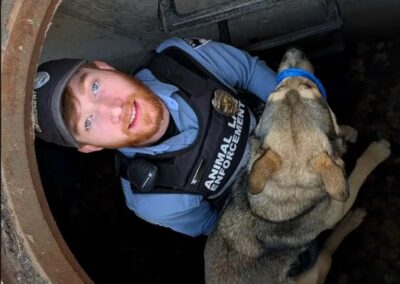
It started with a simple foster placement — a young rescue dog just beginning to adjust to a temporary home, learning routines, people, and the comfort of safety for what may have been the first time in her life.
But in a matter of moments, everything changed.
A door opened. A gap appeared. And the foster dog bolted.
The dog, a 7-month-old rescue, was described as a “flight risk” — the kind of pup who, despite affection and care, can still be overwhelmed by sudden changes or open spaces. When she escaped, panic set in immediately.
Even worse, another household dog followed her into the uncertainty, turning a single escape into a double disappearance.
Within seconds, a safe home had become an active search zone.
The foster owner acted fast, contacting rescue groups and mobilizing help. Volunteers, neighbors, and local animal search teams quickly joined in, turning the situation into a coordinated effort to bring both dogs back safely.
But there was one critical advantage in this search that would make all the difference:
A GPS collar.
The escaped foster dog was wearing a Fi GPS-enabled collar, a device that tracks real-time location data and can be activated in “Lost Dog Mode” to help narrow down search areas.
As rescuers began combing nearby terrain, the collar started to give signals — guiding the search toward a vast conservation area filled with dense woods, snow, and near-zero visibility conditions.
Without that data, the dogs could have been anywhere.
With it, the search had direction.
Even with technology on their side, the rescue was far from easy.
The terrain was unforgiving — thick brush, deep snow, and no clear paths in or out. Searchers had to push through difficult conditions, moving slowly and carefully to avoid missing any signs of movement.
At times, even knowing the exact location didn’t guarantee immediate access.
But it narrowed the impossible into something manageable.
A starting point.
A chance.
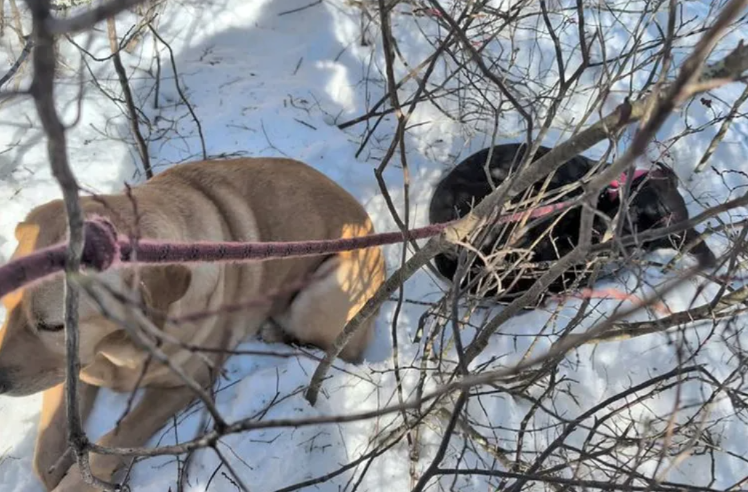
After nearly a full day — about 23 hours of searching — rescuers finally reached the area where the GPS signal had been strongest.
What they found there stopped them in their tracks.
Both dogs were together.
Side by side.
Alive.
The foster pup’s leash had become tangled around a tree, partially frozen into the cold ground, preventing further movement. Despite freezing temperatures overnight, both dogs had survived the harsh conditions without serious injury.
Even more remarkable, the second dog had stayed.
She could have left at any time.
But she didn’t.
She remained with the foster pup until help arrived — a quiet act of loyalty that deeply moved everyone involved in the rescue.

Once freed, the dogs were carefully brought out of the wooded area with the help of rescuers and local volunteers who assisted in navigating the dense terrain. The reunion with safety was emotional, not just because they were found — but because of how narrowly the situation could have gone the other way.
In the days that followed, something unexpected happened.
The bond formed during that night in the wilderness didn’t fade.
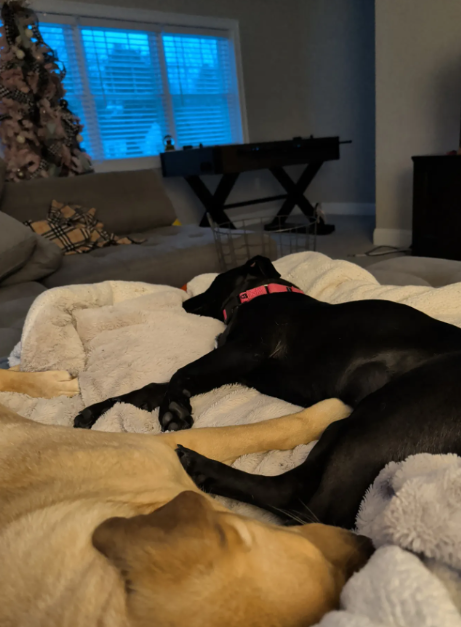
The foster dog and the resident dog had become inseparable — choosing each other’s company constantly, as if the ordeal had cemented a connection neither of them planned but both of them needed.
Eventually, that bond became permanent.
The foster dog was officially adopted.
A new name.
A new home.
A new life.
At its core, this story isn’t just about a rescue made possible by technology.
It’s about timing.
It’s about response.
And it’s about what can happen when modern tools and human determination come together at exactly the right moment.
A dog ran.
Another followed.
A collar guided the way.
And in the end, two lives were brought back from uncertainty into something far more powerful:
A home.