It was supposed to be a normal travel day.
Families moving through departures. Suitcases rolling across the floor. The usual rush of people trying to make their flights on time.
But for one young Labrador puppy, that day ended very differently — alone outside a busy airport terminal, confused, frightened, and running loose near the curb.
The puppy had been brought to Pittsburgh International Airport by his owner, a man traveling from out of state who had attempted to fly with him.
But when he realized the dog could not board the flight, the situation took a sudden and irreversible turn.
Instead of arranging an alternative plan, the puppy was left behind near the departures area.
Within moments, the dog was wandering outside the terminal — exposed to traffic, noise, and the chaos of one of the busiest transit hubs in the region.
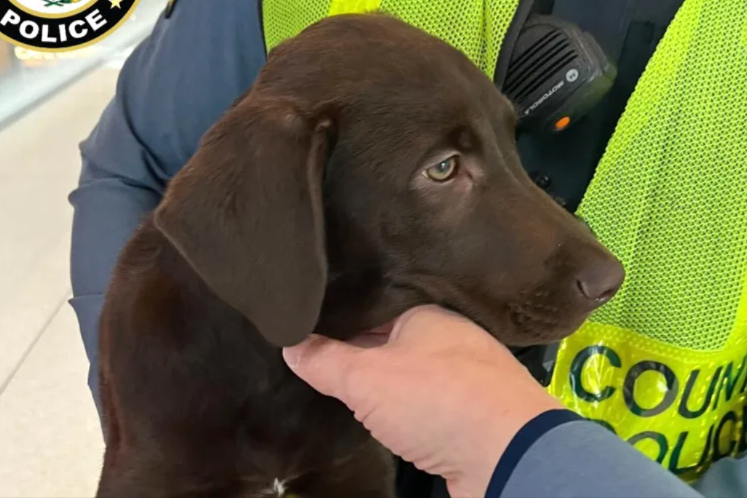
Airport police were alerted quickly after witnesses spotted the loose puppy and moved to intervene.
With help from bystanders, officers were able to safely secure the frightened dog before anything more dangerous could happen.
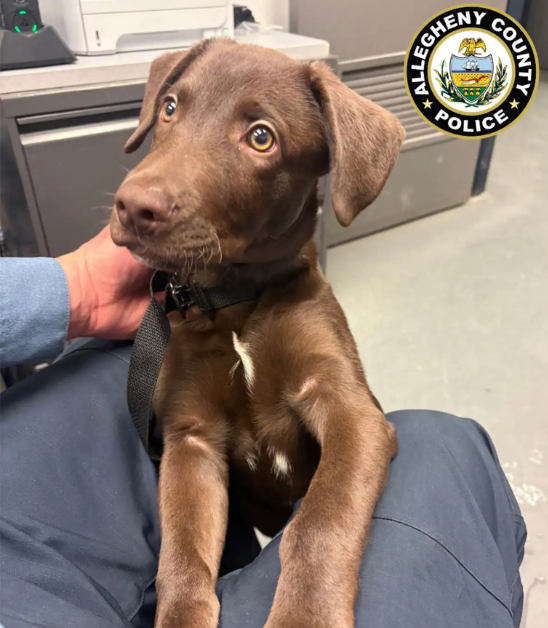
The puppy, a young Labrador retriever, appeared confused but physically unharmed when rescued.
He was immediately taken into care and later placed in foster placement where he began recovering from the stressful ordeal.
As investigators began reviewing what happened, they quickly noticed inconsistencies in the owner’s explanation.
The man initially claimed that a rideshare driver had abandoned the dog outside the airport.
But further questioning and evidence led authorities to a different conclusion — that he had personally left the puppy behind when he realized the animal could not travel with him.
That decision changed everything.
What may have been treated as a travel complication became a criminal investigation.
The owner is now facing charges of animal cruelty and animal abandonment.
Authorities emphasized that leaving an animal in such a situation is not a “quick fix” or an unfortunate oversight — it is a serious offense with real consequences, especially in environments as dangerous as airport roadways and busy transit zones.
The incident also reignited a broader conversation about pet travel planning.
Airlines have strict requirements for animal transport for safety reasons — including carrier regulations, health documentation, and size restrictions.
When those requirements aren’t met, passengers are expected to make alternate arrangements such as pet cargo services, ground transport, or trusted caretakers.
But when those options aren’t prepared in advance, animals are the ones who suffer the consequences.
For the Labrador puppy, the outcome was ultimately a positive one.
He was placed into foster care after his rescue and began settling into a safe environment where he could recover physically and emotionally from the incident.
Early reports indicated that he was doing well and adjusting after the stressful experience.
Still, the story struck a nerve with many people who learned about it afterward.
Not because it was rare — but because it was preventable.
A simple change in planning could have led to a completely different outcome: a kennel booking, a delayed flight, a return home with proper arrangements in place.
Instead, it became a case that highlighted how quickly a moment of panic or poor judgment can escalate into something far more serious for an animal that depends entirely on human decisions.
At its core, this story isn’t just about a puppy left at an airport.
It’s about responsibility.
About the decisions made in high-stress moments.
And about the reality that pets don’t understand travel rules, deadlines, or logistics — they only understand the humans they trust to keep them safe.
And in this case, it was the system around him — and the people who stepped in — that ultimately determined the outcome.
A frightened puppy.
A busy airport.
And a rescue that came just in time.