At first glance, the rescue video is difficult to watch.
A frightened dog stands alone, painfully thin, attached to a heavy chain that seems almost larger than life itself.
His ribs are visible. His fur looks rough and worn down by survival.
Everything about the scene suggests a dog who has spent far too long waiting for kindness.
And yet, despite all of it, his tail still wags.
That detail is what breaks people.
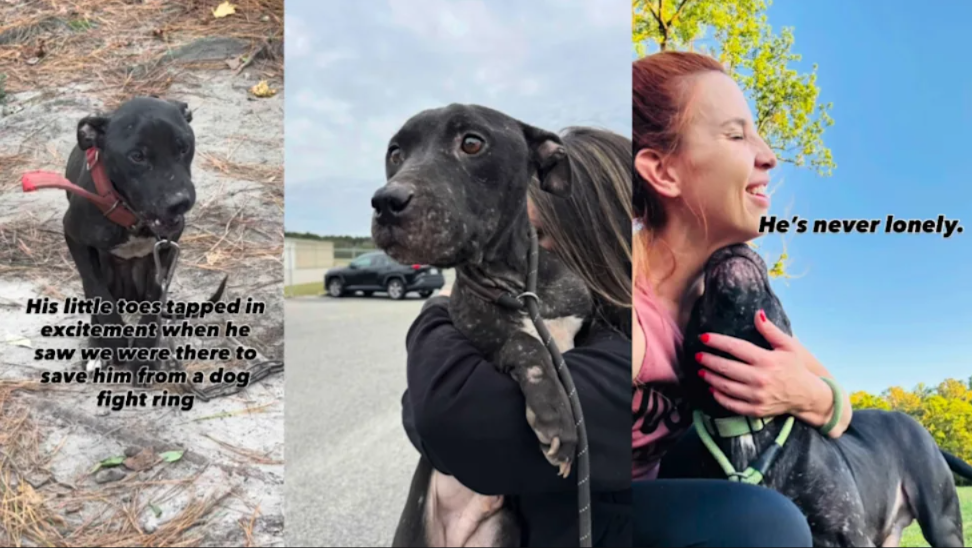
The dog — later named Peter Pan — was found chained at what rescuers described as a dog fight ring.
It was the kind of environment no animal should ever experience, a place built around fear instead of care.
But even standing there exhausted and nervous, Peter Pan did something nobody expected:
His tiny toes started tapping excitedly when rescuers approached.
Not growling.
Not lunging.
Just hopeful little paw taps against the ground, like part of him still believed someone good might finally arrive.
And this time, someone did.
The rescue footage captures that heartbreaking emotional conflict dogs often show after long-term neglect — fear mixed with desperate hope.
Peter Pan appears unsure whether to panic or relax, even letting out a huge yawn as rescuers move closer, almost as if his body cannot process safety yet.
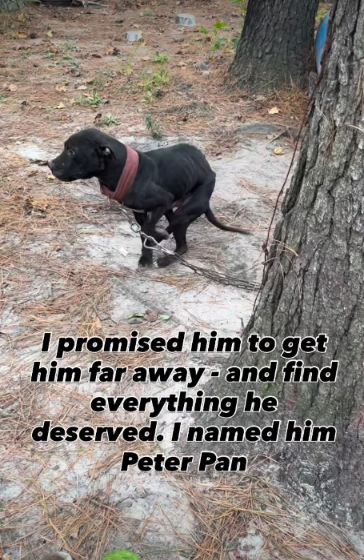
But the moment his chain finally comes off, the story begins changing immediately.
Photos later show him being carried to safety, wrapped close against his rescuer during the ride home.
Slowly, over the following months, the frightened dog from the fight ring begins transforming into someone almost unrecognizable from the version people first met.
His body fills out.
His eyes soften.
And little by little, Peter Pan starts learning what normal life feels like.
That transformation is what rescue organizations talk about so often when discussing chained dogs.
Long-term tethering and isolation can dramatically affect a dog’s physical and emotional well-being, often creating fear responses that people mistakenly label as aggression.
But once safety enters the picture, an entirely different personality can emerge.
And Peter Pan’s real personality turned out to be incredibly gentle.
One of the most emotional moments in the rescue updates shows him sitting beside his rescuer in a park, affectionately kissing their chin while leaning in close.
Another caption jokes that he’s become “a bit harder to hold now” because he finally gained healthy weight back.
It’s a small joke, but emotionally, it says everything.
Because healthy weight means regular meals.
Softness means reduced fear.
Affection means trust survived.
And trust surviving after a life like his feels almost miraculous.
Viewers online were deeply moved by Peter Pan’s scars and obvious emotional resilience.
Many commented that they couldn’t stop thinking about how long he must have waited chained up, still somehow holding onto hope that someone would eventually come for him.
That’s the part rescue stories reveal over and over again:
Dogs often continue reaching for love long after the world has given them reasons not to.
Peter Pan could have shut down completely.
Instead, his paws tapped excitedly the second rescuers arrived.
As if some small part of him had already decided this might finally be the beginning of something better.
And thankfully, he was right.
Now safe, fed, and surrounded by affection instead of fear, Peter Pan’s life looks entirely different from the one he once endured.
The dog who used to wait chained in isolation now spends his days being held, comforted, and treated like he always deserved to be.
Not as something dangerous.
Not as something disposable.
Just as a dog finally allowed to feel safe.