Sometimes dogs aren’t acting out.
They’re crying out.
And for a rescue Beagle named Blanche, the shelter environment felt so overwhelming that she simply could not stop crying.
Not whining for attention.
Not barking to be difficult.
Crying because her entire world had suddenly changed.
The heartbreaking moment was shared by Rose Waldrup, a behavior specialist who focuses on nervous system regulation in dogs.
When Rose met Blanche, the frightened rescue dog was already deeply distressed by the constant noise, unfamiliar smells, and emotional intensity of shelter life.
And honestly, you could see it immediately.
The Instagram video shows Blanche vocalizing nonstop, unable to settle herself even for a moment.
Her body looked tense and panicked, as though she was searching desperately for something familiar in a place where nothing felt safe anymore.
Then came the detail that changed everything.
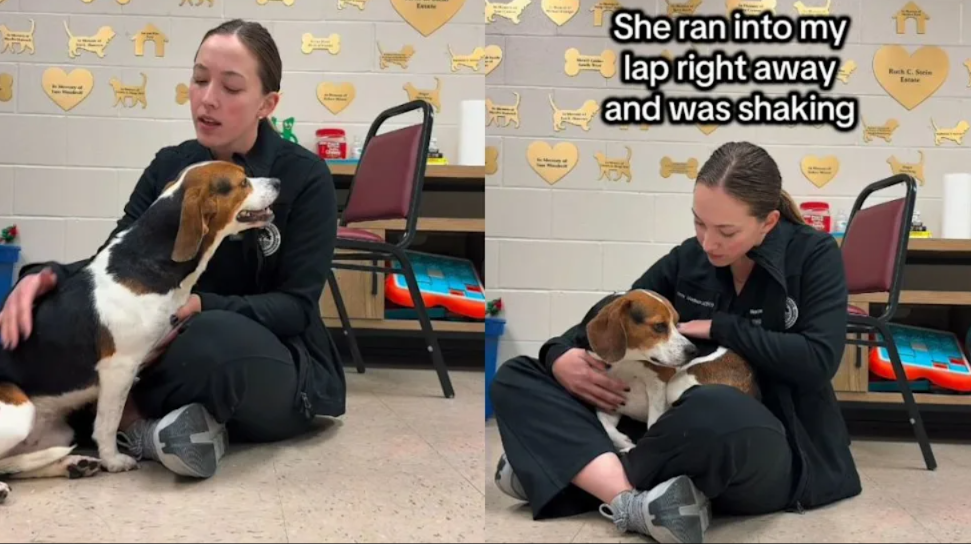
Shelter staff noticed Blanche only stopped crying when someone physically held her.
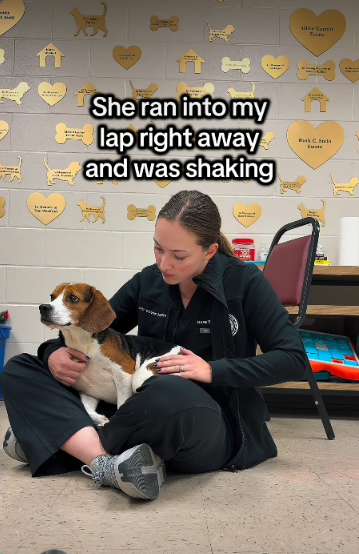
The second Rose sat down near her, Blanche climbed directly into her lap.
No hesitation.
No uncertainty.
Just instant need for closeness.
It was the kind of moment that says more than words ever could.
For many rescue dogs, shelters can trigger complete nervous system overload.
Constant barking, changing routines, unfamiliar people, and the sudden loss of a home environment can push sensitive dogs into a prolonged stress response.
Beagles especially are known for being emotionally expressive and highly sensitive to their surroundings, which can make shelter adjustment particularly difficult for them.
But instead of focusing on obedience or formal behavior correction, Rose approached Blanche differently.
She focused on co-regulation.
In simple terms, co-regulation is the process of helping another nervous system calm down through safe presence, touch, and emotional steadiness.
It’s something humans experience too — like how a calm person can help soothe someone in panic simply by staying grounded and present.
And Blanche responded almost immediately.
As Rose gently held and comforted her, the nonstop crying slowly began to soften.
Within just a few minutes, Blanche’s breathing started slowing down.
The frantic energy in her tiny body eased little by little as she relaxed deeper into Rose’s arms.
It wasn’t dramatic in the loud sense.
It was quiet healing.
The kind you can physically watch happen in real time.
Rose used gentle somatic exercises and calming touch to help Blanche’s nervous system shift away from panic and toward safety.
There were no commands. No force. No expectation that Blanche needed to “behave better.”
Because the problem was never disobedience.
It was fear.
And that distinction matters deeply in rescue work.
Too often, anxious shelter dogs are misunderstood as difficult, clingy, or emotionally unstable when they are actually overwhelmed animals trying to survive environments their nervous systems cannot fully process yet.
Many behavior specialists now emphasize that emotional safety must come before training can truly work.
Blanche’s story became emotional for viewers because it revealed something incredibly simple but powerful:
Sometimes healing starts with being held.
As the video spread online, thousands of people connected with the scared little Beagle instantly.
Many commented that Blanche didn’t need fixing at all — she just needed consistency, gentleness, and someone willing to make her feel safe again.
And honestly, that seemed true.
By the end of the clip, Blanche looked completely different from the trembling dog seen at the beginning. Not “cured.” Not transformed overnight.
Just calmer.
Safer.
Able to rest.
She is currently waiting for her forever home at the Des Moines County Humane Society, where supporters hope the right family will see past her fear and recognize the loving dog underneath it.
Because Blanche’s story is a reminder of something rescue dogs prove over and over again:
Sometimes the most powerful thing you can give a frightened animal is not correction.
It’s comfort.