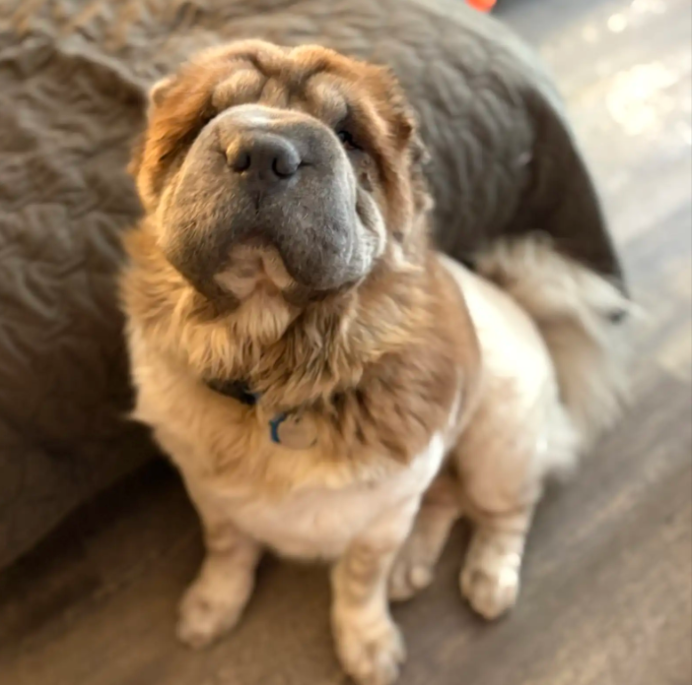
Trauma changes the way dogs see the world.
Sometimes it changes who they trust.
And for one shelter dog, that fear seemed especially connected to men.
The nervous rescue pup had been struggling to relax around male staff members at the shelter, staying guarded and uncertain whenever men approached him.
While he wasn’t aggressive, his body language made it clear that something in his past had left him deeply uncomfortable.
So one shelter worker decided to try something unusual.
He put on a wig.
And somehow… it worked.
The touching moment was shared in a video showing the staff member approaching the dog while wearing long hair, hoping the softer appearance might help the pup feel safer.
At first glance, the idea seems funny — and honestly, viewers online definitely laughed at the visual — but underneath it was something genuinely compassionate.
The staff member wasn’t making fun of the dog’s fear.
He was trying to work around it gently.
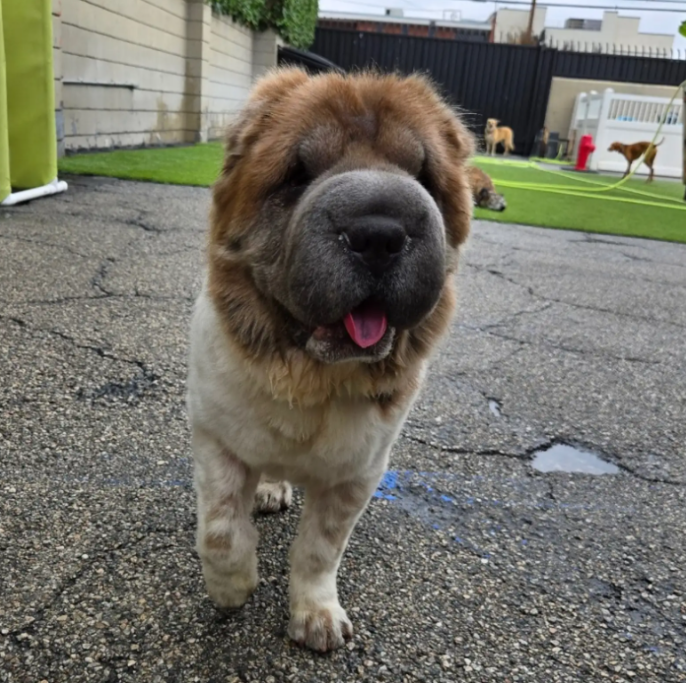
Dogs who have experienced trauma or negative associations with certain people often react to very specific visual or sensory cues.
Research in canine behavior suggests dogs can associate fear with body shape, voice depth, facial hair, clothing, or even movement patterns if those features were connected to stressful experiences in the past.
In this case, the shelter suspected the dog felt safer around women than men.
So the wig became an attempt to soften that initial fear response.
And remarkably, the dog’s reaction began to change almost immediately.
Instead of pulling away or remaining tense, the pup appeared noticeably calmer while interacting with the disguised staff member.
His posture softened. He became more curious. More willing to stay close instead of retreating.
Not fully healed.
Not magically “fixed.”
But willing to try.
And honestly, that’s often what progress looks like for traumatized rescue dogs.
Tiny steps.
Small moments where fear loosens just enough to allow connection through.
Shelter environments can be incredibly overwhelming for anxious dogs.
Loud sounds, unfamiliar people, constant activity, and unpredictable routines can keep nervous dogs in a heightened state of stress for long periods.
Behavior specialists often emphasize that patient, low-pressure interactions are far more effective than forcing fearful dogs into uncomfortable situations.
That’s why this moment resonated with so many people online.
Because instead of expecting the dog to “get over it,” the staff member adjusted himself to meet the dog where he was emotionally.
And that matters.
Viewers praised the creativity and kindness behind the gesture, with many pointing out how moving it was to see someone care enough to try something silly if it meant helping the dog feel safer.
Because underneath the humor of a man wearing a wig inside a shelter was a very serious act of empathy:
Someone looked at a frightened dog and thought, “How can I make this easier for you?”
Not “How do I force trust?”
Not “How do I speed this up?”
Just patience.
Just adaptation.
Just one human trying to make the world feel slightly less scary for a dog who clearly needed it.
And sometimes, for rescue animals carrying invisible emotional wounds, those small accommodations become the beginning of everything.
A softer approach.
A calmer interaction.
A first moment of safety.
Even if it starts with something as unexpected as a wig.