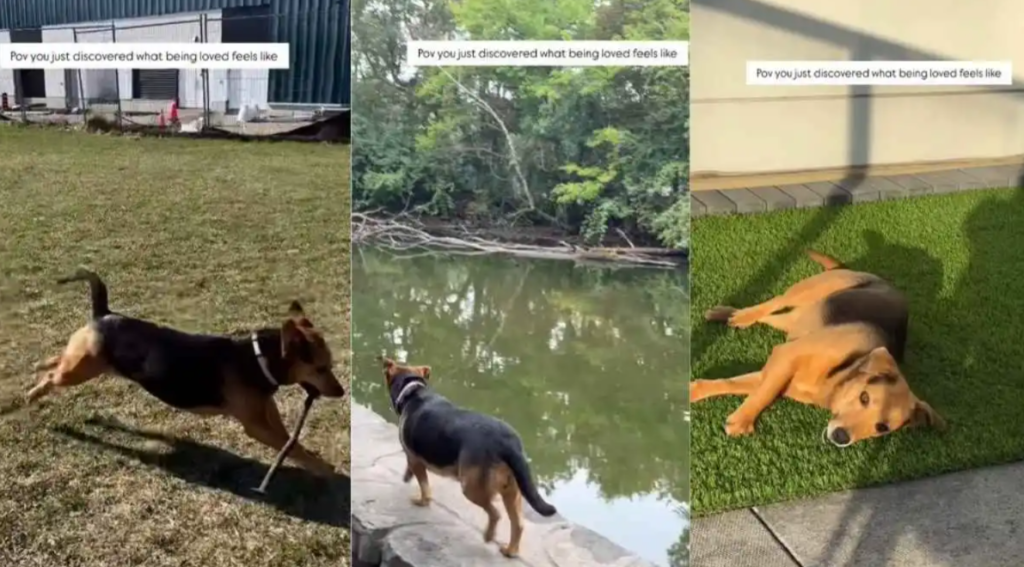
There’s a kind of happiness dogs don’t hide very well.
And for one rescue dog, it showed up in her tail first.
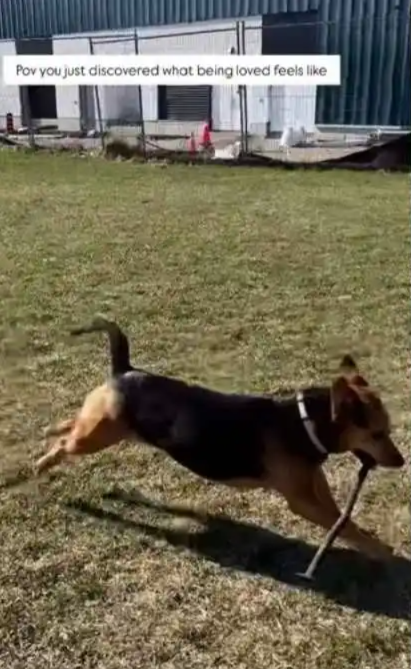
A heartwarming video shared online shows a once-shy rescue pup experiencing something she may not have fully understood before — what it feels like to be safe, wanted, and genuinely loved in a new home.
And the most striking part isn’t a dramatic transformation or big emotional moment.
It’s her tail.
It just keeps going.
The dog appears relaxed but slightly unsure at first, as if she’s still adjusting to the idea that this new environment is permanent.
Many rescue dogs take time to decompress after adoption, especially if they’ve experienced instability or shelter stress.
Even in loving homes, it’s common for animals to go through a transition period where they begin to test whether safety is real or temporary.
But in this case, something shifts.
As she spends time with her new family, her body language begins to change. The hesitation softens. The tension fades.
And then the tail starts moving — slowly at first, then steadily, then almost continuously, as if it has a mind of its own.
That kind of tail wagging isn’t just “cute behavior.”
It’s communication.
In dogs, tail movement is closely tied to emotional arousal and social engagement.
A relaxed, repetitive wag often signals comfort, curiosity, and positive emotional association with the environment and the people in it.
Studies in canine behavior consistently show that dogs use tail position and motion as part of their broader emotional signaling system, especially in social bonding contexts.
What makes this moment resonate so strongly is the contrast.
Before, there was uncertainty — a dog still learning whether she could trust what was happening around her.
After, there is rhythm.
A steady, involuntary-looking wag that doesn’t seem to stop even when nothing dramatic is happening. Just normal life. Quiet presence. Familiar people.
And somehow, that becomes enough to trigger something beautiful in her.
Because for many rescue dogs, love doesn’t arrive as a single defining moment.
It builds slowly.
Through repetition.
Through safety being proven again and again.
And eventually, the body starts to respond before the mind even fully catches up.
That’s what this video captures so well.
Not a transformation forced by training or correction.
But a natural unfolding of trust.
Viewers responding to similar rescue stories often describe this exact moment — the first real, sustained tail wag — as the point where it feels like the dog has finally arrived emotionally.
Not just in a new home, but in a new understanding of life itself.
And that’s what makes it stay with people.
Because a wagging tail isn’t just movement.
It’s a verdict.
A quiet declaration that says, this feels good… I’m staying here… I think I’m safe now.
And once that starts, it doesn’t really stop.
Not when love is finally something the dog can feel without hesitation.
Just like this one.