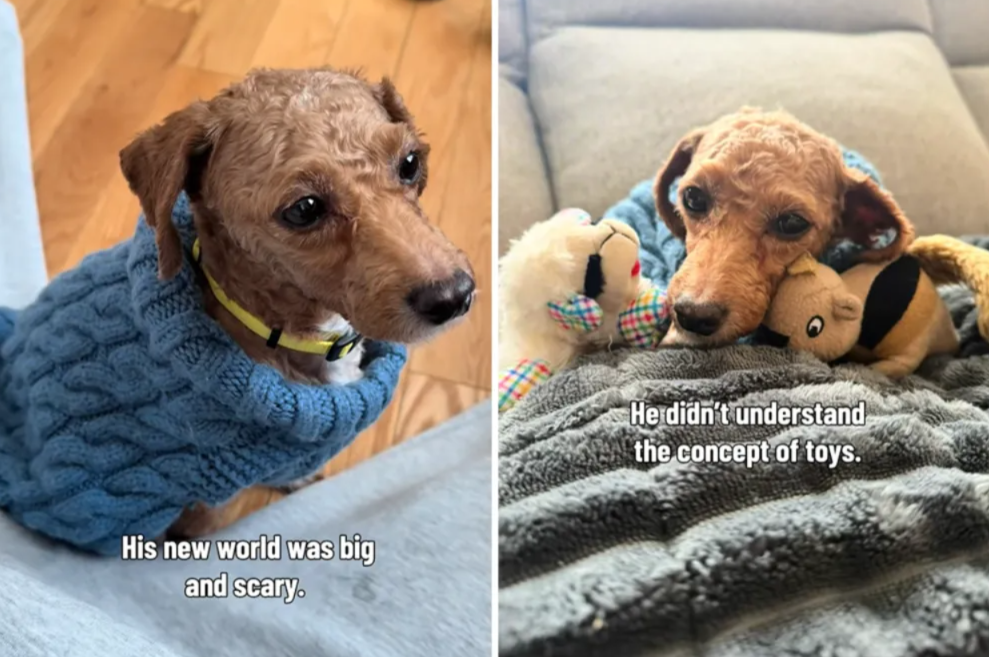
Some rescue stories don’t start with sadness — they begin in it.
And for one puppy mill survivor, years of neglect shaped a life that had almost no softness, no safety, and very little chance to simply be a dog.
In a powerful rescue story, a dog who had spent much of her early life in harsh, overcrowded conditions was finally pulled from a situation of severe neglect.
Like many puppy mill survivors, she arrived in a fragile state — physically worn down, emotionally shut off, and unfamiliar with even the simplest comforts that most dogs take for granted.
Everything was new.
And overwhelming.
Rescue teams who work with puppy mill dogs often describe a similar pattern: fear of touch, hesitation around humans, and confusion in open spaces after years spent in cages or tightly controlled environments.
These dogs are not “unfriendly” — they are under-socialized, conditioned by survival rather than experience.
But what makes this story stand out is what happened next.
Carefully, step by step, the dog was introduced to a completely different world.
Veterinary care addressed her immediate medical needs, while rehabilitation teams focused on something just as important: rebuilding trust.
That process is slow, requiring patience, consistency, and an environment where the dog is never rushed into interaction.

At first, progress is barely visible.
A glance that lingers a little longer.
A moment of stillness instead of panic.
A small willingness to accept food or gentle presence.
These are the early signs that a dog is beginning to decompress — the behavioral shift that occurs when chronic stress starts to ease and the nervous system gradually returns to balance.
For puppy mill survivors, this stage can take weeks, months, or even longer, depending on the severity of their past experiences.
Experts emphasize that recovery is not linear, but incremental, built through repeated exposure to safety rather than sudden breakthroughs.
And then, slowly, something changes.
The dog begins to engage with her surroundings instead of retreating from them.
Movements become less guarded. Rest becomes deeper. Interaction, once avoided, starts to feel less threatening.
It’s not transformation in the cinematic sense.
It’s recovery in real time.
What resonates most in stories like this is the contrast between where the dog started and where she is now beginning to arrive — not fully healed, but no longer trapped in the same cycle of fear.
Rescue organizations working with large-scale puppy mill survivors often see similar outcomes when consistent care is provided: gradual behavioral stabilization, improved social tolerance, and eventually, readiness for adoption into a calm home environment where continued trust can develop.
But perhaps the most powerful part of this story is not the rescue itself.
It’s what it represents.
That even after years of neglect, a dog can still learn what safety feels like.
Still learn what kindness means.
Still learn how to exist without fear leading every moment.
And while the past cannot be erased, it no longer defines what comes next.
Because for this puppy mill survivor, the hardest part is already behind her.
And what remains is something she never truly had before:
A chance to simply live.
Related posts:
 Scared of Humans, Burdened With Tumors — How One Dog Is Finally Healing
 Watch Giant Dog Make His Feelings Known About New Puppy Roommate
 The Heartfelt Story of a Dog Found in a Cage Who Finally Found Freedom and Family
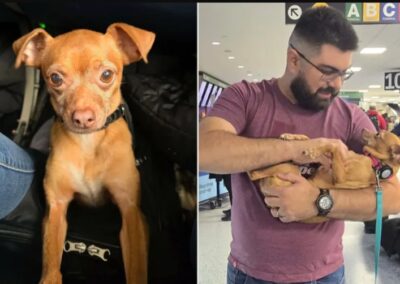 A Thousand Miles and Five Years Later: The Miraculous Return of Bella the Chihuahua