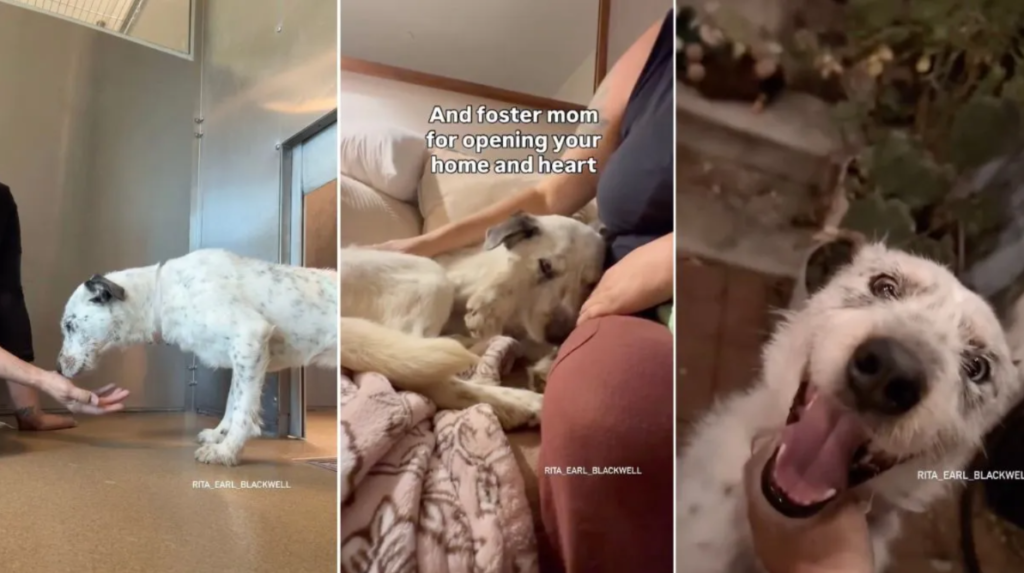
A rescue dog’s first steps outside the shelter aren’t always joyful.
Sometimes, they’re uncertain.
Careful.
Even heartbreaking.
That was exactly the case for one dog whose life had already been turned upside down long before anyone ever called his name again.
He had been left behind by the only family he knew.
No warning he could understand.
No explanation he could grasp.
Just sudden silence where a home used to be.
When he arrived at the shelter, everything was unfamiliar. New smells. New sounds. New faces.
And for a dog who had already experienced abandonment, nothing about this new world felt safe yet.
But then came something rescuers call a “freedom walk.”
A simple idea: take a dog out of the kennel, away from confinement, and let them experience the outside world again—slowly, gently, and with support.
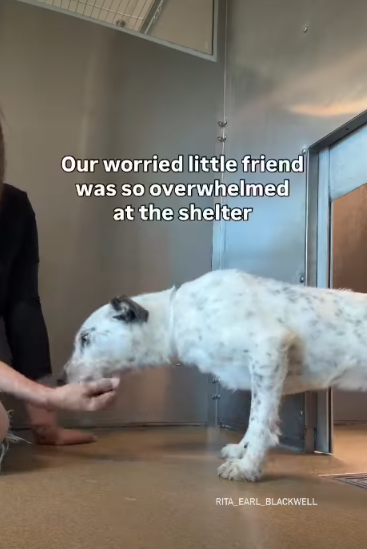
For this dog, it was supposed to be a moment of relief.
Instead, it revealed just how heavy his past still was.
As volunteers clipped on his leash and guided him outside, he didn’t rush forward like a dog discovering freedom for the first time. He hesitated.
He scanned everything around him. His body language stayed low, cautious, as if he expected the ground to shift again at any moment.
Every step forward seemed to come with a question:
Is this real? Or will it disappear too?
But no one rushed him.
The volunteers simply walked beside him, matching his pace, letting him decide how far he was willing to go.
That patience matters more than it looks. For rescue dogs carrying emotional scars, control is the first thing they need to rebuild.
And slowly, something changed.
The tension in his shoulders softened just slightly. His nose lifted to catch new scents instead of searching for danger.
His steps became a little more steady, a little less uncertain.
It wasn’t transformation yet.
But it was the beginning of one.
After the walk, the biggest shift came not from the leash being removed, but from what followed next: a foster home.
Because kennels can only do so much for a heart that’s been broken by abandonment.
What healing really requires is routine, safety, and a place where nothing is expected of the dog except to simply exist.
In foster care, everything starts over in the smallest ways.
Learning where to sleep.
Learning when to eat.
Learning that footsteps in a hallway don’t always mean goodbye.
At first, dogs like him often stay close to walls or corners. They watch everything. They don’t fully relax because relaxation itself is something they’ve forgotten how to do.
But then comes a moment—sometimes unexpected—where the change becomes visible.
A sigh on a couch.
A nap in a sunlit corner.
A tail that finally moves without hesitation.
Those moments don’t look dramatic from the outside. But for a dog who once lost everything without understanding why, they are enormous.
They mean the world is no longer something to survive.
It’s something to live in again.
And that’s what the freedom walk really represents. Not just a break from a kennel, but a first step toward trust.
Not a final destination.
Just the beginning of a life that finally feels safe enough to continue forward.