It started with a sound most people would ignore.
A faint cry carried through a quiet, rocky area—easy to dismiss as wind, or birds, or nothing at all.
But one rescuer stopped.
And listened.
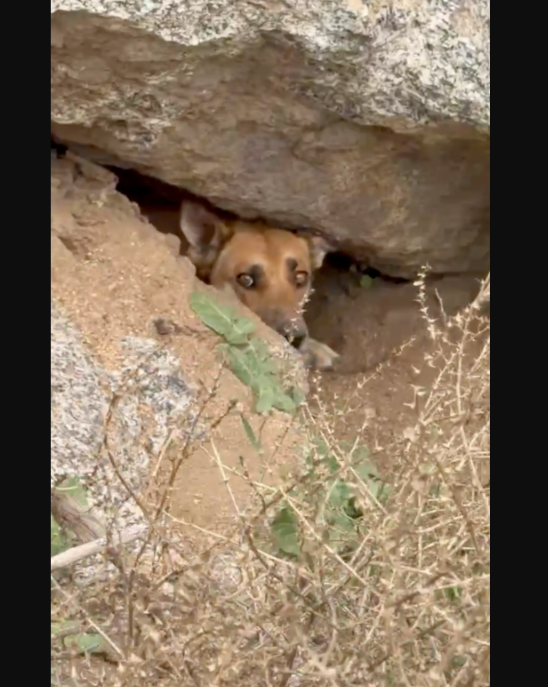
The sound led him toward a narrow cave, half-hidden and hard to reach. The entrance was dark, damp, and quiet in a way that didn’t feel empty—it felt occupied.
Something was inside.
Carefully, he moved closer, following the soft, desperate noise until he could finally see into the shadows.
That’s when he found her.
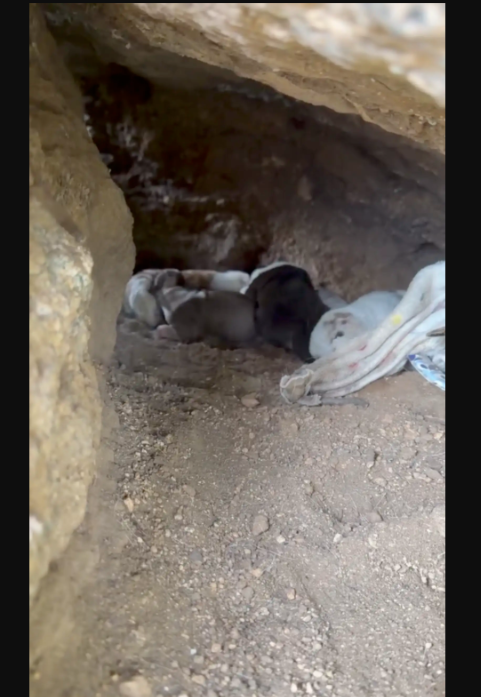
A mother dog, thin and exhausted, curled tightly around a small cluster of newborn puppies.
She wasn’t wandering.
She wasn’t asking for help in a way anyone passing by would easily notice.
She was surviving.
Inside the cave, the world outside barely existed. No food. No comfort. No safety beyond what she could create with her own body.
The mother had made the only shelter she could find, using the cave walls as protection and herself as warmth for her babies.
And she had stayed there.
Protecting them.
Even when it meant starving alongside them.
The rescuer immediately understood the urgency of the situation.
The puppies were tiny—still fragile, still dependent on warmth and milk, still far too young to survive without constant care.
And the mother, though protective, was clearly exhausted from the effort of keeping them alive.
But approaching a mother dog with newborns is never simple.
There’s fear.
Instinct.
The natural drive to defend.
At first, she stayed tense, watching every movement near the cave entrance.
Her body language made one thing clear: she would do anything to keep her babies safe, even if she was scared herself.
So the rescuer didn’t rush her.
He didn’t force contact.
Instead, he moved slowly, speaking softly, letting her see that help wasn’t a threat.
That patience mattered.
Because in moments like this, trust is not given quickly—it’s earned in seconds that feel like hours.
Eventually, the mother allowed just enough space for assistance.
One by one, the puppies were carefully lifted from the cave and placed into safety.
The mother followed closely, unwilling to let them out of her sight for even a moment.
Even in rescue, she stayed a mother first.
Once outside, the reality of their situation became clearer. The puppies were vulnerable and needed immediate warmth and feeding.
The mother needed food, hydration, and medical attention after enduring days of survival in isolation.
They were taken to safety together.
Not separated.
Not lost.
A family still intact—just finally out of danger.
In the days that followed, something remarkable began to happen.
The mother, once tense and protective to the point of exhaustion, began to relax. She no longer had to fight the world alone.
Her body could rest. Her puppies could nurse without fear. And slowly, the cave that once represented survival was replaced by something new:
Security.
For rescuers, moments like this are not just about saving lives in the immediate sense. They are about changing the entire trajectory of those lives.
A hidden cave becomes a beginning.
A desperate cry becomes a turning point.
And a mother who refused to give up becomes the reason her puppies get to grow up safe, warm, and loved.