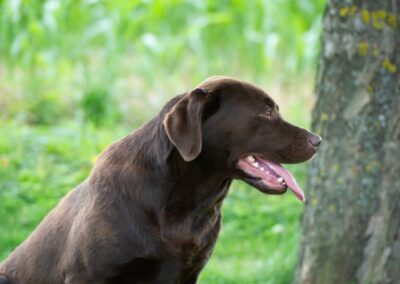
For many dogs, stairs are nothing special.
Just another part of the house. Something they race up without thinking twice.
But for one rescue dog, a staircase looked impossible.
She would stand frozen at the bottom, staring upward as if the steps were a wall instead of a path.
Her body stayed tense, uncertain, unwilling to move forward no matter how gently her new family encouraged her.
She wasn’t being stubborn.
She was scared.
And for rescue dogs, fear often hides inside ordinary things.
A doorway.
A leash.
A loud sound.
Or in this case, a staircase she may have never encountered before.
The dog, recently adopted after a difficult past, was still adjusting to indoor life and all the unfamiliar experiences that came with it.
Every room, every surface, every routine was new territory.
While other dogs might explore without hesitation, she approached the world cautiously—carefully evaluating each unfamiliar obstacle before deciding whether it felt safe.
The stairs became her biggest challenge.
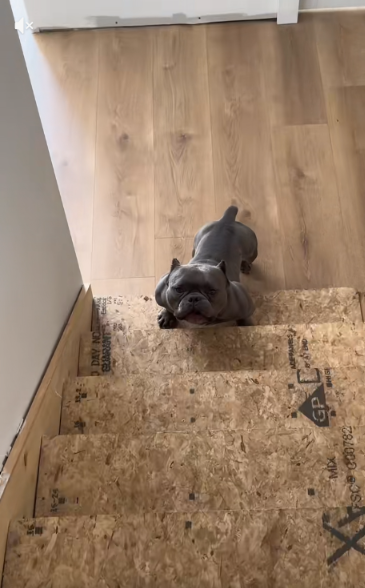
At first, she refused to even place a paw on the first step.
She would stop at the bottom and look up nervously, unable to understand how to navigate something humans barely notice.
Her family tried everything gently.
Encouraging words.
Patience.
Treats placed one step at a time.
But progress didn’t happen immediately.
And that’s the reality many rescue dog owners discover: healing isn’t just emotional. It’s physical too.
Dogs who come from unstable or deprived environments often need to learn basic life experiences from scratch.
To them, stairs are not “normal.”
They are unknown.
And unknown things can feel terrifying.
Still, her family never forced her.
That mattered more than anything.
Instead of carrying her or pushing her beyond her comfort zone, they gave her time to process at her own pace.
Every attempt was met with reassurance instead of frustration. Every tiny effort was celebrated like a major victory.
Eventually, something shifted.
One paw stepped forward.
Then another.
Not confidently. Not gracefully. But bravely.
The dog slowly climbed her first step.
Then paused.
Then another.
Each movement looked careful and deliberate, as though she was learning not only how stairs worked—but how trust worked too.
Her family stayed nearby the entire time, cheering softly, allowing her to decide when she was ready to continue.
And little by little, the impossible staircase became manageable.
By the time she finally reached the top, the moment felt much bigger than simply climbing stairs.
Because it wasn’t really about the stairs.
It was about confidence.
About a rescue dog realizing she could face something frightening and come out safe on the other side.
For dogs recovering from fear, milestones like this matter enormously.
People often imagine rescue transformations as dramatic overnight changes, but real healing usually looks quieter than that.
It looks like a dog entering a room they once avoided.
Sleeping peacefully for the first time.
Accepting affection without hesitation.
Or climbing a staircase that once felt impossible.
Those moments may seem small to outsiders, but for the dog experiencing them, they represent an entirely new understanding of the world.
Not every step leads to danger.
Not every unfamiliar thing has to be feared.
And sometimes, with enough patience and kindness beside them, even the scariest climb becomes possible.
For this rescue dog, the staircase was never just part of the house.
It was proof that she was finally beginning to believe she was safe.