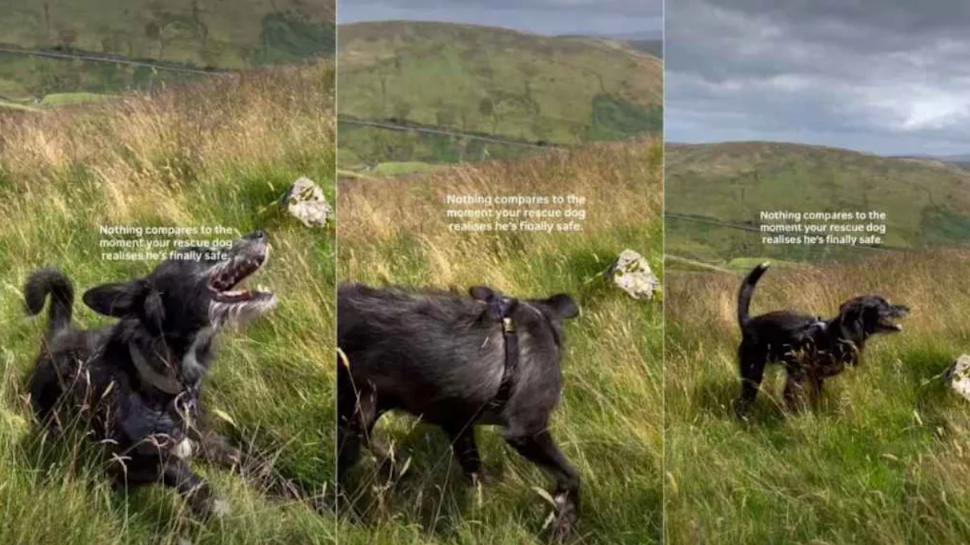
At first, the rescue dog didn’t seem to understand what was happening.
The leash was loose.
No cage surrounded him.
No chain held him in place.
And yet, he hesitated.
As rescuers guided him into an open field for the first time, the dog moved cautiously, almost unsure whether he was truly allowed to explore. Every step looked careful and uncertain, like he was waiting for someone to stop him.
Then something changed.
Slowly, his body relaxed.
His head lifted.
And for the first time, the dog began to run.
Not because he was scared.
Not because he was trying to escape.
But because he was finally free.
The emotional moment quickly captured attention online because it showed something deeply powerful in real time: a rescue animal realizing life no longer has to be about survival.
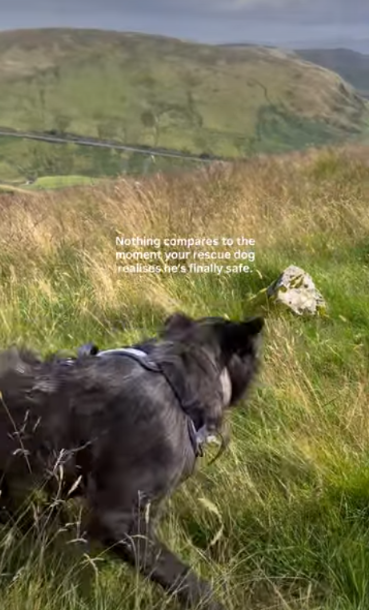
For dogs who come from neglect, confinement, or long-term hardship, freedom isn’t always immediately understood.
Many spend so much of their lives restricted—physically or emotionally—that open space can actually feel unfamiliar at first.
That uncertainty was written all over this dog’s face in the beginning.
He stayed close to the rescuers initially, cautiously scanning his surroundings as if expecting danger to appear at any moment.
But the humans beside him stayed calm, patient, and encouraging, allowing him to process the moment at his own pace.
No forcing.
No pressure.
Just quiet reassurance.
And eventually, instinct took over.
The dog started moving faster.
Tentative steps turned into excited trots. Trots became full-speed zoomies across the grass, his ears bouncing as he explored the open space around him like a dog discovering the world all over again.
It wasn’t just play.
It was release.
The kind of emotional decompression that rescue workers witness when animals finally leave survival mode behind.
People often imagine rescue transformations happening overnight, but in reality, healing usually begins with moments exactly like this—small realizations that safety is real.
A dog learning he doesn’t need permission to move.
A dog discovering there’s enough space to run without fear.
A dog understanding that no one is coming to hurt him anymore.
Those realizations matter more than most people realize.
Trauma changes behavior. Dogs who spend long periods confined or neglected often become hyper-alert, hesitant, or emotionally shut down because their nervous systems adapt to constant uncertainty.
Freedom, then, isn’t just physical.
It’s psychological.
And watching that shift happen can be overwhelming in the best possible way.
As the video continued, the dog’s personality became more visible with every passing second.
The caution that once controlled his movements slowly gave way to curiosity, excitement, and joy.
He circled back toward his rescuers repeatedly, almost as if checking whether this new life was truly his to keep.
Each time, the answer stayed the same:
Yes.
You’re safe now.
That consistency is what allows rescue dogs to heal. Not one dramatic gesture, but repeated moments where fear is replaced by predictability, kindness, and freedom.
By the end of the outing, the dog looked completely different from the frightened animal who first stepped into the field.
His body moved more loosely. His tail stayed higher. His eyes no longer searched constantly for danger.
Instead, they focused on possibility.
And maybe that’s what made the moment resonate with so many people online.
Because it wasn’t just a dog running through grass.
It was a living reminder of what happens when fear finally loosens its grip and an animal realizes life can be bigger than survival.
For this rescue dog, freedom wasn’t simply about having space to run.
It was about finally understanding he was allowed to.