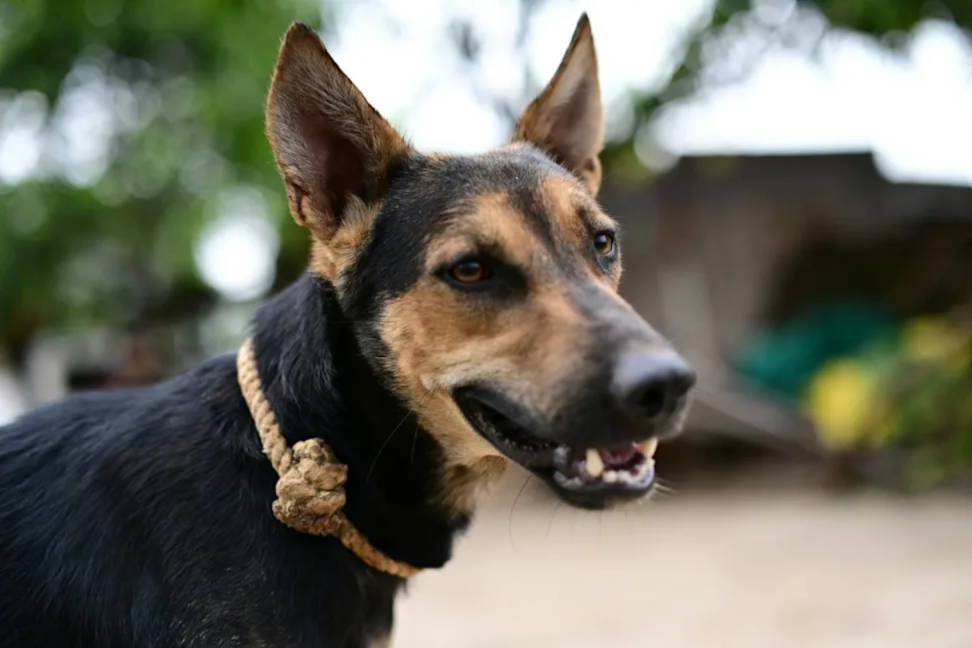
When she first arrived at the shelter, the dog didn’t do much.
She didn’t bark for attention.
She didn’t rush to the front of the kennel.
She didn’t even make eye contact for long.
Instead, she stayed tucked back in the corner, as still and small as she could make herself, watching everything without fully engaging with anything.
To most visitors, she was easy to miss.
To shelter staff, she was impossible to ignore.
Because that kind of silence usually isn’t personality—it’s fear.
The dog had the look of an animal who wasn’t sure what came next, or whether people were something to trust or avoid.
Every unfamiliar sound seemed to make her tense. Every passing shadow outside the kennel seemed to pull her further inward.
And yet, she never showed aggression.
Just withdrawal.
That distinction mattered.
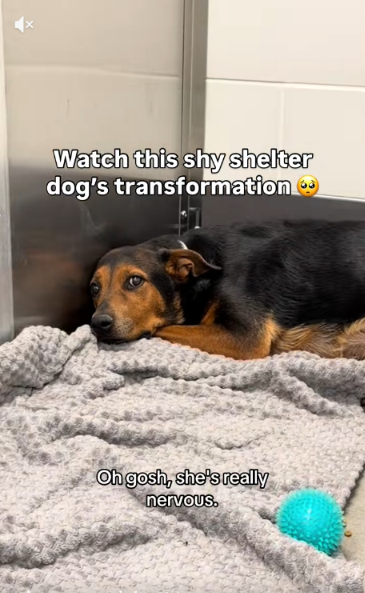
Staff recognized quickly that forcing interaction would only deepen the fear. Instead, they chose a slower approach.
They sat nearby without pressure. They spoke softly without expectation. They allowed her to observe them without demanding she participate.
At first, nothing changed.
Days passed with the same pattern—quiet observation from a distance, minimal movement, and a dog who seemed more comfortable being unseen than being approached.
But healing in shelters rarely looks immediate.
It builds in fractions.
One day, she didn’t retreat quite as far when someone stopped at her kennel.
Another day, she stayed in place when a hand rested near the door instead of pulling away immediately.
Then came a moment that staff quietly recognized as progress: she accepted food without hesitation while someone was still present nearby.
Small steps, but meaningful ones.
Because for a fearful dog, every voluntary interaction is a decision. A choice to trust the environment just a little more than the fear.
Over time, those choices began to stack.
She started to lift her head more often when people approached.
She began to follow movement in the room instead of ignoring it.
Her body language softened—not fully relaxed, but no longer constantly braced for impact.
Then came the breakthrough moment.
It wasn’t loud.
It wasn’t dramatic.
It was simply a shift in presence.
She stayed where she was when someone entered the space—and didn’t immediately shut down.
That moment changed how staff interacted with her going forward.
They adjusted their approach, giving her more opportunities for positive association: short visits, calm voices, predictable routines, and gentle reinforcement when she chose engagement over avoidance.
Slowly, her world began to expand.
What had once been a kennel she hid inside became a space she could exist in without constant fear.
What had once been overwhelming started to feel manageable. And what had once felt like danger began to feel like familiarity.
Her transformation wasn’t about becoming outgoing overnight.
It was about learning that not every interaction required protection.
And for a shy shelter dog, that realization is everything.
Because once fear starts to loosen its grip, even slightly, something else can begin to grow in its place.
Curiosity.
Comfort.
Connection.
And eventually, the possibility of a home where she wouldn’t have to hide at all.