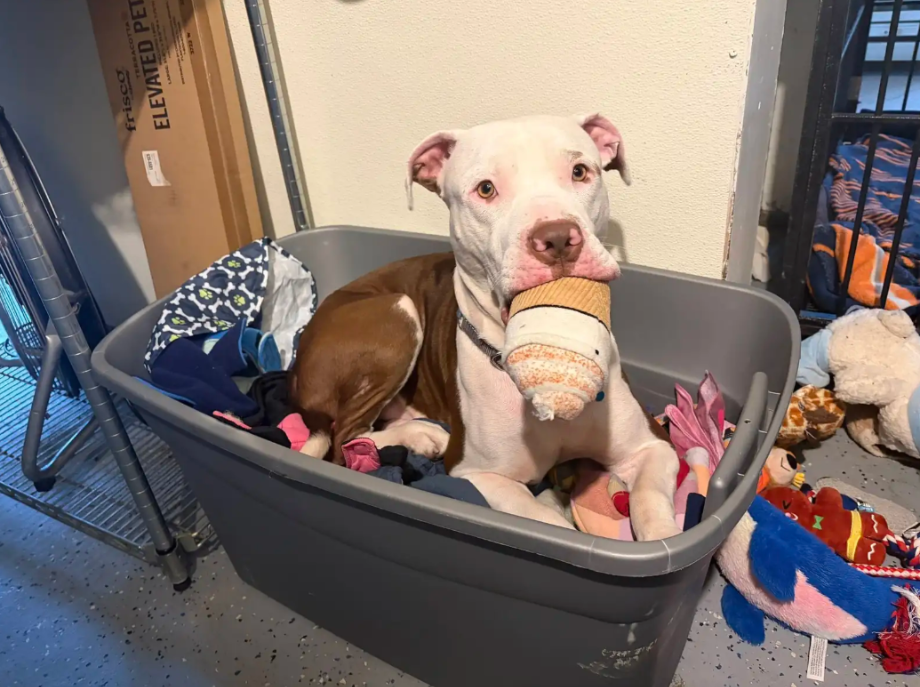
He didn’t act like the other dogs.
While most shelter pups barked, paced, or pressed against kennel doors hoping for attention, this one simply froze.
Quiet. Guarded. Uncertain.
And always holding onto his stuffed animals like they were the only solid ground he had left in a world that didn’t feel safe anymore.
At the shelter, staff quickly noticed something unusual.
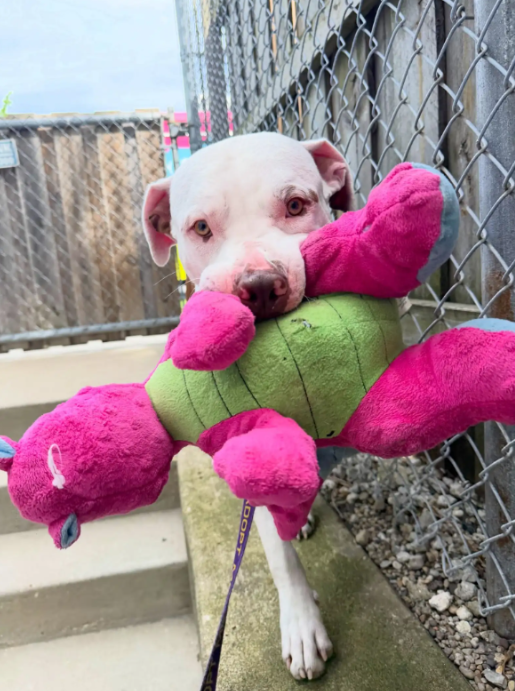
This anxious dog refused to go anywhere without his “emotional support” stuffies. Not one step. Not one hallway. Not one new space.
If the toys didn’t come with him, he didn’t move.
It wasn’t stubbornness.
It was fear.
Somewhere along the way, this dog had learned that the world could be unpredictable. Loud noises. Sudden changes.
Faces he didn’t recognize. And in the middle of all that uncertainty, those soft toys became his anchor. Something familiar.
Something he could control.
So he carried them everywhere.
When he curled up in his kennel, they were tucked beside him.
When staff tried to encourage him to explore, he stayed planted unless his stuffed companions were in reach.
It would’ve been easy to label him as “difficult.” Or “unadoptable.”
Dogs like him often get overlooked because they don’t present the confidence people are looking for.
But the shelter staff saw something different.
They didn’t see a problem to fix.
They saw a dog who had simply never been given a reason to feel safe.
So they didn’t force him.
They followed his pace.
And slowly, something began to shift.
At first, it was small. He would take a few steps further into a room if his toys were with him. Then a few more. He started to look around longer.
He started to pause instead of retreat immediately.
Trust, for him, wasn’t a switch. It was a series of tiny decisions.
One day at a time.
One safe moment at a time.
The breakthrough didn’t come from pressure. It came from patience.
Staff would sit near him quietly, letting him decide how close he wanted to be. They didn’t take his stuffed animals away.
They didn’t try to “teach him confidence” through force. They simply made the world feel less threatening.
And that changed everything.
Because once a dog like that realizes nothing bad is going to happen… curiosity starts to win over fear.
Eventually, something remarkable happened.
He began moving without hesitation.
Still cautious. Still observant. But no longer anchored to fear the way he used to be.
The stuffed animals weren’t a barrier anymore—they were just comfort objects, not lifelines.
And for a dog who once couldn’t take a single step without them, that was huge.
Then came the moment every shelter hopes for.
A person walked in.
Not someone looking for the “perfect” dog. Not someone expecting instant confidence or flawless behavior.
Just someone willing to meet him where he was.
And that made all the difference.
He didn’t transform overnight. That’s not how dogs like him work. But something subtle changed in the air between them.
Less fear. More curiosity. A quiet understanding forming in real time.
The kind you can’t train.
Only earn.
He still had his soft side. Still carried that gentle caution in how he moved through the world. But now, he wasn’t stuck in it anymore.
Because sometimes healing doesn’t look like a big moment.
Sometimes it looks like a dog taking one step forward… without needing to hold onto the only thing he thought could keep him safe.
And realizing, for the first time, that maybe he doesn’t need to anymore.