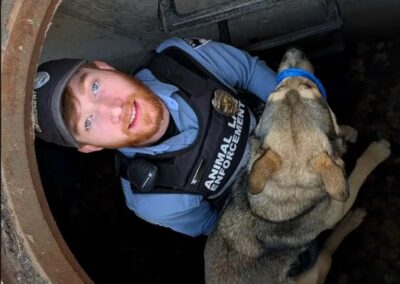
She didn’t come with a dramatic rescue story.
No viral fame. No instant adoption line. No crowd of people falling in love at first sight.
Just a deaf rescue dog who had learned one painful lesson early in life:
people don’t always stay.
So she waited.
Not loudly. Not desperately.
Just quietly, in the way dogs do when hope becomes something they hold instead of something they chase.
Shelter life is already overwhelming for most animals—constant noise, unfamiliar smells, faces that come and go.
But for a deaf dog, it can be even more isolating. The world moves around you, but you don’t fully understand why.
So she adapted the only way she could.
She stopped expecting too much.
And she started attaching herself to the one thing that never seemed to disappear: presence.
When someone came close, she stayed close.
When someone left, she noticed.
And over time, she began to follow a little more closely than before—not out of fear, but out of something softer. A need for stability.

Then something changed.
Someone didn’t just visit her.
They stayed.
At first, it was subtle. Just sitting near her kennel longer than usual. Then coming back again.
Then choosing her—specifically her—when there were plenty of other dogs to meet.
For a dog who had learned not to expect consistency, that kind of attention didn’t register immediately as safety. It registered as unusual.
But she didn’t pull away.
She watched.
She learned.
And slowly, the pattern she had always known began to break.
This person didn’t disappear after a visit.
They didn’t forget her the next day.
They came back.
Again and again.
And then one day, she left the place she had been waiting in for so long.
Not alone.
Not uncertain.
But beside the person who had decided she wasn’t just another dog in a kennel.
She was theirs.
Life after rescue didn’t transform her overnight. That’s not how trust works with dogs who have been left behind before.
But something steady began to form in the background of everyday life.
A rhythm.
A routine.
A new kind of silence that didn’t feel empty anymore.
She started following her person from room to room—not because she was afraid of being left behind, but because being near them finally felt right.
She no longer needed to brace for sudden change.
No longer needed to guess who would stay and who wouldn’t.
Because this time, the answer was consistent.
Every day.
Even in the smallest moments—resting on the couch, waiting by the door, settling quietly nearby—she showed it in the only way she knew how:
by staying close.
People who saw her story often said the same thing in different words. That she finally looked safe. That her eyes were softer.
That she seemed like a dog who no longer had to wonder when love would disappear.
And maybe that’s the real turning point in stories like hers.
Not the rescue itself.
But the moment a dog stops waiting for someone to leave… because they finally understand they won’t.
After years of silence, uncertainty, and waiting for a world she couldn’t hear properly anyway, she finally got something clearer than sound.
She got permanence.
And for a deaf rescue dog who had waited so long, that was the only thing she ever really needed.