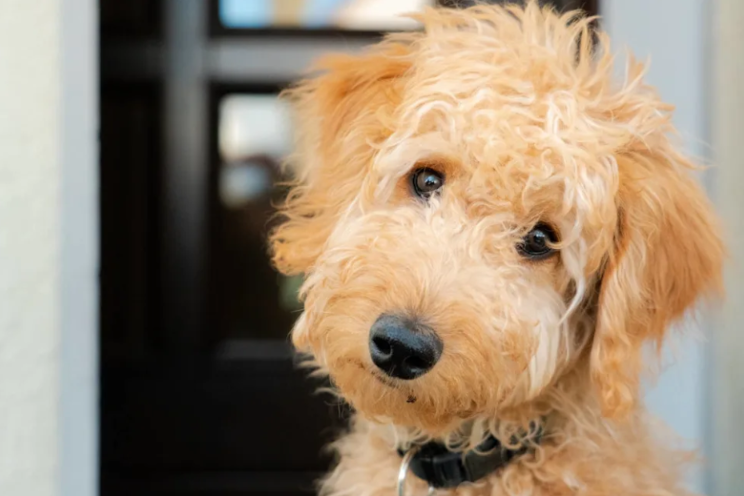
Not every dog walks into daycare like it’s a party.
Some walk in like they’ve just been assigned a shift they didn’t agree to.
Luna is very clearly the second type.
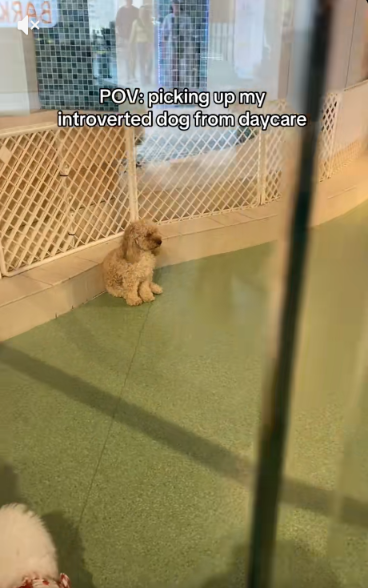
After spending time at a doggy daycare, she was found in a spot that said everything without her having to do anything at all—sitting quietly with her back pressed against the wall, tucked away from the action, watching the chaos from the safest emotional distance she could find.
It wasn’t dramatic.
It wasn’t loud.
It was resignation.
Around her, the other dogs were doing what dogs do in group settings—playing, greeting, interacting, fully engaged in the social experience.
And then there was Luna, deliberately positioned like someone waiting for their ride after a long event they never wanted to attend in the first place.
When her mom arrived, the contrast became even clearer.
The other dogs rushed forward, excited and energized, ready to say hello.
Luna?
She barely moved.
No rush. No enthusiasm. No performance of excitement expected in a reunion moment like this.
Just a quiet acknowledgment that the day had reached its conclusion.
Her message was unmistakable: she was done.
Completely. Emotionally. Socially done.
Her owner even pointed out the moment in a caption, noting how Luna had positioned herself against the wall like she had been counting down the minutes until rescue arrived.
And honestly, that framing fits perfectly.
Because what Luna displayed isn’t unusual in the dog world—it’s just not often highlighted.
Not every dog thrives in high-energy group environments.
Just like people, dogs can have vastly different social tolerances, and for some, constant interaction becomes overwhelming rather than enjoyable.
Daycare can be stimulating, loud, and nonstop.
For dogs that prefer calm environments or limited social exposure, that kind of setting can drain them quickly.
Luna seems to fall squarely into that category.
The type who participates politely for a while… then quietly exits the experience without making a scene.
What makes the moment so relatable is how human it feels.
Anyone who has ever attended a crowded gathering and slowly drifted toward a quiet corner will recognize it immediately.
That subtle shift from engagement to endurance.
The moment when social energy runs out and the only remaining goal is to wait it out without drawing attention.
Luna didn’t need to explain it.
Her body language said it all.
And the internet noticed.
People couldn’t get enough of her quiet protest.
The interpretation of her thoughts ranged from humorous exhaustion to full-blown emotional surrender—because it all felt familiar.
That sense of “I’ve had enough, please retrieve me immediately” translates perfectly across species.
It also highlights something important about dogs that often gets overlooked: personality matters.
Not every dog is built for constant stimulation.
Some prefer quieter routines, predictable environments, and one-on-one time with their humans rather than group chaos.
And recognizing that difference can make a huge impact on their comfort and well-being.
For dogs like Luna, happiness might not come from the busiest daycare or the biggest playgroup.
It might come from something much simpler.
A calm space. Familiar people. Fewer demands.
And the quiet relief of being picked up at exactly the right time.
In Luna’s case, that moment was already waiting at the wall.