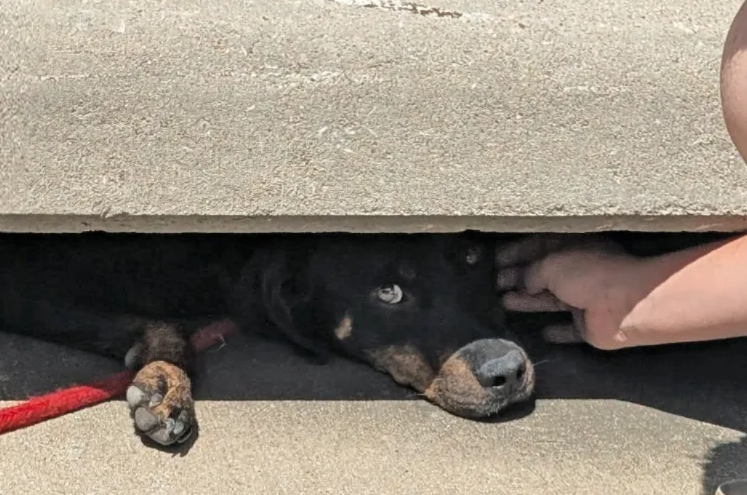
It started with a sound no one expected to hear coming from underground.
A faint, distressed bark.
Not loud. Not constant. But enough to make someone stop, listen, and realize something was wrong beneath the street.
That’s how this rescue in Arkansas began.
A dog had become trapped inside a storm drain system, hidden from view beneath layers of concrete and metal.
From the surface, there was no obvious sign of danger—just another ordinary stretch of road.
But below it, a life was stuck in a space never meant for an animal to enter.
And time mattered.
Local officers were called after concerned residents, including two quick-thinking boys, noticed the dog’s distress and alerted authorities.
That single decision changed everything.
When responders arrived, they quickly confirmed what the callers feared: the dog was indeed trapped below ground, unable to climb out on his own.
What followed was a carefully coordinated rescue effort.
Storm drains are narrow, dark, and unpredictable environments.
They can contain sharp edges, standing water, and hazards that make entry dangerous.
Even trained responders have to move carefully in these conditions, balancing urgency with safety at every step.
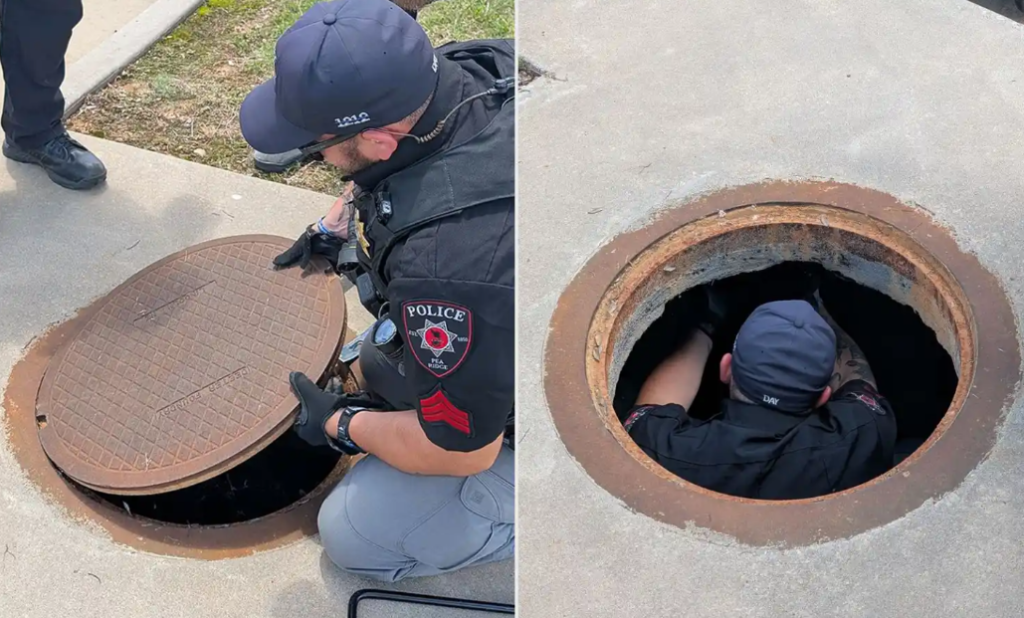
One officer ultimately took on the most difficult part of the operation—entering the drain system to reach the dog directly.
Inside, visibility was limited. Movement was restricted. Every step had to be deliberate.
But the priority was clear: reach the animal, assess his condition, and bring him back to the surface safely.
Down below, the dog was frightened but still responsive.
Exhausted from his struggle, he remained alert enough to understand that help had finally arrived.
From there, the rescue shifted into a slow, careful extraction.
The officer guided the dog through the confined space, working patiently to ensure he wasn’t injured during the process.
Above ground, colleagues prepared to receive him, ready to lift him out the moment he reached the surface.
When the dog finally emerged from the drain, the relief was immediate.
Dirty, shaken, and clearly exhausted—but alive.
The people who had gathered on the street watched as he was safely pulled free, stepping back onto solid ground for the first time since the ordeal began.
Within moments, the tension that had filled the scene gave way to relief.
He had made it out.
And in a situation where things could have gone very differently, that outcome mattered more than anything.
The rescue didn’t just depend on trained officers, though.
It also depended on ordinary people noticing something was wrong and choosing to act.
Without that initial report, the dog might have remained unseen beneath the street.
That small act of attention became the difference between danger and survival.
Once safe, the dog was checked over and given immediate care.
While he was shaken by the experience, the quick response meant he avoided the worst possible outcome.
Storm drains are a hidden hazard in many communities, especially for curious or frightened animals who can slip into openings and become disoriented underground.
Rescues like this serve as a reminder of how quickly a normal environment can become dangerous in unexpected ways.
But they also highlight something just as important.
How fast people can respond when they choose to help.
From the boys who first heard something unusual, to the officers who entered the drain, to everyone who assisted above ground, the effort was collective.
A chain of attention. A chain of action.
And at the center of it all, a dog who simply needed someone to hear him.
In the end, that’s what saved him.