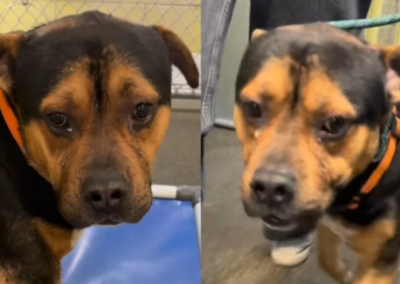
Doug had a problem most dogs never have to think about.
Floors.
Not outside dirt. Not grass. Not gravel.
Floors.
Smooth, hard, indoor surfaces that most of us don’t even notice became something terrifying to him.
The kind of fear that doesn’t just slow you down—it stops you completely.
Because Doug wasn’t just nervous.
He was convinced those surfaces weren’t safe.
For most of his life before rescue, Doug had only ever lived outside.
That shaped everything about how he moved through the world. Grass and soil made sense to him. They gave grip, texture, certainty.
But polished floors? Tile? Anything slick and reflective?
Those felt impossible.
So when he arrived at the shelter, something unexpected happened.
He simply refused to walk on them.
Inside hallways and indoor spaces, Doug would freeze. The moment his paws touched a smooth surface, his confidence disappeared.
It wasn’t stubbornness—it was instinct. His body was telling him something the shelter couldn’t ignore: he didn’t feel safe moving forward.
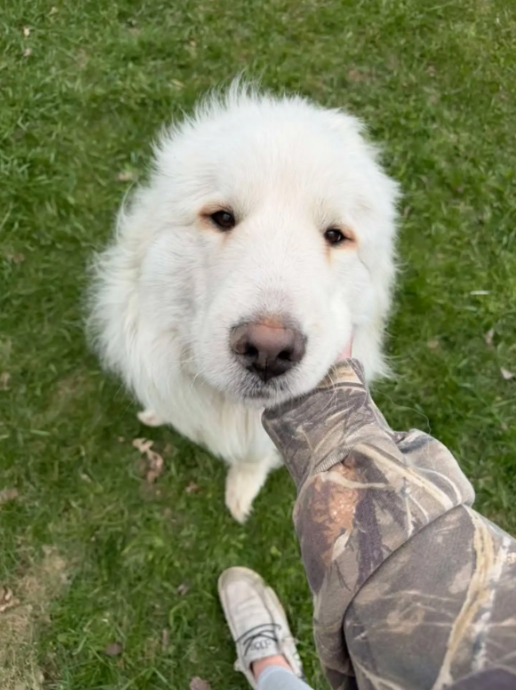
And for a dog of his size, that created a real challenge.
But instead of forcing him through it, the staff made a different choice.
They adapted to him.
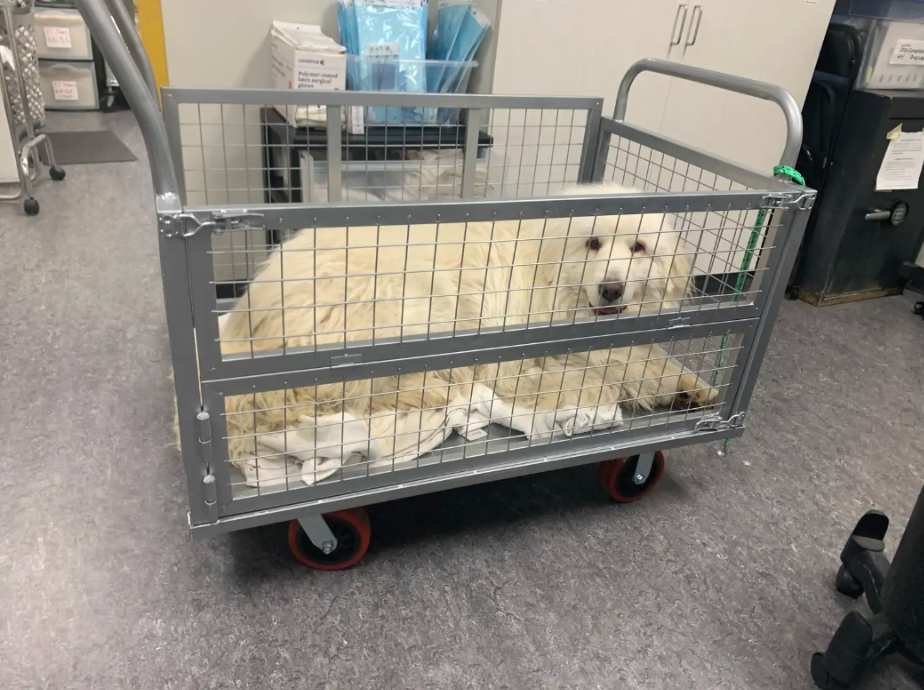
A simple cart became his solution.
Whenever Doug needed to move through parts of the shelter with slippery floors, he was gently placed into the cart and wheeled along.
What might have looked unusual from the outside was, in reality, a quiet act of understanding. No pressure. No punishment. Just support.
For Doug, it meant something deeper than transportation.
It meant trust.
He didn’t have to be pushed into fear. He didn’t have to fail over and over on surfaces he didn’t understand.
He could move safely while he learned, slowly, that not every indoor space was something to be afraid of.
And in between those cart rides, something else started to happen.
People started seeing him—not as a “problem case,” but as a dog worth adjusting for.
That shift matters more than it sounds like it should.
Because shelter life moves fast. Dogs are often judged quickly based on behavior, adaptability, and ease of placement.
A dog who struggles in an indoor environment can easily be overlooked, not because he lacks worth, but because the system isn’t always built for patience.
Doug challenged that.
He forced people to slow down.
To rethink what “ready for adoption” really means.
And eventually, that patience paid off.
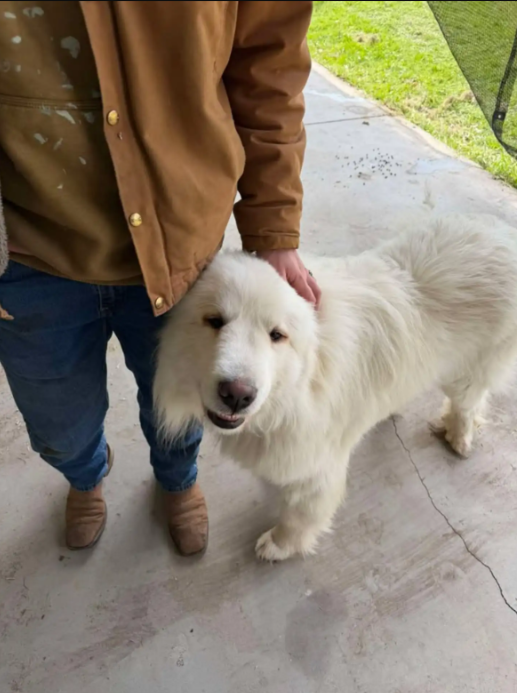
Someone saw him not as a challenge, but as a companion. A dog whose world simply needed a little reshaping to match his comfort level.
That person didn’t try to “fix” Doug.
They met him where he was.
And that changed everything.
Doug found a home with people who understood that fear isn’t a flaw—it’s information.
It tells you where a dog has been, and what they’ve survived. It can be worked through, but only when safety comes first.
Today, Doug’s life looks different.
He isn’t navigating shelter hallways anymore. He isn’t freezing at every doorway or avoiding every smooth surface.
He’s living in a place where the environment has been adjusted with him in mind, not against him.
And the cart that once carried him through fear is now just part of his story—a reminder of a time when even walking across a floor felt impossible, until someone decided it didn’t have to stay that way.
Because sometimes, helping a dog move forward doesn’t start with teaching them to walk.
It starts with making sure they feel safe enough to try.