Not every rescue story begins with transformation.
Some begin with silence.
And hesitation.
And a dog who still doesn’t quite believe the world is safe yet.
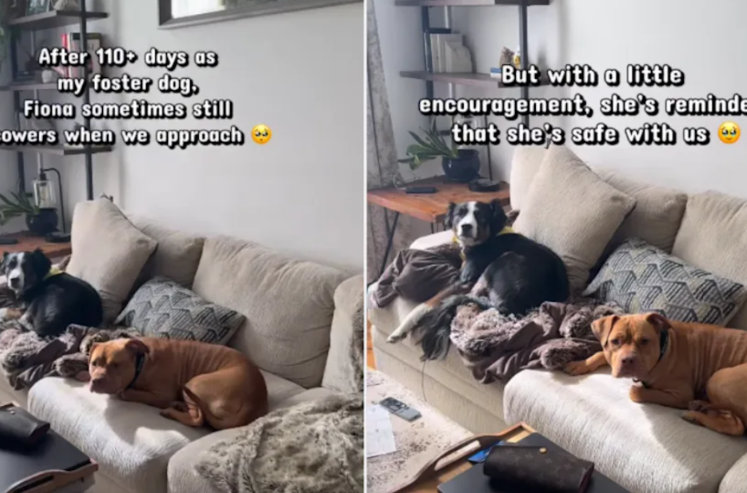
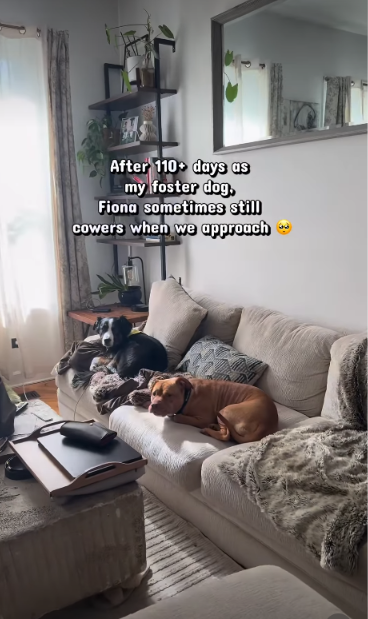
In a quiet foster home, one rescue dog is slowly learning that not all humans are something to fear—but even after time, patience, and care, she still sometimes finds herself shrinking back into old instincts.
The video shared from her foster journey shows a simple moment: the dog moving through the home, unsure, cautious, reading every sound and shift in the room as if it might mean trouble.
There’s no aggression.
No chaos.
Just uncertainty that lingers long after rescue.
When her foster mom appears or approaches, the dog’s first response isn’t excitement—it’s instinctive caution. A slight pause.
A lowered posture. A reminder that whatever she experienced before arriving here still lives somewhere in her memory.
This is what people often misunderstand about rescue dogs like her.
Healing isn’t linear.
Even in a safe home, the body sometimes remembers danger faster than the mind can learn safety.
For dogs with histories of neglect or abandonment, the world doesn’t immediately rewire itself just because the environment changes.
It takes repetition. Predictability. Quiet reassurance that nothing bad follows the small moments anymore.
So her foster family works slowly.
They don’t push.
They don’t force interaction.
They let her choose distance, space, and timing.
And that choice is part of what slowly builds trust.
Over time, small shifts begin to appear. A glance that lingers a little longer. A moment where she doesn’t retreat immediately.
A step forward instead of back. These aren’t dramatic breakthroughs—but in the world of fearful rescue dogs, they are everything.
Experts often describe this stage of recovery as the “decompression period,” where a dog begins to adjust to safety after prolonged stress.
For some dogs, it lasts weeks. For others, months. And for a few, pieces of that fear surface long after they’ve technically been “safe.”
That doesn’t mean progress isn’t happening.
It just means healing is still underway.
What makes her story especially moving is how clearly her foster understands that difference.
There’s no expectation that she should already be “fixed” or fully confident. Instead, there is acceptance that trust must be earned in layers.
Not demanded.
Earned.
And in between those layers are the moments that matter most.
A soft voice that doesn’t startle her anymore.
A familiar routine that starts to feel predictable.
A presence in the room that no longer feels like a threat.
These are the building blocks of recovery for dogs like her—dogs who are learning, sometimes for the very first time, that not every human will hurt them, and not every environment is something to survive.
Even her hesitation tells part of the story.
Because fear that begins to soften is still fear in transition.
And transition is where change lives.
There will likely be more days where she cowers than days where she feels fully secure. That is normal. That is expected.
And in many cases, it is necessary for trust to become real rather than rushed.
Her foster home becomes, slowly, something different than just a place to stay.
It becomes a practice ground for safety.
A space where nothing is demanded of her except time.
And in that time, something quiet is happening.
Not a dramatic transformation.
Not a sudden change in personality.
But something more meaningful.
The beginning of belief.
That this time, she might actually be safe.