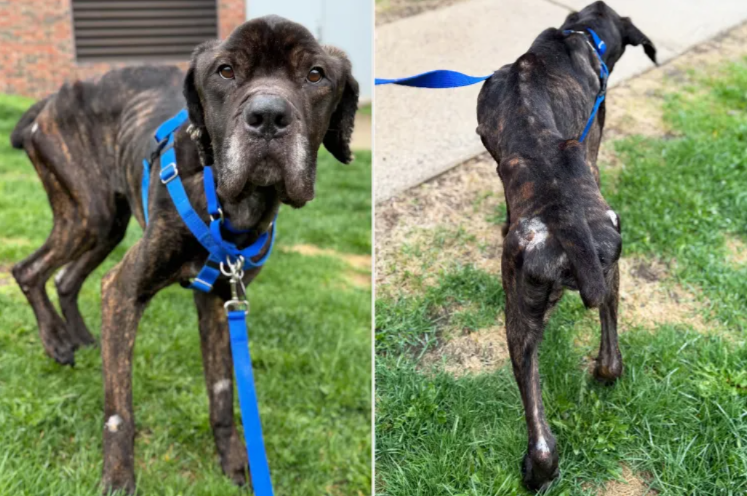
When animal control officers first found him, there was almost nothing about his condition that felt survivable.
A stray dog, severely underweight, barely holding on—his body so depleted that every bone was visible beneath his fur.
He wasn’t just thin. He was in crisis.
But someone got to him in time.
And that timing made all the difference.
The dog, later given the name Balboa, was rushed to the Angell Animal Medical Center in Boston, where veterinary staff immediately recognized the severity of his condition.
He wasn’t just malnourished—he was medically unstable.
His body temperature had dropped to a dangerously low level, far below what is considered safe for dogs.
In situations like this, hypothermia becomes as critical as starvation. The body begins shutting down systems just to conserve energy.
For the veterinary team, the first priority wasn’t recovery.
It was survival.
Warmth therapy was started immediately.
He was carefully stabilized, monitored around the clock, and given supportive care to bring his body back from the edge.
Every decision in those early hours had to be precise—too fast, and his system could crash; too slow, and he might not make it.
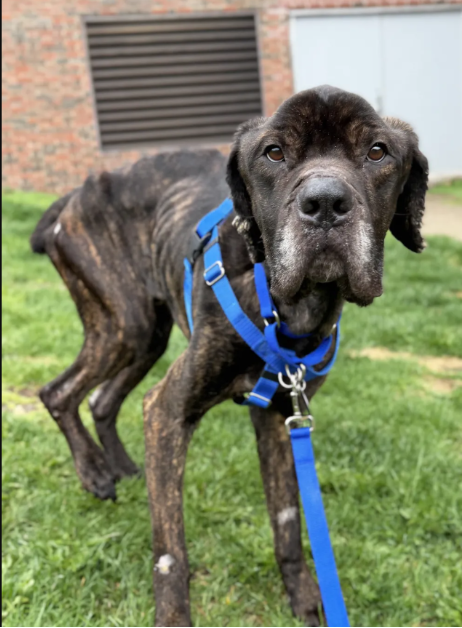
But Balboa responded.
Slowly, he began to stabilize.
Once his condition was no longer critical, the focus shifted from emergency care to recovery.
Feeding him again required extreme caution.
Dogs in severe malnutrition face a serious risk called refeeding syndrome, where the body can react dangerously if nutrition is reintroduced too quickly.
So the veterinary team moved carefully—small amounts, slow progression, constant monitoring.
Each step forward was measured, but meaningful.
And then something even more important started to happen.
Balboa began to change—not just physically, but behaviorally.
As his strength returned, small signs of personality started to emerge. A calmer presence.
A more responsive reaction to people entering the room. Subtle shifts that suggested he wasn’t just surviving anymore—he was starting to come back.
Once stable, he was transferred from emergency care into an adoption-centered facility where staff could continue his recovery in a more comfortable environment.
There, he could begin learning what safety looked like outside of a medical setting.
Warm bedding instead of cold floors.
Regular meals instead of deprivation.
Human interaction that didn’t involve urgency or crisis.
For dogs like Balboa, that shift is often just as important as the medical treatment itself.
Physical recovery is only one part of the equation. Emotional recovery takes longer—and requires consistency.
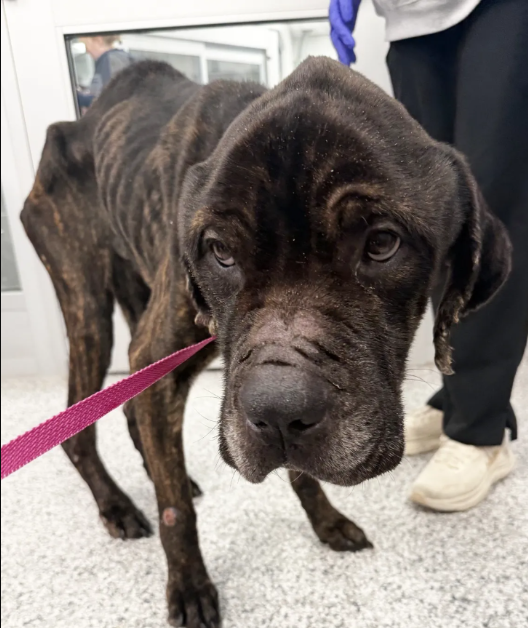
He is now continuing that journey in a structured care environment, with plans for foster placement once he is strong enough.
That next step is important, because a home environment often reveals aspects of a dog’s personality that a shelter setting simply cannot.
How they relax.
How they trust.
How they bond.
There is still an investigation into how Balboa ended up in such a condition.
Authorities are working to understand his background, though in many cases like this, answers are incomplete.
What matters most right now, however, is that he is no longer in that situation.
He is safe.
He is receiving care.
And he is finally on the path toward something he never had before.
Stability.
Stories like his don’t erase what happened in the past. But they do something just as powerful—they redirect the future.
From uncertainty to recovery.
From survival to possibility.
And from a stray with no strength left…
to a dog slowly learning what it means to be cared for.