Training a dog in public spaces is one of the most effective ways to turn basic obedience into real-world reliability—but it only works if it’s done with structure, patience, and clear expectations. Unlike home training, public environments introduce unpredictable distractions: people, other dogs, smells, movement, and noise. The goal isn’t perfection in those settings right away—it’s teaching your dog how to think and respond despite those distractions.
Below is a practical breakdown of how to approach public-space training in a way that builds calm, focused behavior over time.
Start with control before exposure
Before you ever step into a busy park or café area, your dog should already have a foundation of core cues like sit, stay, come, and leash manners. These are the “anchor behaviors” that let you regain attention when the environment becomes overwhelming.
A key mistake many handlers make is rushing into high-distraction environments too early. Dogs don’t generalize behavior automatically—just because they sit in your living room doesn’t mean they’ll sit next to a busy sidewalk.
Start in low-distraction environments, then gradually increase difficulty.
Choose the right public environment
Not all public spaces are equal for training.
Good starting environments include:
- Quiet neighborhood parks during off-peak hours
- Wide sidewalks with low foot traffic
- Pet-friendly outdoor seating areas with distance from crowds
More challenging environments—like busy dog parks or crowded events—should come later in training progression.
The principle is controlled exposure, not overload. Your dog should notice distractions but still be able to respond to you.
Distance is your best training tool
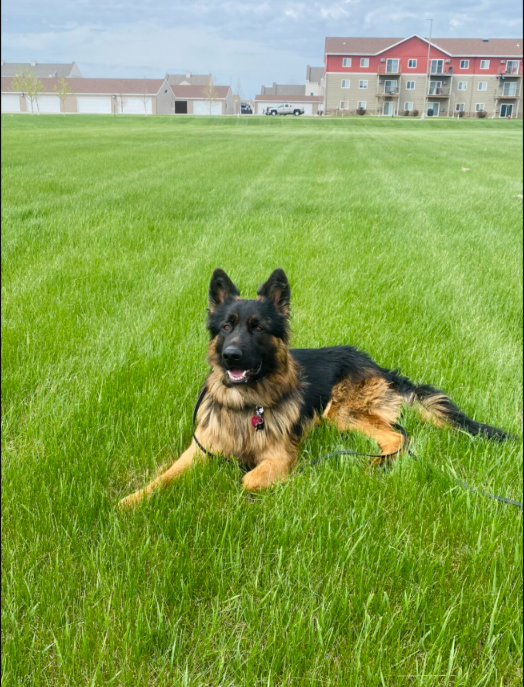
Distance is what keeps your dog under threshold.
If your dog is too close to a distraction, they will likely ignore you. Instead of correcting that, increase distance and try again. This gives your dog a chance to succeed and builds reliable behavior without frustration.
A long leash (not a retractable one) can help maintain safety while still allowing exploration.
Reward focus, not just obedience
In public training, you’re not just rewarding commands—you’re rewarding attention.
Every time your dog:
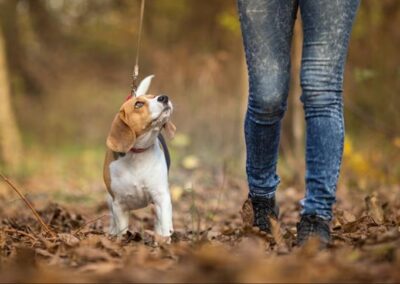
- Looks back at you voluntarily
- Checks in during a distraction
- Chooses to disengage from something interesting
…that’s a moment worth reinforcing.
High-value rewards (food, praise, toys) should be used strategically, especially in environments that compete heavily for your dog’s attention.
Over time, your dog learns a powerful pattern: staying connected to you is more rewarding than the environment.
Teach “check-in” behavior
One of the most useful public-space skills is voluntary engagement.
Instead of waiting for your dog to drift away and then correcting them, teach them to check in naturally. This can be reinforced by:
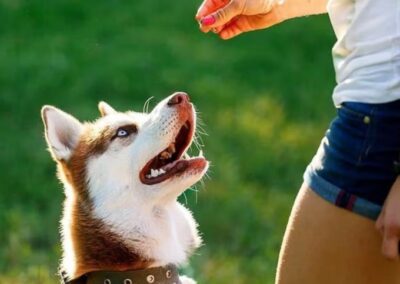
- Rewarding eye contact
- Marking when they return attention to you
- Using a consistent cue like their name or a focus word
This builds a habit of orientation toward the handler even in stimulating environments.
Manage leash etiquette properly
Leash control is not just about safety—it’s about communication.
A properly fitted leash:
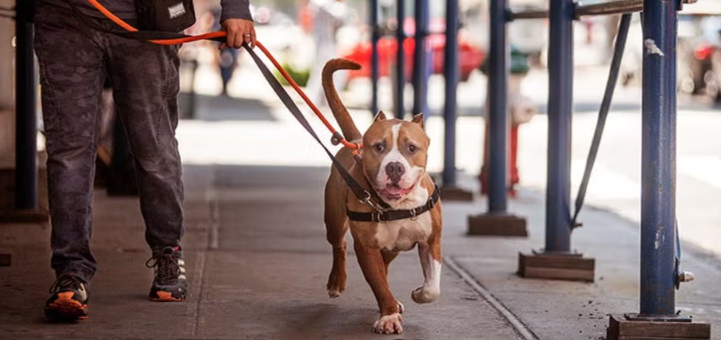
- Gives enough length for movement
- Maintains enough control for redirection
- Avoids constant tension (which increases stress)
Constant pulling or tight leash pressure can increase reactivity and reduce learning capacity.
The goal is a calm, neutral leash connection—not tension-based control.
Teach calm behavior around people and dogs
One of the biggest public-space challenges is impulse control around strangers and other animals.
Instead of allowing uncontrolled greetings, structure interactions:
- Ask for a sit before approaching people
- Reward calm observation of dogs at a distance
- Avoid forced interactions when your dog is overstimulated
This teaches your dog that calm behavior—not excitement or pulling—controls access to the environment.
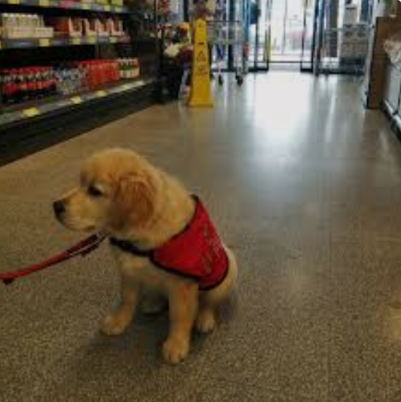
Use short training sessions
Public training is mentally demanding for dogs. Keep sessions short—often 10 to 15 minutes is enough before a break is needed.
Look for signs of overload:
- Sniffing without engagement
- Ignoring known cues
- Restlessness or fixation on distractions
When these appear, step back, reduce difficulty, and reset.
Progress gradually, not randomly
Think of public training as a ladder:
- Home environment
- Quiet outdoor space
- Low-traffic public area
- Moderate distraction environments
- High-distraction public settings
Skipping steps often leads to inconsistent behavior and frustration for both dog and handler.
Final takeaway
Public-space training isn’t about forcing obedience in chaos—it’s about building communication strong enough to survive chaos.
When done correctly, your dog learns three essential skills:
- How to focus under distraction
- How to make good choices independently
- How to stay connected to you anywhere
That combination is what turns basic training into real-world reliability.