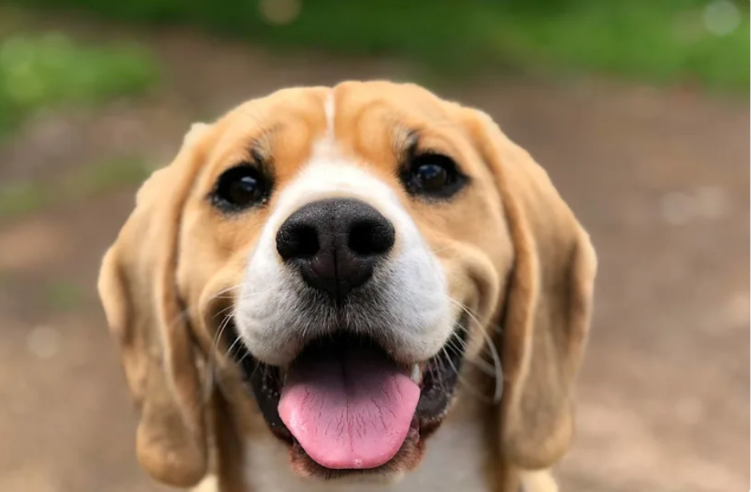
A rescued beagle who spent the early part of his life in a laboratory is now discovering something most dogs take for granted: how to play.
And when that moment finally arrived, it wasn’t subtle.
It started with something simple—a tennis ball placed in front of him in an open yard. No instructions he could understand.
No past experience to guide him. Just a small, bright object rolling across grass, inviting curiosity.
At first, he hesitated.
This wasn’t the kind of environment he had known before. Open space. Soft ground. Movement without constraint.
For a dog whose early life was shaped by confinement, even freedom can feel unfamiliar.
So he watched.
He sniffed the ball cautiously, as if trying to decode what it was supposed to mean. Not food. Not threat. Not something he had been trained to recognize. Just… new.
Then something shifted.
He picked it up.
Carefully at first, like he was testing whether it was allowed. Then again, with more confidence. And suddenly, what began as hesitation turned into engagement.
The idea that this object could be interacted with—chased, carried, enjoyed—started to take hold.
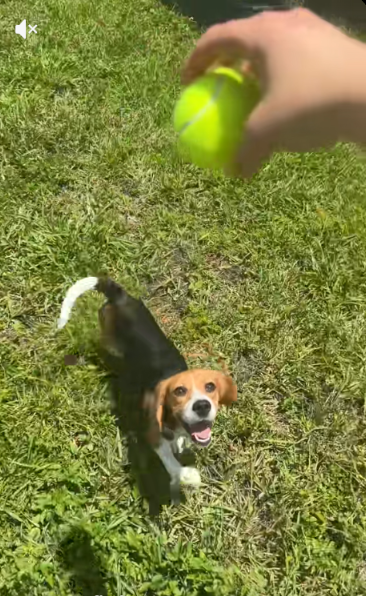
That’s the part that hits hardest in moments like this: not just that he played, but that he learned he could.
His foster caregiver encouraged him gently, introducing the simplest version of the game. A toss. A pause. A wait.
Then the realization that the ball wasn’t gone—it was coming back.
At first, he didn’t fully understand. Dogs aren’t born knowing fetch; they learn it through repetition, feedback, and trust.
For a dog like him, even those basics can take time.
But something about the openness of the space, the patience of the human beside him, and the absence of pressure created room for curiosity to grow.
So he tried again.
And again.
Each repetition built something invisible but powerful: confidence.
Soon, what had started as cautious observation turned into movement. He began to follow the ball more eagerly.
His steps became quicker. His body language loosened. There was less hesitation in his posture and more willingness to engage with what was happening around him.
And then came the moment that says everything without needing explanation: he started to play like it mattered.
Not perfectly. Not with polished skill. But with joy.
The kind of joy that comes from discovery, not habit.
For dogs transitioning out of laboratory environments, these milestones aren’t small. They are foundational.
Learning to play is often tied to learning trust—trust in space, trust in people, and trust that the world outside confinement is not something to fear.
That tennis ball wasn’t just a toy. It became a signal. A simple proof that interaction can be safe, rewarding, even fun.
And as the video of his first real play spread, it resonated for exactly that reason. People weren’t just watching a dog chase a ball.
They were watching a mind wake up to possibility.
There’s something quietly profound about that.
Because for all the complexity of rescue work, sometimes the biggest transformations happen in the smallest moments—like a hesitant nose touch, a first chase, or a dog realizing that when a ball is thrown, it’s meant to be found again.
This beagle didn’t just learn a game.
He learned a new language of life outside the cage he once knew.
And in that language, the first word was joy.