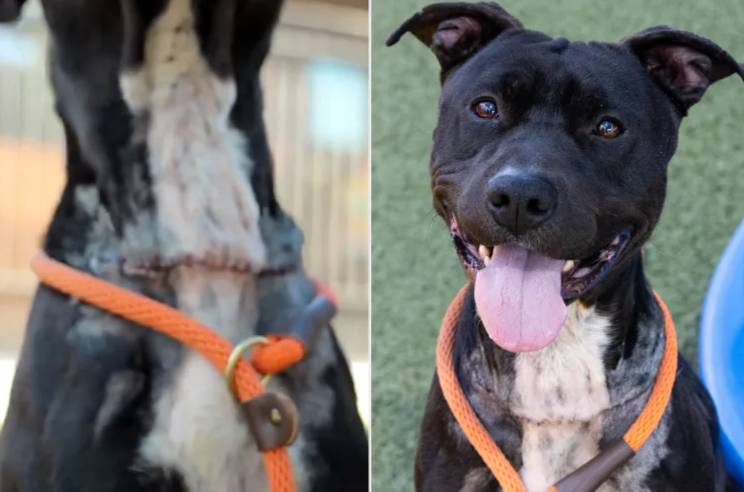
When rescuers first found Loki, the 4-year-old Pit Bull had endured an injury so severe that his neck was covered in wounds.
But despite the pain, Loki’s story wasn’t going to end there.
The American Pit Bull Terrier was rescued in Arizona after being found as an injured stray. Veterinarians determined that a plastic-coated wire tether had been wrapped around his neck twice, along with a nylon collar.
At some point, Loki became tangled and eventually managed to chew through the wire to free himself.
By the time rescuers found him, the damage was extensive. His wounds covered approximately 60% of his neck.
Loki desperately needed medical attention.
He was rushed to the Arizona Humane Society’s trauma hospital, where veterinary staff immediately began treating his injuries. His wounds were cleaned, and he received medicated honey bandages, fluids, and antibiotics.
The road to recovery wasn’t going to be quick.
Loki spent about a week receiving intensive treatment before undergoing surgery. Every step was focused on helping him heal from the injuries that could have had a devastating outcome.
But Loki kept going.
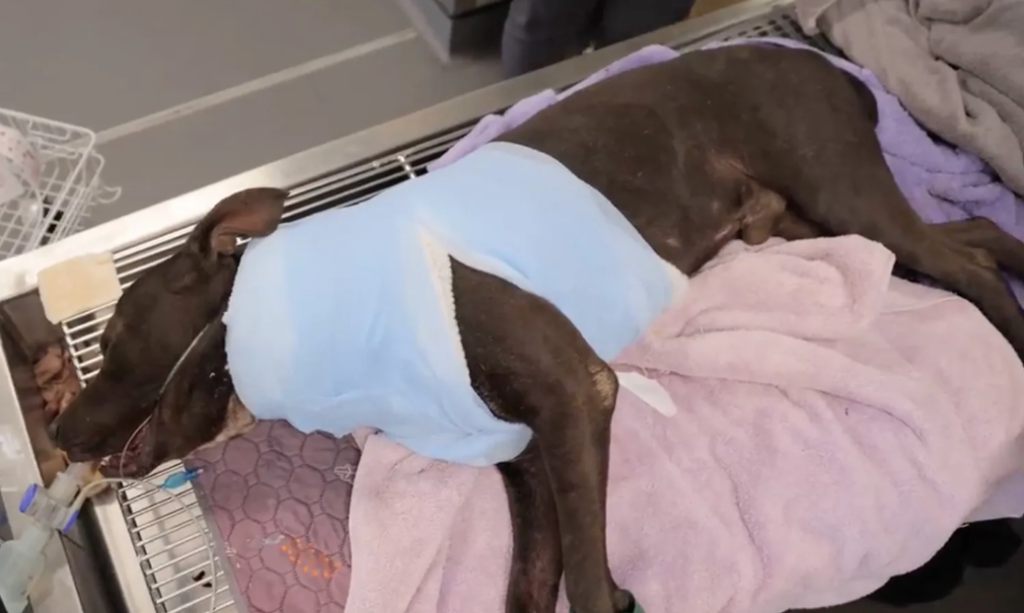
Slowly, his condition improved.
Then came the update everyone was hoping for.
Loki fully recovered.
And his happy ending didn’t stop with his medical recovery.
He found a forever home with a family in Goodyear, Arizona.
After everything he had experienced, Loki finally had the chance to discover what life could look like when a dog is safe, cared for, and surrounded by people who want him to thrive.
His story also highlights the dangers of leaving dogs tethered outdoors without proper supervision. Tethers can become wrapped around objects or the animal itself, potentially leaving dogs unable to reach food or water or causing serious injuries.
In Loki’s case, the consequences were devastating.
His experience comes as Phoenix introduced an updated tethering ordinance requiring dogs to be directly supervised by their owner or handler whenever they are tethered outdoors.
The rules also address extreme temperatures, which can create additional dangers for dogs left outside.
The changes are intended to help prevent animals from becoming trapped, injured, dehydrated, or exposed to dangerous heat and cold.
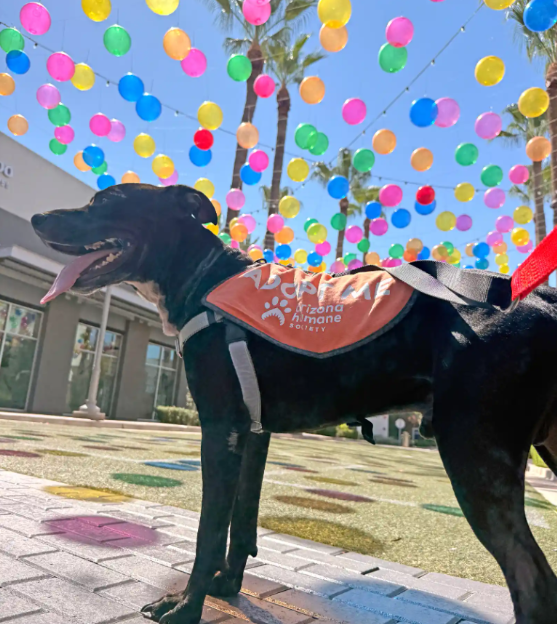
For Loki, however, the most important part of his story is what came after the rescue.
He survived.
He healed.
And he found a family.
It’s easy to focus on the heartbreaking circumstances surrounding a rescue dog, but Loki’s journey is ultimately about resilience.
A dog who was discovered with severe injuries now has the opportunity to spend his days doing something much simpler—being a beloved family pet.
His recovery also shows what can happen when an injured animal receives immediate veterinary care and people refuse to give up on him.
Loki couldn’t change what happened to him.
But he got a chance to move forward.
The wire that once threatened his life is gone. The wounds that covered his neck have healed. And the uncertainty of life as an injured stray has been replaced with something every rescue dog deserves: a permanent home.
His story is a powerful reminder that responsible pet care matters, especially when animals are tethered outdoors. What may seem like a simple way to keep a dog in one area can become dangerous when an animal is left unsupervised.
Thankfully, Loki’s story ended differently.
Instead of remaining defined by his injuries, he gets to be known for the life he has ahead of him.
A healthy body.
A safe home.
A family of his own.
And, most importantly, a second chance.