
Benny has a secret mission.
The Golden Retriever has carefully planned his approach, perfected his stealth and apparently convinced himself that nobody can see him.
There’s just one problem.
His brother knows exactly what he’s doing.
In a hilarious scene, Benny attempts to sneak across the living room as quietly as possible. One paw moves forward. Then another. Slowly, carefully, he creeps toward his unsuspecting brother.
At least, that’s what Benny thinks.
His movements are so deliberately slow that he looks like a dog starring in his very own spy movie.
But Benny isn’t trying to steal classified documents or sneak past a security guard.
He’s after something much more important.
His brother.
The plan seems obvious: creep closer, stay undetected and eventually pounce.
Unfortunately for Benny, his brother isn’t buying any of it.
As Benny approaches, his sibling notices the suspicious movement and responds with an unforgettable side-eye.
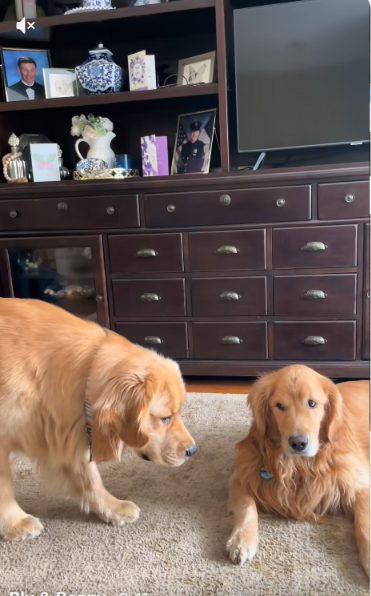
The message is practically written across his face:
“I can see you.”
Benny’s stealth mission comes to an abrupt halt.
It’s a classic sibling moment—and one that dog owners will probably recognize immediately.
Dogs may not actually be secret agents, but sneaking, stalking and pouncing can be perfectly normal parts of canine play.
These behaviors are connected to dogs’ natural predatory instincts. Their ancestors relied on behaviors such as stalking, chasing and pouncing when hunting.
Today’s family dogs don’t necessarily need those skills to find dinner, but those instincts haven’t disappeared.
Instead, they often show up during play.
A dog might crouch low before suddenly sprinting after a toy. Another might freeze dramatically before launching into a game of chase. And sometimes, one dog will slowly creep toward another before making a playful leap.
That’s exactly what Benny appears to be doing.
He’s not hunting his brother.
He’s trying to get him to play.
The slow approach is essentially Benny’s version of saying, “Hey… wanna do something fun?”
Of course, his brother may have a completely different opinion.
Some dogs love being chased, tackled and pounced on by their canine siblings. Others would rather have some personal space.
Benny’s brother seems to fall firmly into the second category.
His epic side-eye suggests he’s not particularly impressed by the attempted ambush.
But Benny doesn’t seem discouraged.
For him, the fun is probably in the anticipation.
The creeping.
The suspense.
The moment when his brother finally notices.
And perhaps the chase that follows.
Play behaviors like stalking and pouncing are generally nothing to worry about when both dogs are comfortable and the interaction stays appropriate.
However, strong prey drive can become problematic if a dog’s chasing behavior becomes excessive or interferes with everyday activities.
For Benny, though, there doesn’t appear to be a serious problem.
His biggest obstacle is simply having a brother who has figured out his tricks.
Benny may believe he’s an international super spy.
He may think every slow-motion step makes him more invisible.
He may even believe his brother has no idea what’s coming.
But his brother knows.
He sees every move.
And judging by that legendary side-eye, he’s already wondering why Benny can’t just walk over like a normal dog.
Still, Benny deserves credit for commitment.
His mission may have been exposed, but he certainly gave it everything he had.
Sometimes, being a dog is about running, barking and chasing squirrels.
And sometimes, it’s about sneaking across the living room in the world’s most obvious attempt at a surprise attack.
For Benny, that’s apparently all part of the fun.
And for his unimpressed brother, it’s just another day living with the world’s least convincing super spy.


I’ve been playing here for a few weeks now and the payout speed is actually impressive. Highly recommend 777ccgame for anyone looking for a smooth experience.