There are stories that warm you, stories that inspire you, and then there are stories that redefine what we think is possible.
The story of Endal is one of those rare narratives — a tale of courage, connection, and devotion so profound that it shifts the way we see not just service dogs, but companionship itself.
Endal wasn’t just a dog. He was an ambassador of empathy, a partner in freedom, and for many, an embodiment of what it means to be truly valuable in this world.
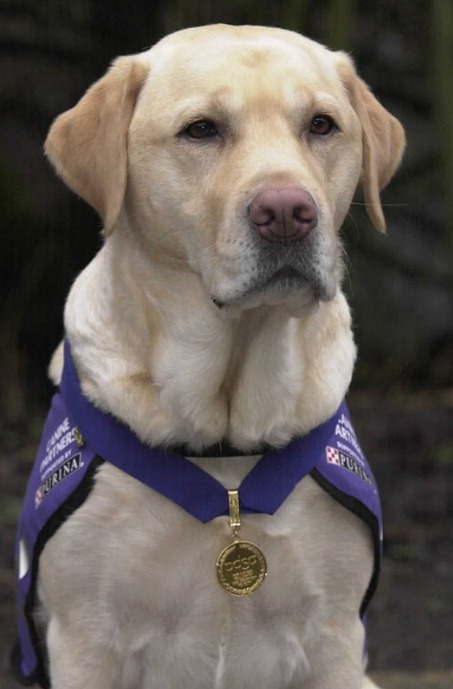
Born in 1988, Endal was a Labrador Retriever–silver sable — a color and coat that made people pause, but it was his spirit that made them remember him.
He wasn’t born into a life of ease. Like many dogs, he began in a rescue shelter. But unlike most, his path stretched far beyond play‑pens and adoptions.
It took him to places where ordinary dogs never go. He became one of the most celebrated service animals in history.
Endal was placed with his eventual handler, Allen Parton, a former Royal Navy chief petty officer who had lost mobility following a workplace accident.
Allen’s life had changed dramatically — simple daily acts like standing from a seated position, dialing a phone, or even maintaining balance in a chair became monumental tasks.
Then came Endal — not just as a companion, but as something far deeper: a bridge back to independence.
In the early stages, Endal underwent intensive training to be a service dog.
What he learned was extraordinary — not just in what he could do, but in how intuitively he responded to Allen’s needs before the need was even spoken.
Endal mastered the skills that any well‑trained service dog would: fetching items, operating buttons and switches, carrying out routine tasks designed to make daily life possible.
But what set him apart was his ability to perceive subtle shifts — in environment, in mood, in physical stability — and to act decisively to help.
There was a moment that captured Endal’s legacy in bold relief.
In 1998, Allen and Endal were walking near the wreckage of the Star — a beached ferry — when Allen slipped and fell.
Trapped and unable to move, Allen faced a dangerous situation. Without hesitation, Endal moved not only to comfort him but to secure vital help.
He pulled Allen’s mobile phone from Allen’s pocket, positioned it by his mouth, and activated it. The phone dialed emergency services.
Endal then stayed by Allen’s side, watching over him until help arrived. This wasn’t just service provision — it was life saving.
But the rescues weren’t limited to one event.
Endal’s intuitive actions throughout his career became legendary: he would stop traffic to keep Allen safe, navigate complex environments during crowded situations, help Allen manage PTSD symptoms, and even retrieve cash from an ATM over a kilometer away.
Endal’s story resonated globally, earning him honors and awards typically reserved for humans. He was featured on television, in newspapers, and on the covers of magazines.
He received the Most Valued Companion award and recognition from the British Geriatric Society and the Royal College of Veterinary Surgeons.
Endal was called one of the most highly decorated dogs in the world — and rightly so.
His achievements were not about tricks or applause; they were about impact, connection, and service at a level most humans would hesitate to try.
Yet for all the accolades, what made Endal unforgettable was not just the tasks he performed — it was the depth of his bond with Allen.
Service dogs are trained to assist, but Endal became a partner.
In the rhythm of their days together, there was a shared dance of trust: Allen trusted Endal with his safety, and Endal trusted Allen with his purpose.
When Endal passed away in 2009, the world mourned.
People spoke of him not as a dog that did things for a man, but as a being who walked alongside him in ways that transformed two lives — both human and canine.
Endal didn’t just serve. He inspired. He didn’t just support. He connected.
We often hear people talk about loyalty and service in the abstract — but in Endal, we find those ideals made living, breathing, wagging flesh.
His story stands as a reminder: animals don’t just mirror our emotions — they amplify them. They don’t just accompany us — they can elevate us.
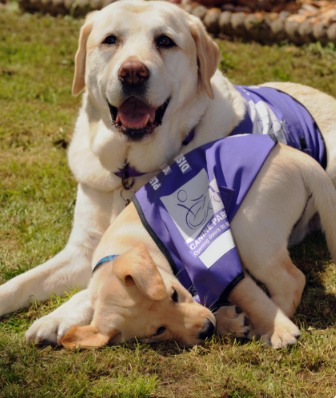
Endal’s legacy lives on not only in memorials and awards but in every service dog program that teaches trainers to trust the intuitive capacities of dogs.
In every handler‑partner connection that blossoms into mutual reliance, and in the countless lives touched by the example of a dog who went beyond obedience to understand human need.
In a world filled with noise, Endal taught us something quiet but powerful: that compassion, attentiveness, and connection matter — that they shape lives in ways we only begin to measure when we open our hearts wide enough to see them.
Because Endal wasn’t just a service dog.
He was proof — in fur, in movement, in instinct — that love and purpose can walk on four legs just as profoundly as they can on two.
If you’d like follow‑up resources on how service dogs are trained today and how partnerships like Endal and Allen’s continue to change lives, just let me know.