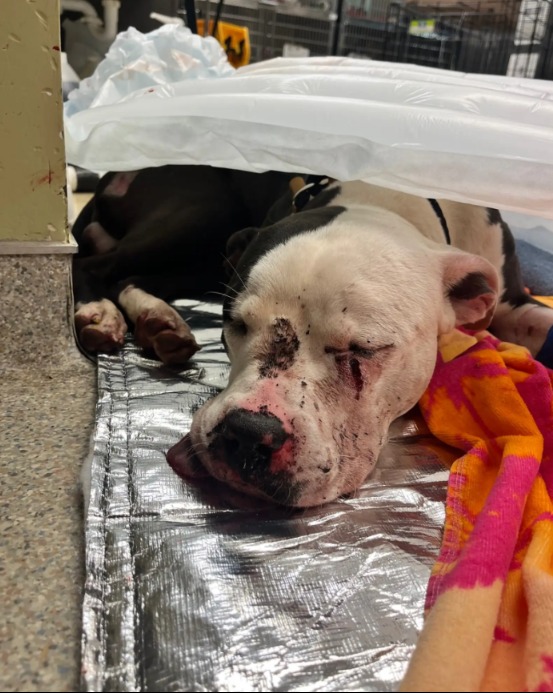
The night should have ended quietly. Fireworks had faded. Streets were empty. But in the middle of the road, under the dull glow of streetlights, a small gray-and-white pit bull stood alone—bleeding, trembling, and somehow still upright.
His body told the truth before anyone else could. He had been shot. More than once. The kind of wounds that steal breath and hope at the same time. Yet there he was. Waiting. Not running. Not giving up.
Later, he would be called Wallace. But in that moment, he was simply a dog who refused to lie down and disappear.
When officers found him, they didn’t know if he would survive the night. They only knew he needed help immediately. They lifted him gently, rushed him to safety, and handed him over to people who could fight for him when he no longer could.
X-rays revealed what everyone feared—and what no one expected. Bullets were lodged in his body, but by some miracle, none had shattered bone or hit anything vital. His injuries were serious, painful, and frightening. But he was still here.
And Wallace wasn’t angry.
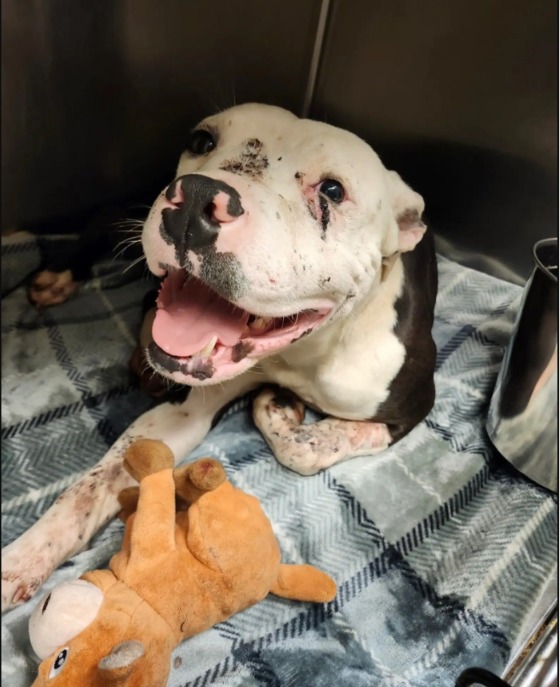
He wasn’t aggressive. He didn’t growl or snap or recoil. Even in pain, even surrounded by strangers, he stayed soft. He leaned into hands that offered comfort. He watched faces closely, as if memorizing kindness in case it disappeared again.
During surgery, while bullets were removed and wounds were cleaned, one caregiver stayed by his side. When he woke up, sore and confused, he wasn’t alone. A hand rested on his head. A voice stayed calm. Fear didn’t win that moment.
Healing began slowly. Day by day. Breath by breath.
Four days later, something extraordinary happened.
The officers who had found Wallace came back.
The second he saw them, his entire body changed. His tail started wagging before his brain could catch up. His eyes softened. His legs wobbled—not from weakness, but from joy. He remembered them.
And then he kissed them.
Again. And again. And again.
It wasn’t one polite lick. It was an avalanche of gratitude. A flood of kisses that felt endless, urgent, and deeply intentional—like he was trying to say everything he couldn’t put into words.
Thank you for seeing me.
Thank you for stopping.
Thank you for not leaving me there.
The room fell quiet except for laughter and the sound of a dog’s heart pouring itself out.
Wallace didn’t just survive violence. He chose love afterward.
As his body continued to heal, his spirit did something even more remarkable—it stayed open. He greeted caregivers with gentle nudges. He leaned into people instead of away from them. He trusted again, despite every reason not to.
And then, less than two weeks after the worst night of his life, his future walked through the door.
A couple came to meet him. They saw the scars. They knew his story. They didn’t hesitate.
Wallace climbed straight into their laps, as if he’d been waiting for them all along. The same kisses. The same joy. The same certainty.
This time, he wasn’t saying thank you.
He was saying, I’m ready.
Ready for mornings that don’t hurt.
Ready for hands that never let go.
Ready for a life that doesn’t end in the street.
Wallace’s story isn’t about what was done to him. It’s about what he did next.
He forgave.
He trusted.
He loved without holding anything back.
Some dogs survive by hardening themselves. Wallace survived by staying soft.
And in a world that often feels heavy, his story leaves us with something lighter—and far more powerful than anger or fear.
It leaves us with proof.
That even after the unthinkable, love can still be the loudest thing in the room.
Pit bulls are so amazing. People often just don’t know how great they can be. I picked up and rescued pitties for years, am in an area where people dump dogs, Never had a bad one they all were so grateful for what I gave to them. Shelter, love, care, food. Had several that should not have liked humans , but they all did.
I’m so happy for Wallace that he came through it and still was able to forgive and forget and was grateful for everyone that help to save him. That he remembered the officers who stopped and got him the help he needed. That’s what I wish every person would do for strays or injured pets. God Bless those that brought him through it and still had love enough for all! ❤️🙏🏻❤️