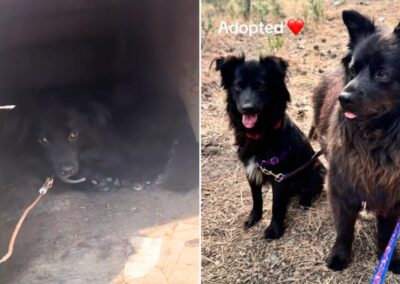
They say a picture is worth a thousand words — and in the case of this tiny white rescue pup, one glance at that trembling neck crane around a doorway tells the heartbreaking story louder than any headline ever could.
Recently rescued, the dog — a mixed-breed little furball — was taken to the groomer for some much-needed pampering and care.
But the moment he was placed on the grooming table, something inside him shifted.
His new human wasn’t beside him; instead, he was alone, surrounded by unfamiliar sounds, smells, and faces.
So he did what rescue dogs often do when insecurity hits: he looked for reassurance.
He stretched his neck, craned his body, and peeked around the doorway — as if checking: “Are you still there? Will you come back?”

For anyone who’s adopted a shelter dog, this scene will hit hard.
There’s an extra layer of awareness, a deep-seated memory of abandonment that doesn’t just disappear overnight.
Rescue pups carry the weight of their past — and sometimes, one moment apart from their humans is enough to stir it all back up.
When the video of this trembling white pup went online, people couldn’t help but respond — many wiping tears, many sharing personal stories.
Comments ranged from “That poor baby” to “They deserve a world full of love.”
Sadly, too many dogs end up in shelters because life circumstances change, not because they did anything wrong.
Housing issues, financial strain, even unpredictable health problems — these are just some of the harsh realities that can force families to surrender pets.
According to shelter data in the U.S., millions of dogs are surrendered annually; many never make it out.
Still, the plight of this little white dog ended differently. He isn’t looking over his shoulder anymore — because he found a family that cares.
With time, patience, and love, many rescue dogs begin to understand they’re safe. That the leash, the home, the new human — these aren’t temporary. They’re forever.
But here’s the thing: love doesn’t erase trauma overnight. For rescue animals especially, safety must be rebuilt, trust must be earned.
Experts helping newly adopted dogs often point to the “3-3-3 rule”: roughly three days to decompress, three weeks to adjust to routine, three months to truly feel at home.
That white pup? He’s just starting that journey.
Maybe the first clip — neck stretched, eyes wide, heart full of uncertainty — felt too vulnerable.
But it’s also full of hope, because it shows he still believes in second chances.
For every heartbroken admirer who saw that video and felt something, remember this: love isn’t just about adoption.
It’s about patience. Consistency. Quiet reassurance. A gentle hand. Extra cuddles.
Knowing that sometimes what a rescue dog needs most isn’t just a forever home — but a forever promise: You’re safe now.
I’m not going anywhere.
Rescue dogs don’t just learn to trust again — they learn what it feels like to be loved.
And sometimes, all it takes is one new human willing to wait a little longer.