When Marlee — a young puppy, likely a Staffordshire-type terrier — was rescued off the streets and placed into foster care, the fear in her little body was written all over her.
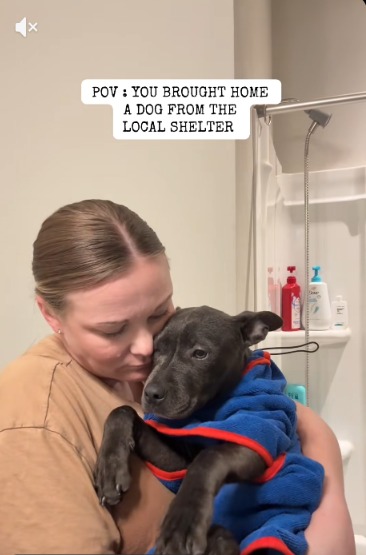
A video showing her trembling uncontrollably as she was held by her foster mom — known online as Jess from Alabama — quickly went viral, touching millions and shining a harsh light on what rescuing a traumatized dog can really mean.
Wrapped in a towel robe, Marlee’s trembling wasn’t subtle. It was full-body, deep-rooted, a reaction more to fear and uncertainty than cold.
As Jess held her close, gently rocking and speaking softly, it was clear this was no ordinary shelter surrender — this was a soul begging for security and healing.
In the video’s caption, Jess made clear why she took Marlee in: she simply “wasn’t going to leave her” behind in the shelter.
She promised to love the terrified pup for as long as it took, until a forever family was found.
Marlee’s situation is, sadly, not unique. Dogs — especially those labeled “pit-type” — often face steep odds in shelters.
Visual breed identification is notoriously unreliable, yet many shelters and potential adopters base decisions on it.
Combine that with trauma and fear, and you have a dog that might shake, cower, or struggle to trust — often resulting in long shelter stays or worse.
But what rescue and foster care demonstrate — especially in cases like Marlee’s — is that with patience, empathy, and time, many of these fearful dogs can begin to heal.
Studies show that foster placement consistently improves live-release and adoption rates, reduces euthanasia, and gives dogs a chance to decompress and rebuild trust.
Still, fostering a traumatized puppy demands more than shelter walls and a bed.
It requires an environment full of calm, predictability, gentle handling — and lots of patience.
For Marlee, that meant being wrapped in soft towels, held gently, and allowed to tremble until she felt safe enough to relax.
It meant letting her experience kindness for the first time in a long time — perhaps ever.
For many viewers, that vulnerability hit hard.
Comments on social media ranged from “That breaks my heart” to “Why is the world so cruel to such innocent creatures?” — reflecting a collective sorrow and empathy so many people felt watching Marlee try to calm herself.
What’s especially heartening: many people pleaded with Jess to adopt Marlee permanently — a “foster fail,” in online parlance, but really a success: someone recognizing that this pup, so fragile and afraid, deserves a real home.
Marlee’s story isn’t just sad.
It’s a testament to resilience — and to what can happen when someone stops seeing fear, and starts seeing potential.
The shaking may not disappear overnight. Recovery may take weeks or months.
But the moment she felt warmth, heard a soothing voice, and was held with patience — that was the first step toward healing.
It’s also a harsh reminder about shelter life’s realities: so many animals arrive broken, scared, and desperate for kindness.
Their pasts may be unknown — maybe abused, abandoned, or left to fend for themselves. What they need most isn’t just food or a bed.
They need a human willing to sit through the trembling, offer a towel, a gentle voice, and let them know: “You’re safe now.”
For anyone considering adoption or fostering, Marlee’s story highlights a powerful truth: with compassion and commitment, rescue dogs often give back far more than we ask.
They return trust, affection, unconditional loyalty — and sometimes, a chance to believe again.
Marlee is still young. Her future — while uncertain — now looks infinitely brighter than the street she came from.
And thanks to one person willing to hold her, love her, and wait for her to heal, she now has a shot at the life she always deserved.