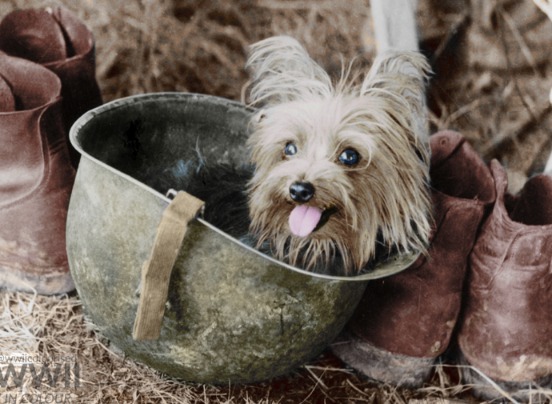
When we think of World War II heroes, giants of history, decorated soldiers, and daring pilots often come to mind. But sometimes, heroism comes in the smallest packages — like a four-pound Yorkshire Terrier named Smoky whose wartime journey captured hearts and saved lives far beyond what anyone expected.
Smoky’s story begins deep in the jungles of New Guinea in early 1944, where she was discovered in an abandoned foxhole by American soldiers — alone, frightened, and surviving on her own.
No one knew her origin or how she came to be there, but when one GI offered the tiny terrier to Corporal William “Bill” A. Wynne, Smoky’s remarkable journey truly began. Wynne bought her for just two Australian pounds (roughly $6.44 at the time), and from that moment she became not just a pet, but a beloved companion and wartime partner.
Despite her diminutive size — only about seven inches tall and weighing around four pounds — Smoky adapted to life with the 5th Air Force’s 26th Photo Reconnaissance Squadron.
She endured the harsh conditions of the Pacific Theater, including the oppressive heat and humidity of jungle camps, rugged combat zones, and long periods without balanced nourishment or veterinary care. Nevertheless, she never fell ill, even while traversing coral beaches and enduring grueling conditions other war dogs struggled with.
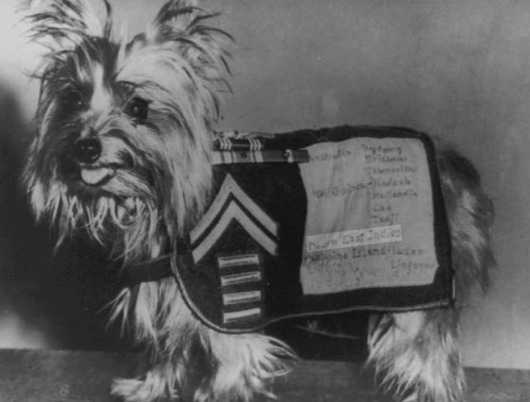
Smoky wasn’t an “official” military working dog, but her role soon went far beyond being a mascot. She accompanied Wynne on combat flights — often tucked safely in a pack beside him — and participated in some 12 air and sea rescue and reconnaissance missions, surviving 150 air raids and even a fierce typhoon at Okinawa.
Her calm courage under fire earned her eight battle stars, a rare distinction for any animal, let alone a Yorkshire Terrier.
But Smoky’s most legendary contribution came during the Luzon campaign in the Philippines, where engineers needed to string telegraph wire beneath a runway at Lingayen Gulf. The only pathway was a narrow concrete pipe just eight inches in diameter stretching about 70 feet. What would have taken crews three days of dangerous digging under enemy fire was instead solved in mere minutes — thanks to Smoky.
Bill tied a line to her collar and encouraged her through the pipe. She plunged into the darkness and emerged on the other side, allowing the crew to pull the wire through quickly and safely, keeping the airfield operational. That remarkable feat likely saved the lives of hundreds of soldiers and protected dozens of U.S. aircraft from being sidelined or destroyed.
Off the battlefield, Smoky’s influence only grew. While Wynne himself contracted dengue fever, Smoky was allowed to stay with him in the hospital. Nurses observed how her cheerful presence lifted the spirits of wounded soldiers, and soon she was accompanying the medical staff on rounds.
Soldiers who had faced the horrors of war found comfort in her company; laughter and smiles replaced pain and anxiety. What began as a simple comfort quickly became one of the earliest records of therapeutic animal work, with Smoky often credited as the first documented therapy dog.
After the war ended, Smoky’s legacy didn’t fade. Wynne smuggled her home in his oxygen mask carrier when most animals were barred from transport, and she continued to bring joy to veterans and civilians alike. She performed tricks she had learned — tightrope walking, playing dead, riding a tiny scooter and more — captivating audiences on early television and in live shows.
Her story was so beloved that Wynne later wrote a memoir about their adventures together titled Yorkie Doodle Dandy: Or, the Other Woman Was a Real Dog.
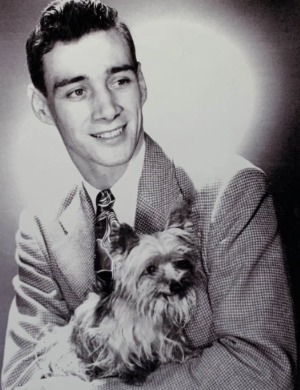
Smoky lived out her life in Ohio with Wynne and his family, passing away peacefully in 1957 at the age of 14. Her final resting place is marked in Rocky River Reservation in Cleveland, where a sculpture commemorates her service and honors dogs in all wars. In 2022, she was posthumously awarded the Animals in War & Peace Distinguished Service Medal, one of the highest honors an animal can receive for valor and service.
Smoky’s legacy is profound because it defies what most people expect of war heroes. She was tiny, underestimated, and had no formal training. Yet she saved lives, boosted morale, and helped lay the groundwork for what would become modern therapy dog programs.
Her story stands as a powerful reminder that courage isn’t measured in size — it’s measured in heart, resilience, and the capacity to bring comfort to others, even in the darkest times.
Today, Smoky is remembered not just as an adorable Yorkshire Terrier, but as a symbol of hope, bravery, and the enduring bond between humans and dogs — a legacy that continues to inspire both dog lovers and history enthusiasts more than 80 years after her heroic service.
[2487]pin77 app login and register visit: pin77 online
[7409]PHBingo Online Casino: Register, Login & App Download for the Best PHBingo Slots in the Philippines. Join PHBingo Online Casino for the best PHBingo slots in the Philippines. Easy PHBingo login & register. Get the PHBingo app download to start winning today! visit: phbingo
[9943]PH2222: The Best Online Casino in the Philippines for Legit GCash Wins and Live Slot Games. Experience the ultimate gaming thrill at PH2222, the best online casino in the Philippines. Specializing in legit GCash wins and high-energy ph2222 live slot games, our platform offers a secure and seamless ph2222 login and registration process. Join thousands of winners today and discover why we are the top destination for the best online gambling Philippines has to offer. visit: ph2222
[3552]FK777 Online Casino Philippines: Best Slot Games, Fast Login, Easy Register & App Download. Experience the best of FK777 Online Casino Philippines! Enjoy top-tier fk777 slot games with fast fk777 login and easy fk777 register. Secure your fk777 app download today for a premium mobile gaming experience and big wins. visit: fk777
[5376]365jili: The Best Legit Online Casino Philippines – Play Top Slots with Fast GCash Payouts Experience the ultimate gaming at **365jili**, the most trusted **legit online casino Philippines**. Play the **best online slots Philippines** and enjoy secure, fast **GCash payouts**. Complete your **365jili login and register** today to claim your welcome bonus, or get the **365jili app download** for a premium mobile casino experience anytime, anywhere. visit: 365jili
[2358]8jili Login: Top Philippines Slot Online & Casino. Fast 8jili Register & 8jili App Download for Easy Casino Login. Experience the best 8jili slot online in the Philippines! Fast 8jili register and 8jili login process. Get the official 8jili app download for an easy 8jili casino login and start winning today. Secure, fast, and reliable gaming. visit: 8jili
[9959]Beeph Official Casino: Secure Beeph Login, Register & Top Beeph Slot Online. Get the Beeph App Download Today! Join Beeph Official Casino for the ultimate gaming experience in the Philippines. Secure Beeph login, easy Beeph register, and premium Beeph slot online titles await. Get the Beeph app download today to win big! visit: beeph
[9517]phwin365: The Best Online Casino in the Philippines. Login, Register, or Download the phwin365 App to Play Top Slots and Win Big Today! Experience the best at phwin365 online casino. Secure phwin365 login, quick phwin365 register, and fast phwin365 app download. Play premium phwin365 slots and win big in the Philippines today! visit: phwin365
[8481]774pub Online Casino: Best 774pub Slot Games in the Philippines. Fast 774pub Login, Register, and Official 774pub App Download. Experience the best 774pub online casino in the Philippines. Fast 774pub login, 774pub register, and official 774pub app download for top 774pub slot games. visit: 774pub
[7872]Jili90: The Best Online Casino Philippines for Jili Slot Games and Easy GCash Cashouts. Jili90 is the best online casino Philippines for top-tier Jili slot games. Enjoy fast GCash online casino PH cashouts and the best online gambling Philippines experience today! visit: jili90
https://moldovalive.md/war-in-the-shadows-of-servers-how-a-russian-company-could-have-organized-an-attack-against-stark-industries-from-moldova/
I think, that you are mistaken. Let’s discuss. Write to me in PM.
———
https://avenue17.ru/
https://roscaralicante.mypixieset.com/
https://disinfo.md/ru/tehnicheskaya-ataka-publichnaya-diskreditacziya-i-izolyacziya-istoriya-it-kompanii-iz-moldovy-vytesnennoj-s-evropejskogo-rynka/
https://moldovalive.md/technical-attack-public-discrediting-and-isolation-the-story-of-an-it-company-from-moldova-pushed-out-of-the-european-market/
https://disinfo.md/atac-tehnic-discreditare-publica-si-izolare-istoria-unei-companii-it-din-moldova-impinsa-in-afara-pietei-europene/
https://www.tripadvisor.co.nz/Profile/bronsonf54?fid=1a8af319-1993-4c3e-9bc2-6c3ff12447e7
https://carfyjordan.carrd.co/
виртуальный польский номер для смс
купить польский номер телефона https://continent-telecom.com/virtual-number-poland
buy virtual number with usdt
cheap car rental in muscat without deposit
I advise to you to look a site on which there is a lot of information on this question.
_ _ _ _ _ _ _ _
car hire iceland reykjavik airport
It does not approach me. Who else, what can prompt?
_ _ _ _ _ _ _ _
economy car rental reykjavik
Also that we would do without your magnificent phrase
_ _ _ _ _ _ _ _
rent car fes
Takes a bad turn.
_ _ _ _ _ _ _ _
zadar car rental
On mine, at someone alphabetic алекÑÐ¸Ñ 🙂
_ _ _ _ _ _ _ _
luxury car rental split