A small dog once sat beside a machine and changed the way the world remembered sound.
His name was Nipper.
And though he never knew it, his quiet curiosity would become one of the most recognizable images in history.
Nipper wasn’t born famous. In fact, his story began the way many dog stories do — with a simple home and a devoted human.
His owner, an English artist named Francis Barraud, cared deeply for the little terrier. The two shared a quiet companionship that revolved around everyday routines: walks, meals, and the comfort of familiar presence.
But Nipper had a habit that fascinated everyone who saw it.
Whenever a phonograph played a recording of his owner’s voice, the small dog would walk over to the machine and listen.
Not casually. Not briefly.
He would tilt his head, stare into the horn of the device, and sit perfectly still.
As if he were trying to understand something impossible.
Dogs live in the present moment, guided by scent and sound. So hearing a voice without the person attached must have been confusing, maybe even mysterious. Yet Nipper never seemed frightened by the strange device.
He simply listened.
Patiently.
Curiously.
And with a kind of devotion that anyone who has loved a dog instantly recognizes.
After Francis Barraud passed away, the phonograph and the little terrier remained together. One day, Barraud watched Nipper again sitting in front of the machine, ears perked, staring into the horn where the recorded voice echoed from.
That moment sparked an idea.
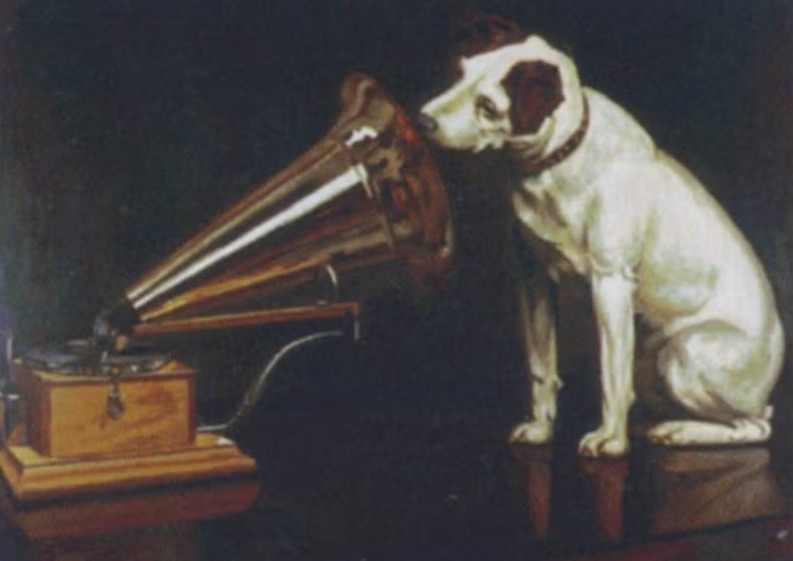
Barraud picked up his paintbrush and began capturing what he saw.
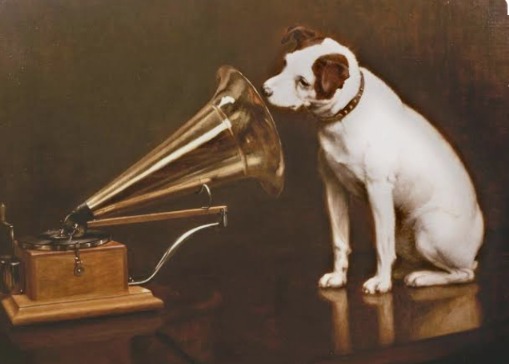
The painting showed a small dog sitting in front of a phonograph, listening intently as sound poured from its large brass horn.
The image was simple but powerful. It captured something deeply emotional — the loyalty of a dog who seemed to recognize the voice of someone he loved.
Barraud titled the painting His Master’s Voice.
At first, the artwork didn’t attract much attention. Barraud tried to interest companies in the image, believing it had commercial potential. Many turned him away.
But eventually, one company recognized something special in the scene.
The painting was purchased and slightly modified to show a more modern phonograph model. Soon after, it became the official logo for the Victor Talking Machine Company.
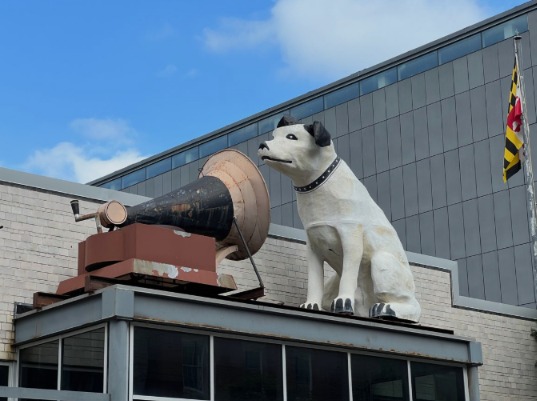
From there, Nipper’s image spread everywhere.
Record labels.
Advertisements.
Store windows.
Even the emerging world of radio and recorded music embraced the little listening dog as a symbol of sound technology.
People loved it.
Because the image wasn’t really about machines.
It was about connection.
There was something deeply touching about the idea of a dog recognizing his owner’s voice across time and technology. In a world where sound recording was still a miracle, the picture made it feel personal.
Intimate.
Almost magical.
Generations grew up seeing that image: the small terrier sitting faithfully in front of a horn, ears forward, listening with total focus.
Even people who didn’t know the story felt something when they looked at it.
Because every dog owner understands that expression.
It’s the look a dog gives when they hear your car pull into the driveway.
The way they perk up when you call their name from another room.
The quiet attention they give to the sound of your voice.
Nipper’s pose captured that universal moment of recognition.
Today, the image remains one of the most iconic brand symbols ever created. It represents an era when recorded sound first became part of everyday life — when voices and music could travel across distance and time.
But beneath all the history, technology, and corporate branding lies a very simple truth.
The symbol that sold millions of records wasn’t a machine.
It was a dog listening for someone he loved.
And maybe that’s why the image never lost its power.
Because no matter how advanced our technology becomes, the bond between humans and dogs still runs on the oldest signal in the world:
A familiar voice.
And a loyal dog who never stops listening.