He wasn’t bred for battle.
He didn’t wear rank when he first arrived.
He didn’t belong to anyone.
He was just a small stray dog wandering around a military training camp — unnoticed by most, overlooked by many.
Until one soldier stopped.
That soldier was J. Robert Conroy, a young private preparing to ship out for World War I. And the little brindle pup who wandered into camp that day didn’t look like much. Stocky. Short-tailed. Curious. But there was something steady in his eyes. Something alert.
Conroy fed him. Spoke softly to him. And just like that, the stray had chosen his person.
They named him Stubby — for his cropped tail and compact build. No one expected him to make history. He wasn’t a military dog. He had no formal training. He wasn’t even supposed to board the ship when Conroy’s unit deployed overseas.
But Stubby had already decided.
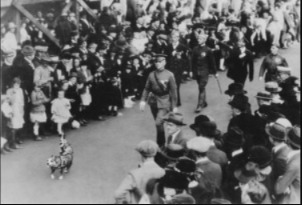
When it was time to leave, Conroy hid him aboard the transport ship. By the time the pup was discovered, it was too late to send him back. And when Stubby lifted his paw in a salute — something he had learned by mimicking the soldiers — even the commanding officers couldn’t help but smile.
He stayed.
And then came the trenches.
The mud was thick. The air was heavy with smoke and fear. Explosions shook the earth. Men slept in wet uniforms, boots never fully dry. It was chaos and exhaustion wrapped together in endless gray.
And in the middle of it all was a small dog with sharp ears and sharper instincts.
Stubby quickly proved he wasn’t just a mascot.
He could hear incoming artillery before the soldiers could. The second his ears twitched and he bolted toward cover, the men followed. Again and again, his warnings saved lives. He learned to detect the scent of gas attacks before the fumes spread fully through the trenches, giving the soldiers precious seconds to put on their masks.
Precious seconds meant survival.
He stayed beside wounded soldiers, refusing to leave until medics arrived. He comforted them in the only way he knew how — by pressing close, by offering warmth, by reminding them they weren’t alone.
In a place designed to break spirits, Stubby became something steady.
Something good.
One day, he did something even more extraordinary.
When a German soldier infiltrated the Allied trenches, Stubby didn’t hesitate. He latched onto the man’s uniform and held on, barking until American troops arrived. The enemy soldier was captured — and Stubby was credited with helping secure him.
For that act, he was promoted.
Yes — promoted.
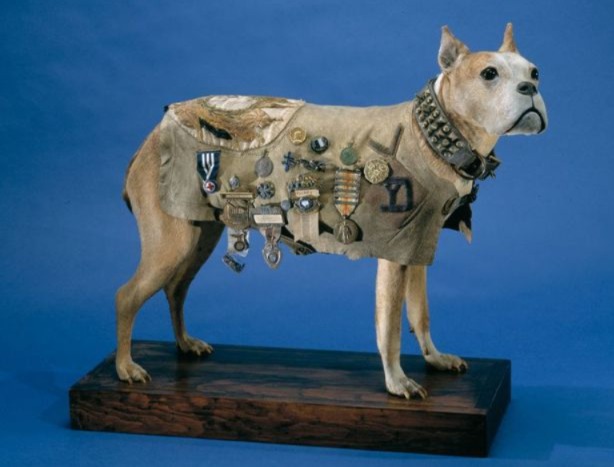
Stubby became Sergeant Stubby, the only dog to be officially given rank during the war.
He served in 17 battles alongside his unit. Seventeen.
Through gunfire. Through mustard gas. Through the relentless grind of war.
And he survived.
When the war ended and the soldiers returned home, Stubby came back with them — not as a stray, but as a decorated hero. He marched in parades. Met dignitaries. Even encountered three U.S. presidents over the years.
One of them was Woodrow Wilson.
Crowds gathered just to see him.
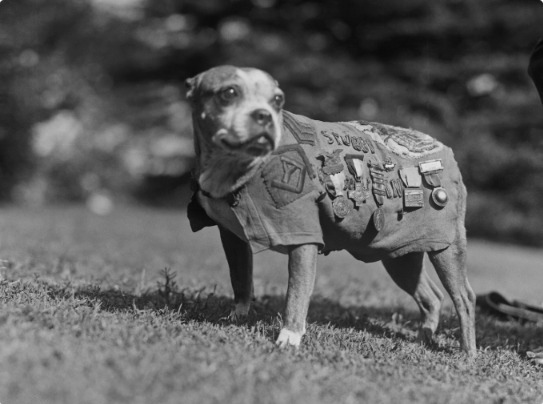
But if you look at the photographs, what stands out isn’t the medals pinned to his small chest.
It’s his expression.
Alert. Calm. Loyal.
Stubby didn’t know he was famous.
He knew he had stayed with his people.
That’s the quiet truth beneath the legend. He wasn’t driven by glory or recognition. He didn’t understand strategy or politics. He understood belonging.
He understood loyalty.
He followed his human into a war zone because that’s what dogs do. They stay. They protect. They love without calculation.
Sergeant Stubby passed away years later, but his story never faded. His preserved form now rests at the National Museum of American History, where visitors still stop to read about the small dog who stood in trenches beside soldiers twice his size.
A stray who wasn’t supposed to be there.
A dog who didn’t carry a weapon — only courage.
And maybe that’s why his story still matters.
Because in the darkest places humans create, sometimes it’s a dog who reminds us what loyalty looks like.
It’s not loud.
It doesn’t need rank.
It just stays.
Through fear. Through fire. Through everything.
And that kind of devotion?
That’s a hero.