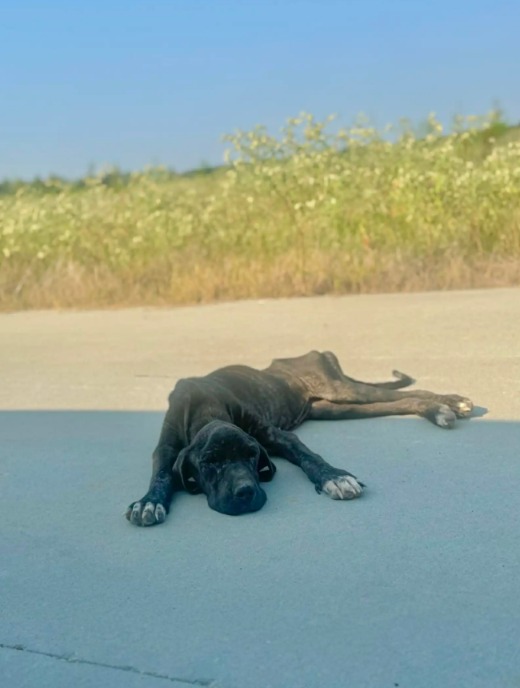
Some rescue moments are unforgettable not because they’re dramatic, but because they touch you deep in the heart. This is one of those stories — about a dog found lying by the side of a road, too weak to stand, yet still mustering the strength to wag his tail for someone who had stopped to help.
On what started as an ordinary day, concerned locals noticed a dog lying motionless near a roadside shoulder, visibly struggling and too weak to walk. The animal looked exhausted, breathing shallowly, and clearly in a desperate situation.
Many dogs in distress might hide, cower, or refuse to engage, but this one did something remarkable: he wagged his tail just a little bit when his rescuer approached — as if trying to say, “I’m here. I’m scared. But I’m not giving up.” That tiny wag was a spark of life in an otherwise fragile body.
When the rescuer, a volunteer known for helping injured animals, first saw the dog, it was clear that something was terribly wrong. His body was thin and tired; his legs could barely support him.
He didn’t run toward help, didn’t bark loudly, and didn’t show signs of fear. All he did was look up with tired eyes and give that small, fading wag. It was heartbreaking — a gesture of trust, even in weakness.
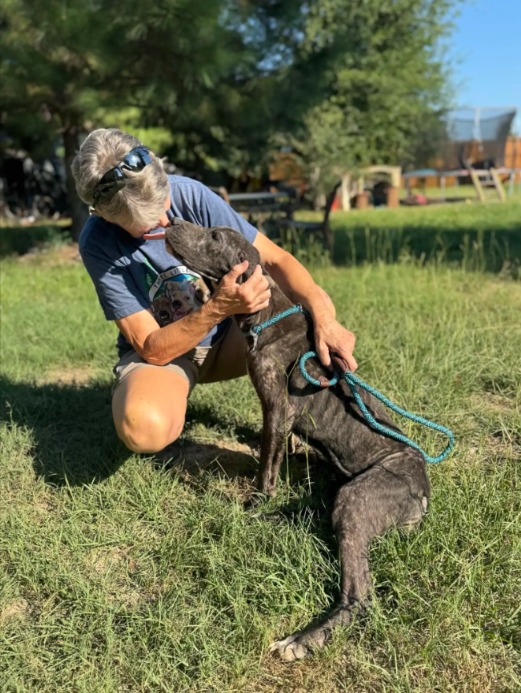
Getting close took patience. The rescuer sat quietly, speaking in soothing tones, letting the dog know that help was coming, not harm. Slowly, the dog responded — inching his body just a little closer, and yes, letting that tail thump again, small but unmistakable.
In that moment, it wasn’t just a reflex. It was a sign that despite his pain and exhaustion, the dog still wanted kindness, still valued connection, still hoped for gentle care.
With a careful approach, the rescuer managed to gently lift the dog and bring him to safety. At the shelter, the first priority was medical assessment.
The vets discovered that his weakness came not from a single injury but from prolonged suffering — malnutrition, exhaustion, and likely having been alone without food or water for far too long. Yet through it all, that dog never completely lost his faith in people.
Once inside, the transformation began. The medical team stabilized him with fluids, warm blankets, and food given in small, monitored amounts to avoid shock.
He was too weak to walk far at first — only able to shuffle short distances — but every day, he found a little more energy. The caregivers noticed that even in his fragile state, he continued to wag his tail whenever someone entered his space or offered a gentle pet.

That wag, small at first but growing stronger, became symbolic. It wasn’t just a tail movement; it was the language of a dog who had endured so much yet never gave up on goodness. It told everyone who saw it that he still cared, still felt joy, still wanted connection despite the pain he must have lived with.
Rescue teams and shelter staff often talk about the resilience of dogs — how even traumatized animals can relearn trust — but this dog’s story captured that idea in the most powerful way possible.
His tail wasn’t just wagging; it was speaking — saying, “I trust you. I’m grateful. I still believe in love.”
In the days that followed, the dog’s strength continued to grow. With proper care, good nutrition, and a calm, loving environment, he started walking steadier, gaining weight, and showing personality.
He offered soft head nudges, gentle eye contact, and, of course, that wag, which became full-bodied instead of tentative.
People who witnessed his turnaround were moved not just by the physical improvement, but by the emotional message behind every small wag — that even when life is hardest, hope can still wag its way into the world.
And for a dog who once could barely lift his legs, that’s the kind of courage we all remember.