They say dogs never forget how to love — but sometimes, love takes time.
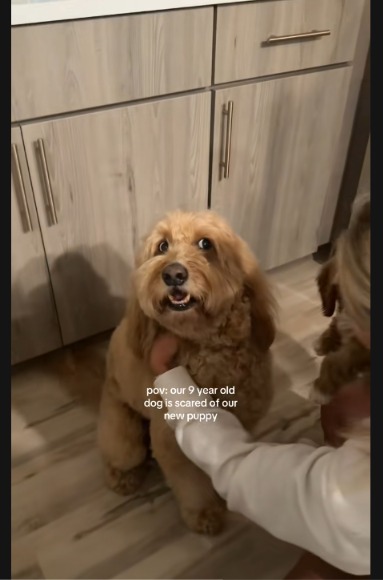
Meet a 9-year-old dog whose first encounter with a new puppy went viral, not because of sweetness or snuggles, but because of pure, unfiltered anxiety.
In a video shared by owner @annataylorrrrrr, this senior dog recoiled, then retreated, clearly overwhelmed the moment the tiny newcomer pressed forward for a friendly greeting.
The clip begins innocent enough: the puppy is cradled in arms, gently moved close for a sweet forehead-kiss.
But instead of leaning in, the older dog jerks back, eyes wide, ears turned — like someone waking from a bad dream. He seems stunned, confused.
In the caption, the owner offered the truth: “He loves her — he just gets social anxiety.”
People everywhere saw themselves in that reaction. Comments flooded in: “That’s how I feel at parties,” one wrote.
Another joked about demanding extra treats for “the traumatized senior.”
Others confessed their dogs were the same way — loyal, loving, but terrified at the idea of change.
The reaction makes sense — because according to canine-behaviour experts, this kind of anxiety is more common than many realize.
When you introduce a puppy to a dog who’s spent years as “the only one,” the energy shift can feel seismic.
Puppies are unpredictable — bounding, barking, smelling, exploring — and what’s fun for them might be overwhelming for a seasoned soul who prefers quiet, calm, and routine.
For this senior dog, the world collapsed for a moment: a new smell, a new sound, a new expectation.
It wasn’t fear of the puppy — not exactly.
It was fear of chaos. Fear of change. Fear of losing the peaceful routine he’s known all his life.
But this story isn’t just about fear. It’s about patience, empathy, and second chances.
Experts recommend gentle introductions: swap their bedding or toys first so they get used to each other’s scent.
Meetings should be slow, calm, and supervised.
Food, toys, and resting spaces? Keep them separate at first. Give the older dog space. Let him approach on his own time.
Because when you rush, you risk more than a startled yelp — you risk trust. And trust, once shaken, takes much longer to rebuild.
What this video teaches us is simple: love isn’t always instant. Sometimes it’s slow. Sometimes it’s awkward. Sometimes it’s tense.
But often, with a calm hand and a little patience, trust grows. Maybe the puppy becomes a friend someday. Maybe the older dog learns new rhythms of joy.
Or maybe — just maybe — the very act of trying matters more than the outcome.
For every person scrolling through the thousands of laughing, “aww”-filled comments: remember the dog whose tail didn’t wag. The dog who pulled away.
The dog who needed time, understanding, and space.
Because behind that reaction was a heart still learning, still trying, still wanting to belong — even when everything felt too loud, too fast, too much.
So if you have — or plan to get — a second dog: go slow. Let the first one lead. Respect their pace.
Give them the dignity to say “not yet.”
Because sometimes, the best way to show love isn’t with excitement.
It’s with patience.