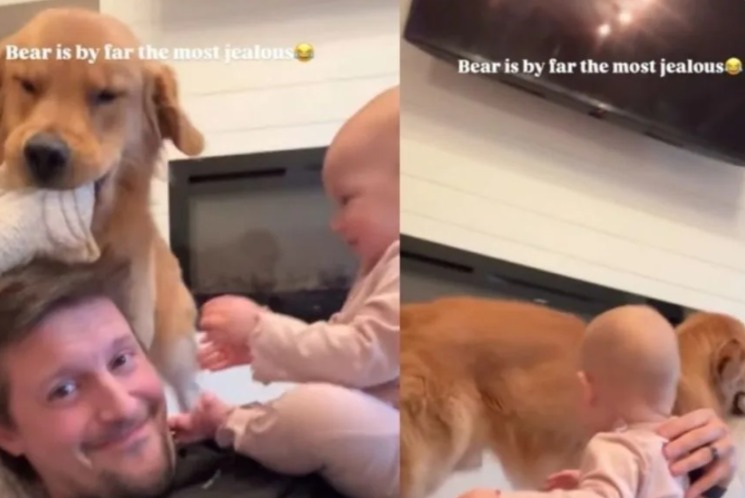
Family life hit a new chapter in this household — a newborn arrived, arms filled with love and giggles, and everyone gathered around to fuss and coo.
But one member of the family wasn’t too thrilled about the change: a golden retriever named Bear.
For Bear, things were pretty perfect. His routine was steady. His humans were present.
He had plenty of pats, belly rubs, laps to sit on.
Then the baby came. Suddenly, arms were full, attention divided, and Bear sensed the shift.
In a viral clip, the camera pans quietly: dad is cradling the baby, lovingly cooing and rocking.
Bear sits nearby. His posture is relaxed, but his eyes tell a story. Straight ahead, dad holds the baby.
But Bear’s gaze flicks not to the infant — he looks out, looks away, maybe looking for someone to notice him.
He doesn’t bark.
No dramatic protest. Just a slow blink, a subtle head tilt, an exhale that says: Wait… what about me?
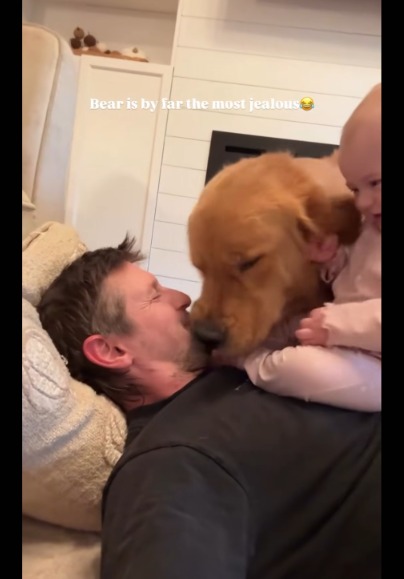
Then he moves. Not too far. Just far enough to stay in view of the baby and mom. He lies down. He watches.
His face softens, but the message is clear. He’s still part of the family — but he’s also gently asking for acknowledgment.
This wasn’t spite. It wasn’t anger. It was emotion. Bear felt the shift. And he wasn’t sure what it meant for him.
For so many dogs, routine isn’t just convenience — it’s their anchor. When everything changes, they adjust in their own quiet way.
What’s beautiful in this story is how relatable it is. For us humans, it’s easy to dismiss a dog’s side‑eye as just a joke.
But in that moment, Bear was processing. He didn’t walk off. He didn’t sulk. He remained present. Loyal. Waiting.
The family filmed the clip and shared it online. Commenters melted.
“The way he’s just watching… I’m dying.”
“Yep, that’s my dog when I hold my phone too long.”
“If he starts sighing, I’m going to laugh and cry at the same time.”
And the truth is, dogs like Bear teach us something: attention isn’t just given.
Sometimes it’s asked for. Sometimes it’s needed.
For our pets, changes in the household are more than background noise. They’re real. They matter.
Bear’s story also opens a door to how families with pets and new babies can adapt. It’s not just about baby proofing and feeding schedules.
It’s about balance. It’s about reminding the golden retriever, the cat, the dog — you still belong here.
Because when a new life arrives, it’s easy for others to slip into the edges.
For Bear’s family, the journey didn’t end with the viral clip. They’ve changed how they include him in baby time.
A pat here, a cuddle there.
A gentle “look at Bear, he’s asking for high‑five” during a feeding.
They’re making space for everyone — especially the dog who’s been part of their world long before the lullabies started.
At home, Bear has found his groove. He still watches the baby. He still keeps his place.
But now he gets more moments where he’s the centre too.
A wag. A belly rub. The same love he always had, just adjusted to the rhythm of new life.
And in the quiet evening, when baby is asleep and dad reconvenes with Bear on the couch, you can see the relief in the golden’s eyes.
They’re back to being his people. Side‑eye turned into soft gaze turned into contented sigh.
Because love in a family grows — and so does the golden retriever’s role within it.
Bear isn’t jealous forever. He’s just reminding us all: Don’t forget me.
Related posts:
 Ten Feet Down, Surrounded by Rushing Water—But Rescue Climbed the Ladder
 Twice Abandoned — This Rescue Dog’s Reaction to Moving Should Break Your Heart (and Fix It)
 Senior Great Pyrenees Lets Toddler Spoon-Feed Him—and the Internet Can’t Handle It
 Ethan’s Incredible Journey: The Rescue Dog Who Became a National Hero