Waiting rooms aren’t fun for anyone.
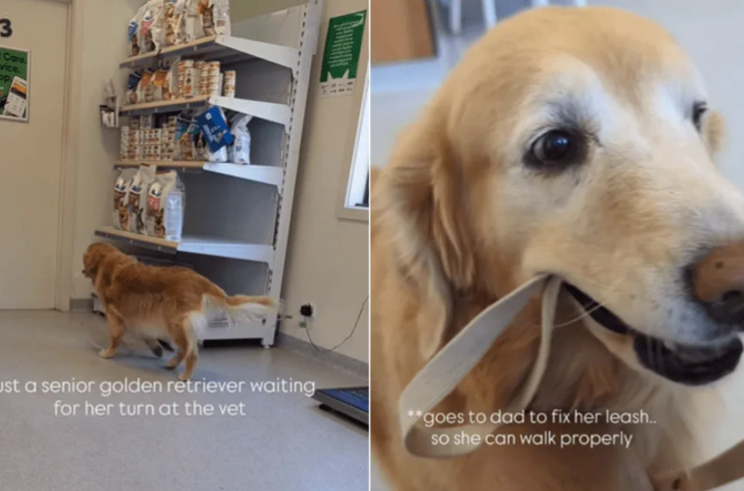
Not for people. Not for kids. And definitely not for a senior Golden Retriever with energy still tucked inside her gentle old bones.
So when this sweet older dog found herself at the vet, she didn’t do what most dogs do—sit quietly and patiently wait.
She decided to handle things her own way.
Instead of staying still, she picked up her leash… and took herself for a walk.
Yes. Really.
It started in the waiting area, where the senior Golden stood with a calm but determined expression. There was no panic, no confusion—just a quiet sense that she had her own agenda for the moment.
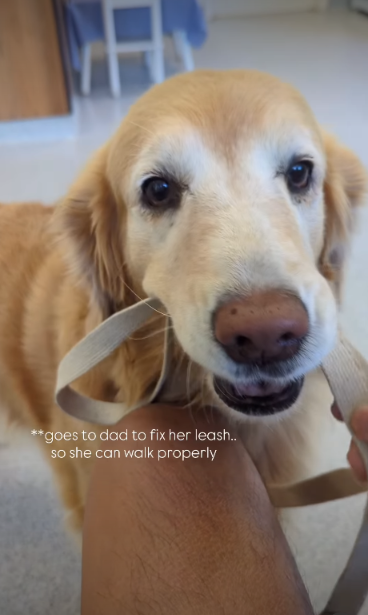
Her leash was in her mouth, gently held like she had done this a hundred times before.
Not because she was trying to escape, but because she seemed to understand something simple: waiting doesn’t have to mean doing nothing.
So she moved.
Slowly at first, padding across the floor with the steady confidence only older dogs seem to have. There’s something special about senior dogs—they don’t rush anymore.
They move with purpose. Every step feels considered, like they’ve learned that life doesn’t need to be hurried to be enjoyed.
She wandered through the space as if she was on a mission.
A little patrol. A gentle inspection of the world around her.
Her leash stayed in her mouth the whole time, giving her the look of a dog completely in charge of her own experience. And in a way, she was.
She wasn’t confused.
She wasn’t lost.
She was simply making the best of where she was.
At one point, she paused—just briefly—before continuing her self-guided walk through the room. No stress. No resistance. Just calm exploration.
For the people watching her, it was impossible not to smile.
Because this wasn’t rebellion.
It was personality.
It was a dog saying, in her own quiet way, “I’ve got this.”
Even in a vet clinic—often a place filled with uncertainty and nerves—she brought something different into the room. A kind of lightness.
A reminder that age doesn’t erase curiosity or independence.
Senior dogs often surprise people like that.
They slow down physically, yes. But emotionally? They often become more themselves than ever. More expressive. More deliberate.
More aware of what makes them comfortable—and what doesn’t.
This Golden Retriever was no exception.
She didn’t need to be led everywhere.
She chose how she moved through the moment.
And that choice made her all the more endearing.
Eventually, she made her way back toward her people, still holding her leash proudly. As if completing a small but very important task on her own schedule.
No drama.
No fuss.
Just a simple, sweet return.
These are the kinds of moments that stick with people—not because they’re extraordinary in scale, but because they reveal something deeply familiar.
Dogs don’t just follow us through life.
They develop their own ways of navigating it.
Even in waiting rooms. Even in unfamiliar places. Even in the later chapters of their lives.
Especially then.
Because senior dogs don’t lose their personality—they refine it.
They strip away the excess and keep what matters most: comfort, familiarity, and little routines that make them feel in control of their world.
And sometimes, that looks like a Golden Retriever deciding that waiting… is better done while taking herself for a walk.