At first, she didn’t even look like a dog.
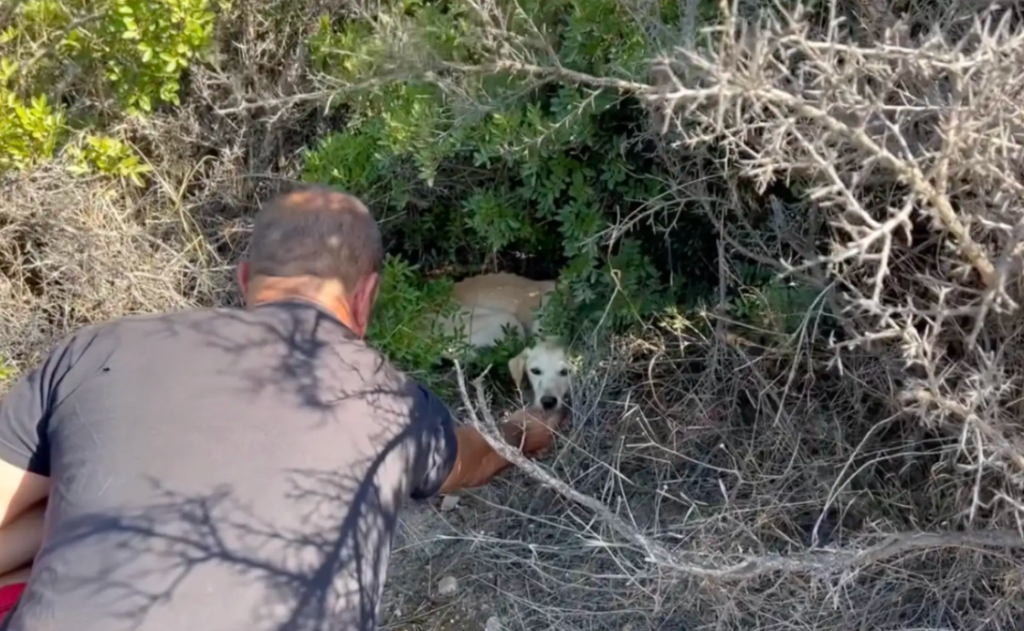
Just a shape beneath the bushes.
Still. Silent. Almost blending into the dirt like she had been there long enough to disappear into it.
That’s how the rescuer found her.
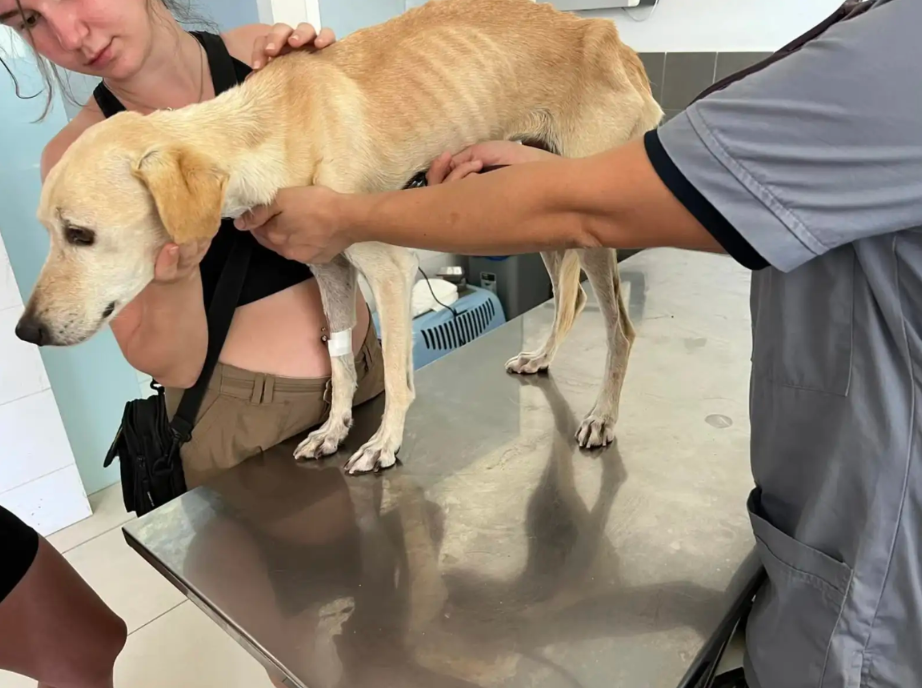
Hidden, fragile, and so thin her body looked more like a frame than something alive. Her ribs pushed sharply against her skin. Her limbs looked too weak to carry her weight. From a distance, it would have been easy to assume there was nothing left to save.
But there was.
Barely—but there was.
Moments like this don’t come with certainty. When rescuers approach animals in this condition, they don’t know what they’ll find. Fear, aggression, or something even harder to face—complete exhaustion beyond recovery.
But this dog didn’t react with fear.
She barely reacted at all.
She just stayed there.
Watching.
Waiting.
As if she had already accepted whatever came next.
That quiet stillness is often the most heartbreaking part. It isn’t resistance. It isn’t survival mode. It’s what happens when an animal has been pushed so far past struggle that they no longer have the energy to fight or flee.
And yet… something remained.
Because when the rescuer came closer, she didn’t turn away.
She didn’t run.
She allowed it.
Allowed the presence. Allowed the help. Allowed the possibility that something different might finally happen.
And that’s where everything began to change.
Rescue, in situations like this, isn’t dramatic. It’s careful. Slow. Intentional. Every movement matters. Every touch has to be gentle enough not to break trust that barely exists.
She was lifted.
Not with resistance—but with the kind of stillness that feels heavier than movement. A body that had been surviving alone for too long, now finally being carried by someone else.
From there, the process shifted from discovery to recovery.
Food. Small amounts at first.
Water.
Medical care.
And most importantly—time.
Because dogs in this condition don’t transform overnight. Their bodies need to rebuild. Their systems need to stabilize. And their minds… need to relearn what safety feels like.
At the beginning, she was still just what the rescuer first saw: bones under skin.
But slowly, almost imperceptibly, that started to change.
Her body began to fill out.
Not quickly—but steadily.
Each day adding something back that had been lost. Strength. Weight. Energy. Presence.
And then something even more noticeable began to happen.
Her expression changed.
At first, her eyes had that distant look—the kind that doesn’t quite focus, because there’s nothing in the world worth focusing on anymore.
But as the days passed, that distance softened.
Her gaze became clearer.
More aware.
More present.
It’s often said that recovery shows first in the eyes—and in her case, that was true.
Because behind the physical transformation, something deeper was returning.
Trust.
Curiosity.
A quiet willingness to engage with the world again.
As her body healed, her personality began to emerge.
And that’s when the most surprising part of her story became visible.
She was beautiful.
Not in the dramatic, instant way people expect. Not in the polished, perfect sense.
But in the way that only reveals itself after survival.
Her features softened. Her coat improved. Her posture changed. And suddenly, the dog who once looked invisible under bushes began to stand out in a completely different way.
The same dog.
Just seen clearly for the first time.
That contrast is what makes stories like this so powerful. Not just the “before and after”—but the realization that the beauty was always there.
It was just buried under neglect, hunger, and time.
And once those layers were removed, what remained wasn’t a different dog.
It was the dog she had always been.
Now visible.
Now alive in a way that could be recognized.
By the end of her recovery, she no longer resembled the fragile shape found hidden in the bushes. She moved with more confidence.
She carried herself differently. She responded to people with awareness instead of detachment.
She had returned.
Not just physically—but completely.
Stories like this resonate because they challenge the way people see animals at their lowest points.
It’s easy to look at a dog in that condition and see only damage. Only loss.
But recovery tells a different story.
It shows potential.
It shows resilience.
And sometimes, it reveals something even stronger:
That what looks broken… is often just waiting for the right moment to be seen again.
In the end, the rescuer didn’t just save a dog.
They uncovered her.
And what they found underneath everything she had been through… was something worth saving all along.