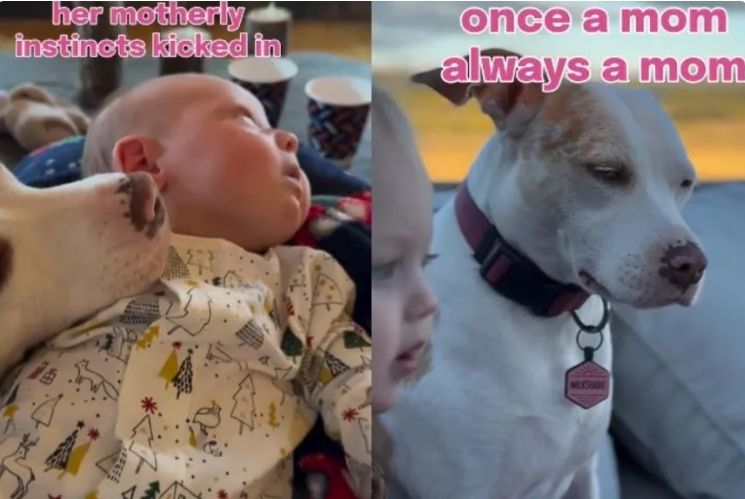
From the moment the baby entered the room, the rescue dog changed.
She moved more carefully.
More gently.
More protectively.
It was the kind of shift dog owners notice immediately — subtle, but unmistakable. A softness in the eyes. A slower approach. The quiet instinct to stay close.
And for one deaf rescue Pit Bull, that instinct would eventually lead to a discovery nobody saw coming.
The dog had already been through more than most animals ever should.
Rescued and living with hearing impairment, she was still learning how to navigate safety, trust, and communication in her new home.
But according to her owners, something happened when she met the family’s baby.
She seemed to recognize the role instantly.
A video shared online captured the early stages of their bond — the baby calm and curious, the dog staying close nearby, attentive despite being unable to hear.
Instead of uncertainty, there was immediate tenderness. The rescue dog carefully approached, sniffed the baby, and wagged her tail with visible excitement.
It didn’t feel random.
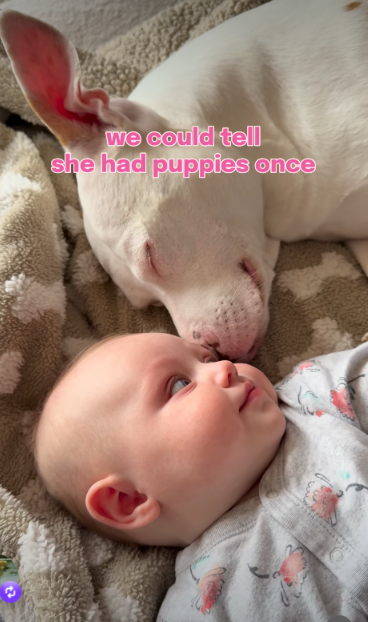
In fact, her owners began wondering if the dog may have once been a mother herself.
The idea lingered in the background as they continued building trust with her.
Because she was deaf, communication relied heavily on touch, consistency, and visual signals.
The family even introduced hand signs associated with concepts like “family,” helping her connect gestures with belonging and routine.
And the dog responded beautifully.
She stayed near the baby often, calm and watchful, displaying the kind of nurturing behavior that made viewers emotional almost immediately.
But then the story took a completely unexpected turn.
At some point, the owners decided to run a DNA test. Initially, they simply hoped to learn more about her breed background and history.
Instead, they uncovered something deeply personal.
The rescue dog had a biological daughter.
A dog named Sagey, living with another family entirely.
Suddenly, the maternal behavior around the baby seemed to carry a different emotional weight.
The instincts people had noticed may not have been imagined at all.
So the families arranged a reunion.
And when the two dogs finally saw each other again, the reaction was immediate.
Excitement.
Recognition.
Movement that didn’t look hesitant or unfamiliar.
The dogs approached each other with the kind of energy that made it feel less like a first meeting and more like something remembered.
They ran together, interacted naturally, and settled into each other’s presence with surprising ease.
It’s impossible to know exactly what animals remember after separation.
Science still debates how dogs process long-term recognition and memory in emotional relationships.
But moments like this make people wonder anyway.
Because whatever the explanation, the connection felt real.
And perhaps the most moving part of the entire story is this:
The dog never needed hearing to understand love.
Not with the baby.
Not with her new family.
And maybe not even with her daughter.
She understood through presence.
Through scent.
Through closeness.
Through the quiet language animals seem to speak fluently without ever needing words.
Viewers online were deeply affected by the story, many pointing out how extraordinary it felt that a rescue dog who once faced uncertainty and abandonment ultimately found both a family and a lost piece of her own past.
And honestly, that’s what makes the story stay with people.
Not just the reunion.
But the idea that even after hardship, separation, and silence… some bonds still find their way back to each other.