A quiet street can hide a lot of things.
Most people walk by without noticing much—just pavement, shadows, and the usual signs of daily life.
But one woman slowed down when she saw something unusual near a traffic cone.
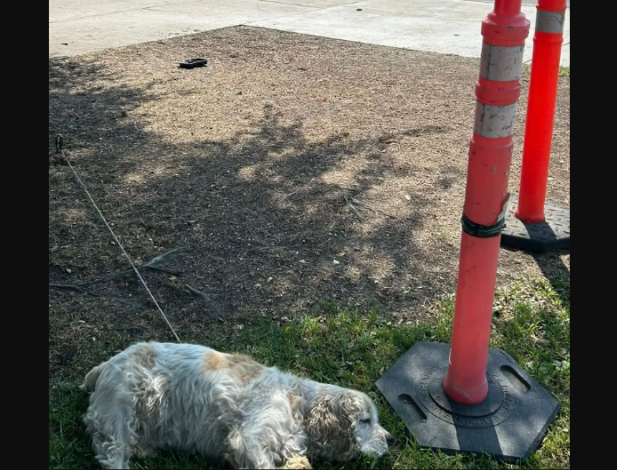
At first, it looked like nothing more than a stray dog resting beside it.
A senior dog, curled up low to the ground, barely moving, as if the world had become too heavy to keep walking through.
But something didn’t feel right.
So she looked closer.
And that’s when she realized the heartbreaking truth.
The dog wasn’t just lying there.
He was tethered.
Attached to a fixed point near the cone, unable to move freely, confined to a small stretch of space on a roadside where he had clearly been left for some time.
His body told the story before anyone else could.
He was older—his movements slow, his posture tired. The kind of exhaustion that doesn’t come from a single bad day, but from a long stretch of being overlooked.
There was no clear shelter around him.
No obvious sign of where he belonged.
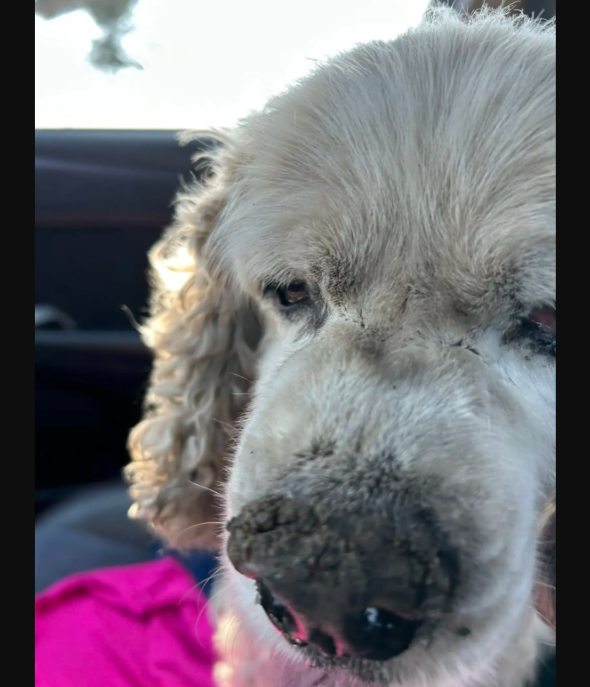
Just a senior dog, tied up in a place where safety is fragile even for people, let alone an animal with limited mobility and age-related vulnerability.
The woman didn’t hesitate.
She approached carefully, speaking softly so as not to startle him.
He didn’t react with aggression—only confusion, as if he wasn’t sure whether this interaction would bring relief or more of the same uncertainty he had already been living with.
When she got close enough, she could see how worn down he really was.
Not just physically, but emotionally too.
Dogs like him don’t always bark for help.
Sometimes they just… wait.
But this time, waiting was over.
She worked quickly to free him, checking for injuries and making sure he could stand without pain.
Then she guided him away from the roadside and into safety, where he could finally rest without the constant tension of being restrained in an exposed place.
At the shelter or veterinary care setting, the focus shifted immediately to comfort and assessment.
Food. Water. Warmth. Medical evaluation.
The basics that every dog deserves, but this one had clearly been missing for a while.
Senior dogs in situations like this often carry hidden complications—joint pain, dehydration, untreated conditions that build quietly over time.
But even more than that, they carry the emotional weight of being left behind in a stage of life when stability matters most.
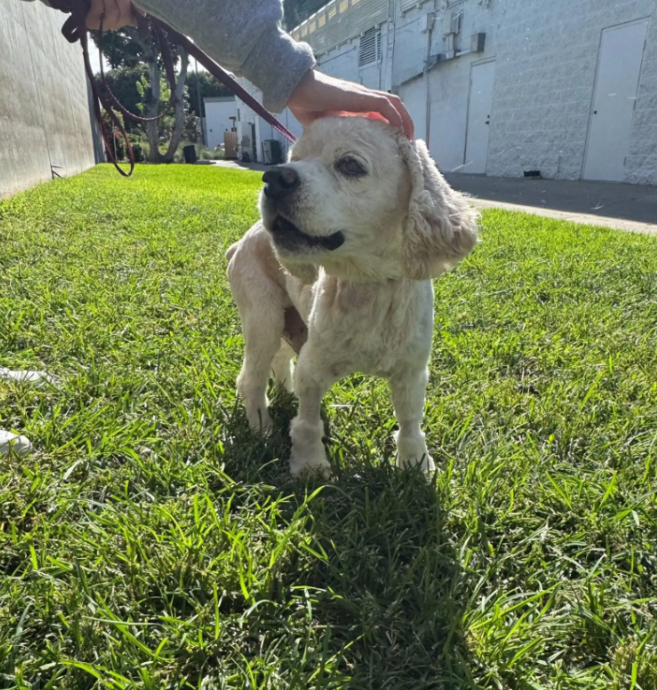
And yet, something about this dog stood out.
Even after everything, he didn’t shut down completely.
There was still a quiet presence in him.
A gentleness that hadn’t been erased by whatever had happened before.
And that matters in rescue work.
Because it means recovery is still possible.
As days pass, dogs like him often begin to show small signs of change. A more relaxed posture. A willingness to accept touch.
The first moments of sleep that feel deep instead of guarded.
These shifts don’t happen loudly.
They happen in silence.
In stillness.
In the absence of fear.
For this senior dog, the journey forward won’t be instant.
Older dogs take time to rebuild trust and comfort, especially after being confined or left in uncertainty.
But what changed in a single moment on that quiet street was everything.
He was no longer just a dog lying beside a traffic cone.
He was a dog who had been seen.
And for many rescue animals, that is where healing truly begins.