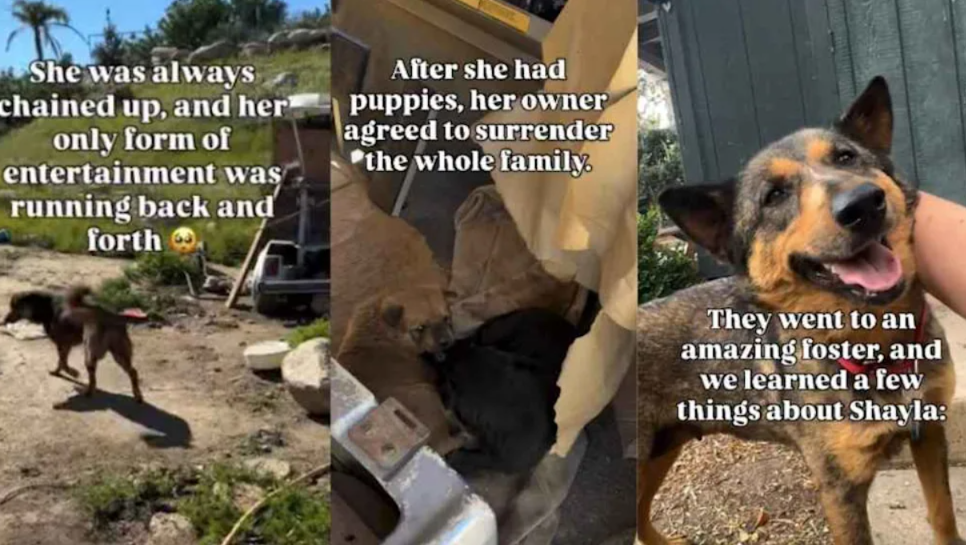
For years, his world was small.
Smaller than most people can imagine.
A chain. A patch of ground. A life measured in how far he could move before reaching the end of his restraint.
That was it.
Day after day. Year after year.
No freedom. No real comfort. No space to simply exist as a dog.
And then, one day, someone saw him differently.
Not as a problem.
Not as a label.
But as a life worth saving.
This is the kind of story that begins in silence — the quiet kind of neglect that happens in plain sight, where a dog becomes part of the background of a yard instead of part of a family.
For the dog, nothing about the world changes for a long time. The same chain. The same limited routine. The same waiting.
But outside that world, someone eventually notices.
And everything shifts.
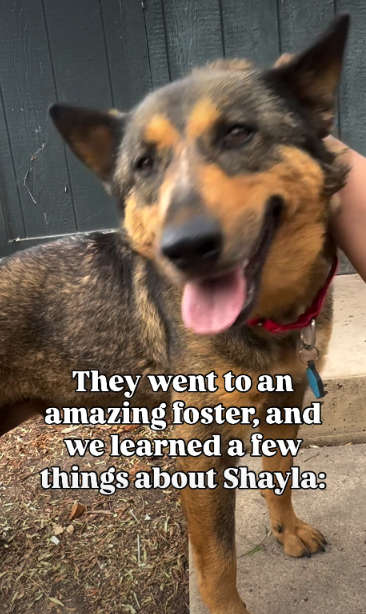
Rescue stories like this often start with a simple act of attention — a person deciding not to ignore what they’ve seen.
In many documented cases of chained or neglected dogs, it is that one decision that changes the entire trajectory of an animal’s life.
When rescuers finally step in, what they often find is not an aggressive or “bad” dog — but one who has simply adapted to an environment that gave them very little else to be.
Dogs in long-term restraint situations frequently develop behaviors shaped by stress, isolation, and lack of stimulation. It’s not who they are at their core — it’s what they’ve been forced to survive.
And when that chain finally comes off, the transformation doesn’t always look dramatic at first.
Sometimes it looks like hesitation.
Sometimes confusion.
Sometimes a dog standing still, unsure whether the world has really changed or if it’s just temporary.
But then something else begins to happen.
Curiosity returns.
Softness returns.
The ability to trust begins to reappear in small, careful steps.
A walk without tension.
A space without limits.
A moment where no one is pulling back on a chain anymore.
That’s where the real story begins.
Because rescue isn’t just about removal from suffering — it’s about rebuilding what was taken away over time: safety, predictability, and connection.
In many cases, dogs who were once labeled as “difficult” or “unfriendly” begin to reveal entirely different personalities once they are placed in stable, loving environments.
The same dog who once had no reason to trust humans slowly learns that hands can mean food, comfort, warmth, and care instead of restriction.
And that shift is everything.
Not instant.
Not perfect.
But real.
For this dog, the journey from chain to freedom is not just a physical relocation — it is the beginning of a completely different identity.
One where he is no longer defined by where he was kept, but by where he is finally allowed to go.
Grass under paws that can move freely.
Open space without fear.
Quiet moments that don’t feel like waiting.
And maybe, most importantly, people who stayed long enough to see him as more than his past.
Because that’s what rescue ultimately does.
It doesn’t erase what happened.
It replaces what followed.
With care.
With patience.
And with a life that finally belongs to him.