If you’ve ever loved a Labrador Retriever, you know one thing for certain:
Their tail never stops moving.
It clears coffee tables.
Knocks into walls.
Smacks unsuspecting legs.
And somehow manages to communicate every emotion imaginable.
For an 8-year-old Labrador named Blue, that wagging tail wasn’t just part of his personality.
It was part of who he was.
That’s why a devastating accident nearly changed everything.
One ordinary day, Blue was out with his owner, Ian, enjoying time outdoors. As Blue attempted to jump into a vehicle, a tragic accident occurred. Before anyone realized what had happened, the back of Blue’s pelvis was run over at a very low speed, causing a serious injury.
Blue was rushed to an emergency veterinary hospital where doctors evaluated the damage.
The news was difficult to hear.
Although Blue was fortunate enough to still walk and maintain normal bodily functions, his tail had become completely paralyzed. A fracture near the base of his spine had caused the first vertebra of his tail to detach, leaving it motionless.
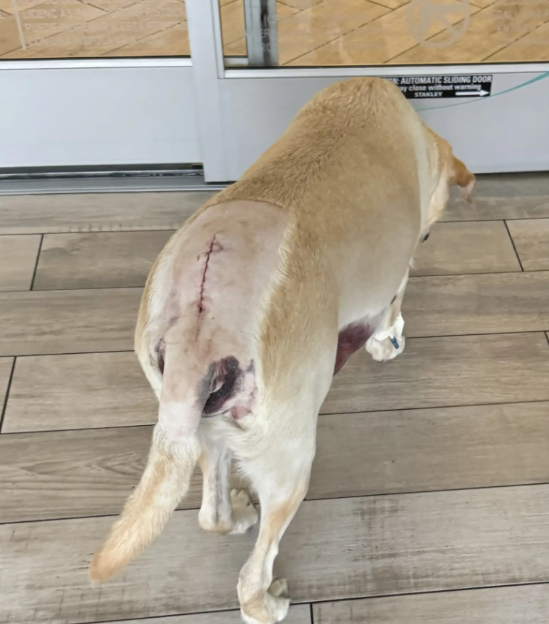
For many dogs with injuries like Blue’s, the standard recommendation is tail amputation.
But one veterinarian wasn’t ready to accept that outcome.
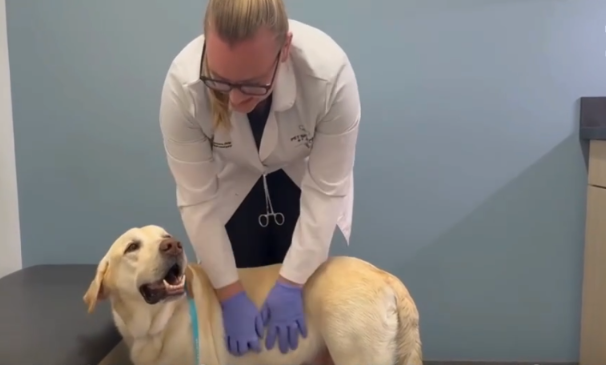
When veterinary neurologist Dr. Elizabeth Passmore examined Blue, she noticed something encouraging.
Despite the paralysis, Blue still had sensation in his tail.
That small detail offered a glimmer of hope.
If the damaged structures could be repaired and the nerves given time to heal, there was a chance Blue might recover movement.
The challenge was figuring out how.
Dr. Passmore searched the available veterinary literature and discovered only a single published study describing a similar procedure—and that surgery had been performed on cats, not dogs. In fact, she could find no documented cases of the technique ever being used on a canine patient.
Still, she believed Blue deserved a chance.
Drawing on her experience and surgical expertise, she adapted the procedure for a Labrador Retriever.
The operation took approximately two and a half hours.
During surgery, damaged tissue was removed, pressure on the nerves was relieved, and the fractured bones were carefully realigned. Instead of using metal implants, Dr. Passmore employed a specialized suture-sling technique designed to stabilize the injury and support long-term healing.
Then came the waiting.
No one knew for certain whether Blue would ever wag his tail again.
But within a week, something incredible happened.
The tip of his tail moved.
Just a little.
But it was enough.
It meant the nerves were responding. It meant healing was underway.
Over the following weeks, Blue continued improving.
Five weeks after surgery, he was a completely different dog. During a follow-up visit, he was reportedly rolling around, asking for belly rubs, and even doing zoomies around the exam room. Most importantly, his tail was wagging again.
For many people, a tail might seem like a small thing.
But dog lovers understand better.
A wagging tail is excitement.
Joy.
Affection.
It’s one of the primary ways dogs communicate with the people they love.
That’s what made Blue’s recovery so meaningful.
He didn’t just avoid losing his tail.
He regained a part of himself.
Today, Blue is back to enjoying life with the family who adores him. While he’ll continue easing back into some of his favorite activities, his prognosis is excellent.
His story is a powerful reminder that sometimes hope can be found in the smallest movements.
In Blue’s case, it started with a tiny twitch at the end of a tail.
And it ended with a wag that nobody will ever take for granted again.