When soldiers are sent into dangerous territory, they rely on training, technology, and one another to make it home safely.
But sometimes, one of their most important teammates walks on four legs.
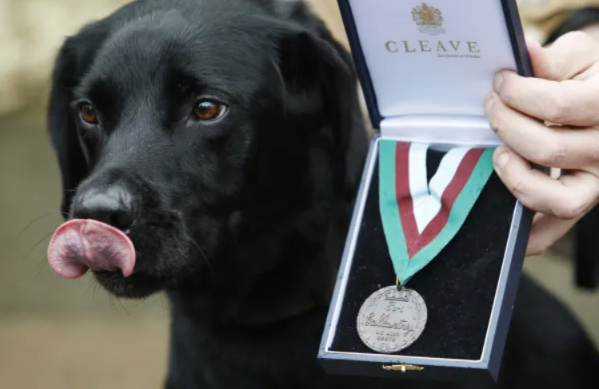
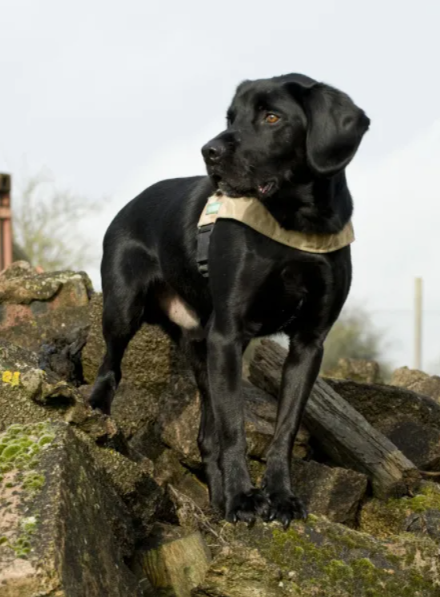
Treo, a black Labrador serving with the British Army in Afghanistan, became one of those extraordinary teammates. His incredible ability to detect hidden explosives helped protect soldiers from potentially devastating attacks—and eventually earned him one of the highest honors an animal can receive for bravery.
Treo wasn’t carrying a weapon.
He didn’t wear body armor like the soldiers around him.
His greatest weapon was his nose.
A Nose That Could Save Lives
Treo worked as a specialist detection dog, searching areas where hidden explosives could pose a deadly threat to troops.
His job required him to identify explosives that could be extremely difficult for humans to spot.
In August 2008, while operating in Sangin, Afghanistan, Treo detected a concealed improvised explosive device known as a “daisy chain.” The explosives had been carefully hidden beside a path used by troops.
Finding it before soldiers reached it potentially prevented a devastating attack.
But Treo wasn’t finished.
Just one month later, he discovered another concealed daisy-chain explosive device.
Again, his extraordinary sense of smell alerted his team to a danger that might otherwise have gone unnoticed.
For the soldiers working alongside him, those discoveries weren’t simply impressive.
They could mean the difference between coming home safely and suffering catastrophic casualties.
A Partnership Built on Trust
Behind every successful military working dog is a handler who understands how to communicate with them.
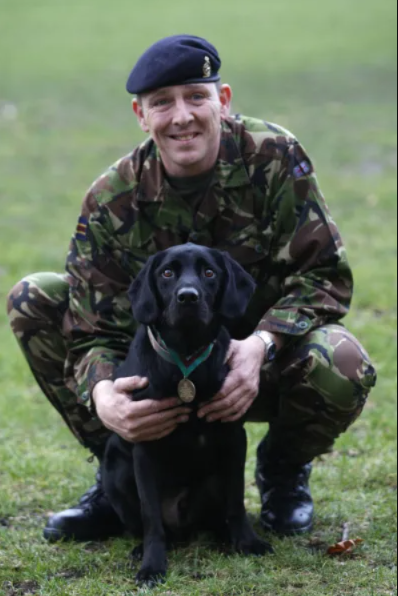
For Treo, that person was Sergeant Dave Heyhoe.
Their relationship went far beyond the typical working partnership.
Searching for explosives in a war zone requires complete trust. The handler has to understand the dog’s behavior, while the dog must respond to commands and remain focused despite an unpredictable and dangerous environment.
Heyhoe understood that Treo wasn’t simply another piece of military equipment.
He was a teammate.
The pair spent countless hours working together, learning how to communicate almost instinctively.
That bond became especially important when they were searching dangerous areas.
Treo had to know where to search and when to move, while his handler had to recognize the dog’s signals and trust what his nose was telling him.
It was a partnership built through training, experience, and mutual confidence.
The Ultimate Recognition
Treo’s bravery eventually earned him the Dickin Medal, one of the highest honors awarded to animals for acts of courage and devotion during wartime.
The award was established in 1943 by Maria Dickin, founder of the People’s Dispensary for Sick Animals. It recognizes animals whose actions have demonstrated exceptional bravery or dedication while serving alongside people.
The medal has often been described as the animal equivalent of the Victoria Cross.
Treo became the 63rd animal to receive the honor and the 27th dog.
For a military working dog, it was an extraordinary achievement.
But the medal represented more than a shiny piece of recognition.
It reflected the lives potentially saved by Treo’s work.
From War Zone to Retirement
After years of service, Treo eventually retired from military duty.
And after spending his working life in one of the most dangerous environments imaginable, he finally got something every hard-working dog deserves:
A chance to relax.
Treo retired alongside Sergeant Heyhoe, allowing the two longtime partners to remain together.
For Heyhoe, that was particularly meaningful.
Their relationship had grown far beyond the duties they performed during military operations. Treo had become a trusted friend and companion.
The dog who had spent his career searching for hidden explosives could finally enjoy a much quieter chapter of life.
More Than a Military Working Dog
It’s easy to look at a highly trained military dog and focus on what they can do.
They can detect explosives.
They can search dangerous areas.
They can work alongside soldiers in environments where mistakes can have deadly consequences.
But Treo’s story shows the emotional side of these partnerships, too.
Military dogs aren’t machines. They are living, highly trained animals whose courage and instincts can make an enormous difference to the people around them.
For Treo, his remarkable nose helped identify dangers that humans might never have detected in time.
His work helped give soldiers a better chance of making it home.
And his loyalty to his handler demonstrated the extraordinary bond that can develop between a dog and the person who works beside him.
A Hero With Four Paws
Treo may not have understood what a medal meant.
He probably didn’t know that people considered him a hero.
He simply did what he had been trained to do.
He searched.
He detected.
He alerted his team.
And he did it again and again in places where the danger was very real.
That’s what makes his story so remarkable.
Sometimes courage doesn’t look like a battlefield charge or a dramatic rescue.
Sometimes it looks like a Labrador quietly following his nose down a dangerous path—and stopping his team before disaster strikes.
Treo’s legacy is a powerful reminder that heroes don’t always wear uniforms or carry weapons.
Sometimes, they have four paws, a wagging tail, and an incredible nose.