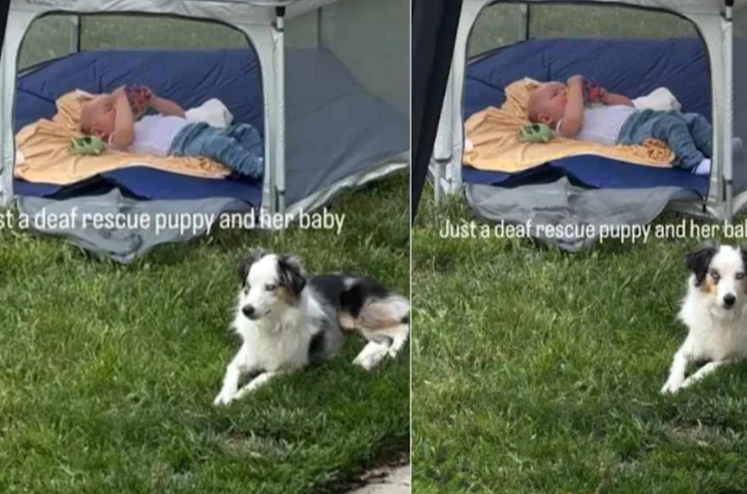
Not every rescue story begins with noise.
Some begin in silence.
This one starts with a deaf puppy who couldn’t hear commands, couldn’t hear danger, and couldn’t hear the world the way most dogs do—but somehow understood something even more important.
Safety.
Love.
And the person she chose to trust.
The puppy had already been through the kind of early life no animal should experience.
She ended up in rescue care after being pulled from a difficult situation, where uncertainty was the only constant she knew.
For a deaf dog, that kind of instability can be even more disorienting—no sounds to anchor her, no verbal cues to guide her, just instinct and observation.
So when she finally met her new human, everything could have gone either way.
But something clicked.
Deaf dogs don’t rely on voice. They rely on presence. Body language. Energy. Consistency. And this puppy paid attention to every detail.
She studied how her human moved through space. She learned what calm looked like. She learned what safety felt like.
And then she did something that surprised everyone watching her journey unfold.
She became protective.
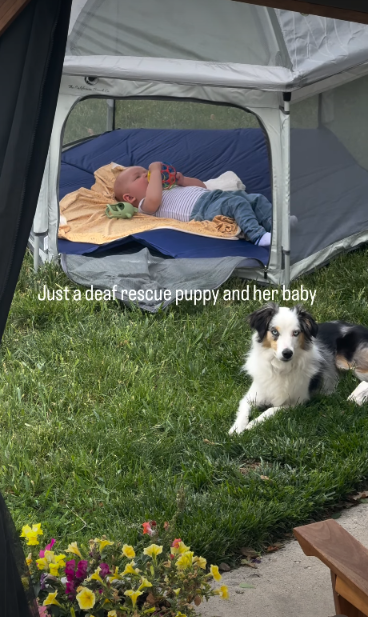
Not in a fearful, reactive way—but in a devoted, grounding way. The kind of protection that doesn’t come from aggression, but from attachment.
From knowing where home is, and deciding that nothing is going to threaten it without being noticed.
She started sticking close to her person.
Following them from room to room.
Positioning herself nearby when strangers entered the space.
Watching carefully, always alert, but never panicked.
It was as if she had decided: this is my person, and I understand what matters now.
For many deaf rescue dogs, that shift is a turning point. Without sound, they often become more visually tuned-in than most dogs.
They notice subtle movements. Shifts in posture. Changes in routine. And in doing so, they often become incredibly perceptive companions.
This puppy was no different.
Her bond with her human deepened quickly, built on trust instead of noise.
Every interaction reinforced the same message: you are safe here, and I will show up for you.
And in return, she began to relax.
Deaf dogs often carry extra stress early on because the world feels unpredictable.
But once routine and trust are established, something remarkable happens—they settle into a calm, grounded confidence that can be even stronger than hearing dogs, because they’ve learned to rely on something deeper than sound.
This puppy found that stability in her person.
And her protective nature wasn’t a burden—it was a reflection of love.
She wasn’t guarding out of fear.
She was guarding because she cared.
Because in her world, connection wasn’t spoken—it was lived.
Over time, what started as cautious observation turned into something unmistakably tender.
She would check in constantly, making sure her human was nearby. She would respond instantly to visual cues.
And she would position herself in ways that quietly communicated one thing:
I’m here. I’ve got you.
And her human responded in kind, learning how to communicate in the way she understood best—through gestures, consistency, and presence.
No shouting. No commands she couldn’t hear.
Just understanding.
Just partnership.
Stories like this challenge the assumption that hearing defines connection for dogs. It doesn’t.
Connection is built in repetition. In trust. In shared space. In the quiet decision, made over and over again, that someone is worth staying close to.
For this deaf rescue puppy, that decision was simple.
She had already been lost once in a world she couldn’t hear.
She wasn’t going to lose her person in the one place she finally understood as home.