Some dogs don’t just notice emotions.
They respond to them.
And in this touching moment, one dog’s reaction to his mom’s sadness shows just how deeply that connection can run.
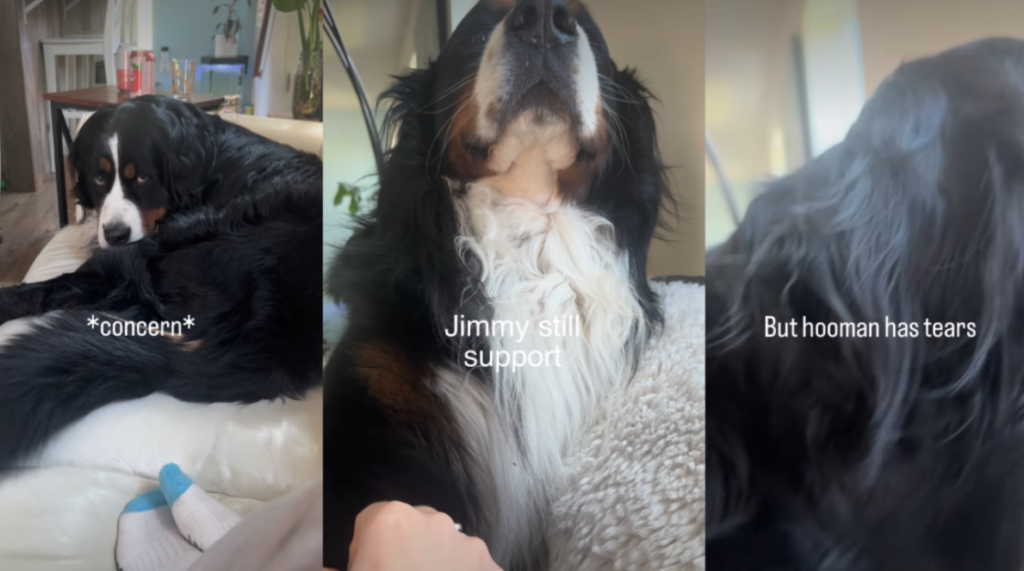
A heartfelt video shared online captures a dog immediately shifting his behavior the moment he senses his owner is feeling down.
Instead of staying distant or distracted, he moves closer — quietly, intentionally — as if he understands that something isn’t right.
There’s no confusion in his actions.
Just concern.
He stays near her, leaning in and remaining present in a way that feels almost instinctive, like he’s offering comfort without needing to be asked.
Moments like this are often described by pet owners as “emotional support in real time,” where dogs appear to adjust their behavior in response to human mood changes.
Research supports that dogs are highly sensitive to human emotional cues, including facial expression, tone of voice, and even crying.
Studies have shown they are more likely to approach distressed humans and exhibit calming behaviors such as close proximity or gentle contact.

In this case, the dog’s response feels especially personal.
He doesn’t panic.
He doesn’t withdraw.
He simply stays close — choosing presence over everything else.
That kind of behavior is widely recognized in dogs who have strong attachment bonds with their caregivers.
These bonds are built through routine, trust, and repeated positive interactions over time, creating a sense of emotional synchronization between dog and owner.
And when that bond is strong, dogs often seem to “read the room” before anything is said out loud.
What makes this moment resonate so deeply is how natural it looks.
There’s no training cue, no command, no signal.
The dog is simply reacting the way many emotionally attuned dogs do — by moving closer when something feels off.
For people watching, it becomes more than just a cute interaction.
It becomes relatable.
Because most dog owners recognize that exact behavior — the quiet presence, the lingering nearby, the refusal to leave your side when you’re not yourself.
Animal behavior experts note that dogs can pick up on subtle shifts in human behavior and may respond with what appears to be empathy, even if the underlying mechanism is more instinctive than emotional understanding in the human sense.
Still, the effect is the same.
Comfort is given.
Silence is filled.
And emotional distance is reduced simply by being there.
The dog in this story doesn’t fix anything.
He doesn’t need to.
Instead, he does something arguably more powerful in moments of sadness:
He stays.
And in that choice, he offers exactly what many people need most when they’re feeling low — steady, uncomplicated companionship.
No questions.
No pressure.
Just presence.
And sometimes, that’s enough to make a heavy moment feel a little lighter.