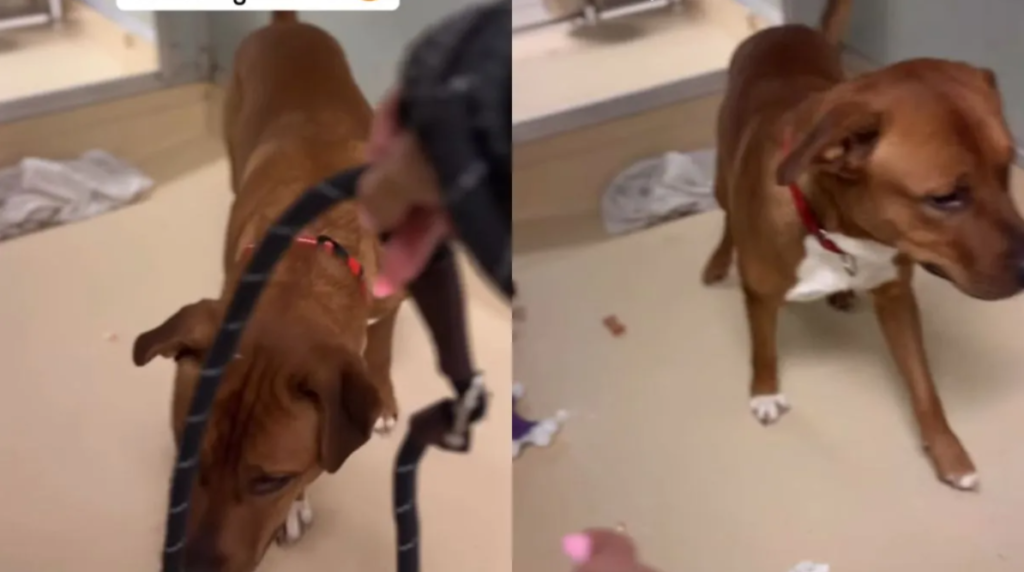
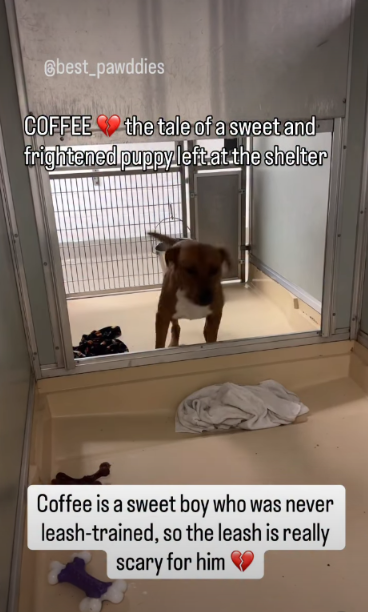
At Miami-Dade Animal Services, a young shelter dog named Coffee is learning something most dogs take for granted:
That a leash doesn’t always mean something scary is about to happen.
At just nine months old, Coffee has already developed a strong fear response to anything resembling walking gear.
The moment a volunteer picks up a leash, he barks sharply from his kennel—loud, startled, and overwhelmed.
But what makes his story different is what happens next.
Even in fear, Coffee doesn’t shut down completely.
He still reaches for connection.
When the leash is hidden from view, his reaction changes instantly. The barking stops. His body softens.
And instead of retreating, he cautiously steps forward to accept treats from the volunteer offering him kindness.
It’s a small shift—but in shelter behavior, small shifts are everything.
Coffee’s fear isn’t aggression. It’s confusion.
According to shelter staff, he and his brother were surrendered after growing up in an environment where they likely never learned how leash walking works.
Without proper exposure, something as simple as a leash can feel unpredictable and threatening rather than routine.
That lack of early socialization shows up clearly in dogs like Coffee.
What most people see as “bad behavior” is often just a nervous system trying to protect itself from the unknown.
But here’s what makes Coffee stand out:
He still wants to trust.
Once he feels safe enough—once the leash is out of sight and pressure is removed—he allows himself to engage.
He takes treats. He leans into calm voices. He even lets caregivers wrap him gently in a towel so they can safely carry him to outdoor spaces without triggering panic.
That kind of responsiveness matters. It means fear hasn’t fully closed the door on learning.
Outside the kennel, Coffee’s behavior shifts again. In a controlled play area, away from the immediate stress of the leash, his personality starts to emerge in fragments—curiosity, alertness, and brief moments of relaxation that weren’t visible inside the kennel.
This is the part of rescue work most people never see.
Not the dramatic “before and after,” but the slow middle ground where healing actually happens.
For dogs like Coffee, trust isn’t built through correction. It’s built through repetition of safe experiences. The leash appears.
Nothing bad happens. The leash disappears. A treat follows. A calm voice stays consistent.
Over time, the brain begins to rewrite the association.
Leash ≠ danger.
Leash ≠ pain.
Leash = something that leads to safety.
It’s a slow process, and it can’t be rushed.
Shelter volunteers know this well. That’s why they focus less on forcing walks and more on creating moments where Coffee can choose engagement on his own terms.
That choice is critical—it’s the difference between compliance and confidence.
And confidence, in a dog like Coffee, is fragile but real.
What makes his story especially powerful is that it reflects so many shelter dogs who arrive with invisible histories.
Dogs who were never taught how to navigate the world outside a backyard or living room.
Dogs who interpret everyday objects as threats simply because they’ve never seen them used kindly.
But even in that fear, there’s something hopeful in Coffee’s behavior.
He doesn’t stay shut down.
He doesn’t reject connection entirely.
He keeps trying.
Step by step, treat by treat, moment by moment, Coffee is learning that the world can be predictable. That people can be safe. That leashes can lead somewhere good.
And for a dog who once barked in panic at the sight of walking gear, that shift isn’t small at all.
It’s the beginning of everything.