
Some rescue stories don’t start with grand transformations.
They start with tiny paws, big curiosity, and a name you don’t forget.
That’s the case for a foster puppy named Egg Roll — a small pup with an instantly memorable name and an even more heart-melting beginning.
Egg Roll was discovered after being abandoned as a very young puppy, found in a vulnerable situation alongside other pups before being taken in by a foster caregiver.
From that moment forward, her life shifted from uncertainty to care, safety, and structure — the kind of environment where a young dog can finally begin to grow.
In her foster home, Egg Roll is quickly introduced to a new world: people, routines, and another resident dog who helps guide her through early social learning.
Like many foster puppies, she is still figuring out the basics — how to navigate space, how to interact confidently, and how to keep up with a world that suddenly feels much bigger than before.
And yet, what stands out immediately is her energy.
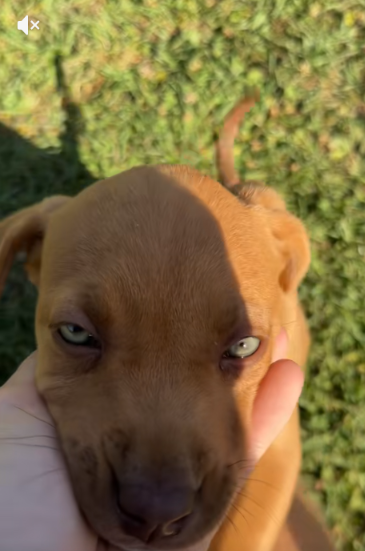
Despite her rough start, she moves through new experiences with a surprising amount of curiosity. Small barriers become challenges she tries to solve.
New spaces become playgrounds. Even simple interactions turn into learning moments that shape her confidence day by day.
Foster environments like this play a critical role in early behavioral development for rescued puppies.
At this stage, exposure, socialization, and gentle structure are key factors that influence long-term adaptability.
Puppies who receive stable foster care often show improved confidence, better social behavior, and easier transitions into adoptive homes later on.
Egg Roll’s story is a clear reflection of that process in motion.
She’s not “fixed” or fully formed yet.
She’s learning.
And that learning is visible in everything she does — from tentative exploration to sudden bursts of playful determination when she figures something out.
There’s also something especially meaningful about her interactions with her foster environment.
Having an older, more stable dog nearby provides her with a behavioral reference point — a calm presence she can observe and subtly mirror.
This kind of cross-dog social learning is common in foster settings and often helps younger dogs develop confidence faster than isolation-based environments.
But even without analysis, what people notice most is simple:
She’s thriving.
Not in a polished, finished way.
But in a real, unfolding way.
Every new day adds another layer to her personality — a bit more confidence, a bit more coordination, a bit more trust that the world is not something to fear.
And that’s what makes Egg Roll’s story resonate so widely.
Because she isn’t a “before and after” yet.
She’s the in-between.
The messy, adorable, growing stage where everything is still becoming something better.
And for a puppy who started out abandoned and uncertain, that “becoming” is everything.
Related posts:
 Scared of Humans, Burdened With Tumors — How One Dog Is Finally Healing
 Watch Giant Dog Make His Feelings Known About New Puppy Roommate
 The Heartfelt Story of a Dog Found in a Cage Who Finally Found Freedom and Family
 A Thousand Miles and Five Years Later: The Miraculous Return of Bella the Chihuahua