It started with something simple: an empty truck and a lonely stray.
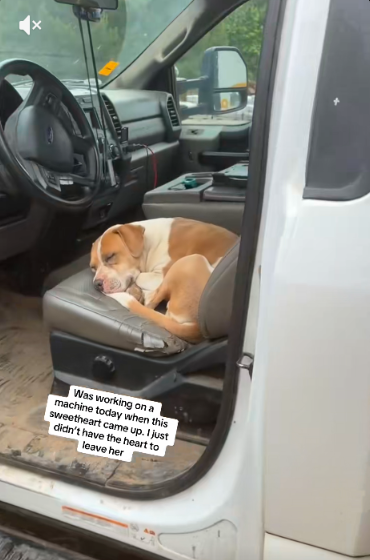
No one knows exactly how long the pit bull had been on his own before that moment, but when he spotted the open vehicle, he made a choice that would end up changing his entire trajectory.
He climbed inside.
Just like that, what began as survival on the streets turned into an unexpected pause—inside a parked truck that suddenly became his temporary safe space.
For a stray dog, opportunities like this don’t come with instructions.
There’s no understanding of ownership, no awareness of rules about personal property.
There is only instinct: warmth, shelter, safety. And when a dog has been living without stability, those things matter more than anything else.
When the truck’s owner discovered him, the scene was equal parts surprising and confusing.
There he was—settled inside the vehicle as if he belonged there, refusing to simply leave on command.
Like many stray dog encounters, the situation didn’t resolve instantly. Attempts to coax him out were met with hesitation.
Not aggression, but uncertainty.
A kind of stubborn stillness that often shows up in animals who have learned not to trust easily, or who simply don’t want to return to the uncertainty outside.
Eventually, patience became the deciding factor.
Instead of rushing him, the response shifted. Calm voices. Space. Time. The kind of approach that tells an animal they don’t have to fight or flee anymore.
And slowly, that changed everything.
Stories like this are not uncommon in the world of rescue.
Stray dogs often gravitate toward enclosed, human-made spaces—cars, porches, garages—places that feel like shelter after long periods of exposure.
What looks like “invading” a space is often just a search for safety.
Once trust begins to build, even slightly, everything starts to shift.
Food becomes easier to accept.
Movement becomes less guarded.
And the idea of being helped—rather than chased away—starts to take hold.
In many cases, these encounters become turning points.
A stray dog that refuses to leave a truck isn’t being difficult; he’s often making the only choice that feels safe in that moment.
And when humans respond with patience instead of force, that moment can evolve into something much bigger.
A rescue.
A foster situation.
Sometimes even a permanent home.
For this pit bull, what happened next followed that familiar path.
Once he was no longer treated as a problem to be removed but as a life to be understood, the tension eased.
The refusal softened. And the dog who had first entered the truck out of instinct eventually began to respond to care.
What looked like stubbornness was really uncertainty.
What looked like occupation was really opportunity.
And what started as a stray climbing into a parked vehicle became the beginning of a second chance.
Because sometimes rescue doesn’t begin with a leash or a shelter intake form.
Sometimes it begins with a door left open—and a dog brave enough to step inside.