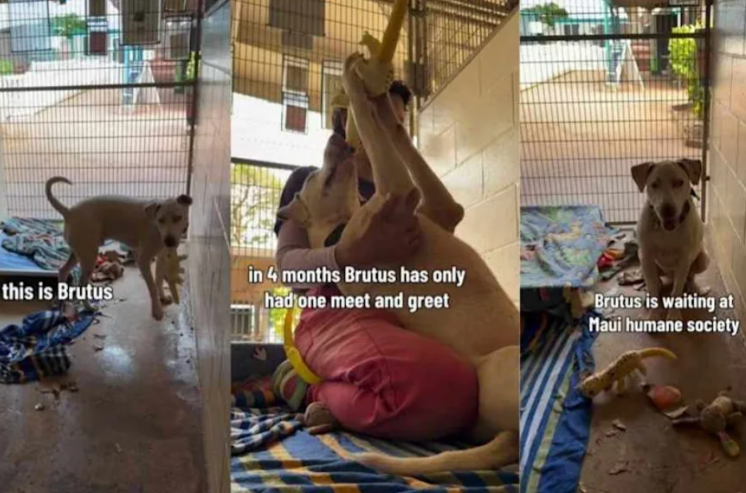
When Brutus was given a toy, it wasn’t just playtime.
It was a test.
Not one anyone had told him about—but one he had learned through experience.
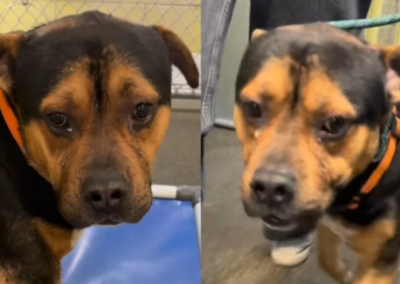
Because Brutus is a deaf shelter dog, and for him, the world has always been quieter and more uncertain than most.
So when a volunteer entered his kennel and gently offered him a plush toy, his reaction came fast and instinctive.
He grabbed it.
And he ran.
Straight to the far side of his space, clutching it like something precious—something he couldn’t afford to lose.
Not because he was being possessive in a playful way, but because he didn’t yet understand something many dogs take for granted:
that gifts are meant to stay.
For Brutus, life had taught a different lesson. Things don’t always last. Comfort can disappear.
And when something good appears, it might be taken away just as quickly.
So he protected it the only way he knew how.
By holding on tightly.
The volunteer didn’t rush him.
No grabbing. No sudden movements. No pressure to “share” or “release.” Just patience, quiet presence, and time.
Because trust doesn’t respond to force—it responds to consistency.
So she stayed nearby.
Let him keep the toy.
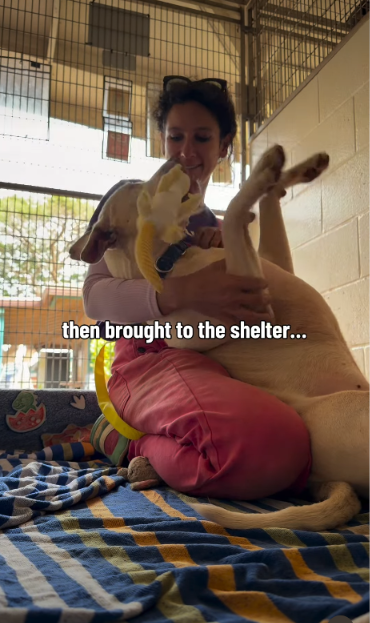
Let him decide what happened next.
And slowly, something began to shift.
Brutus didn’t run farther away.
He started watching her instead.
That small change mattered more than it looked like it should. For a dog who can’t rely on sound, visual trust becomes everything.
He had to read intention through movement, posture, and repetition. And what he saw wasn’t threat.
It was calm.
It was safety that didn’t demand anything in return.
Eventually, curiosity started to outweigh fear.
He didn’t drop the toy immediately, but he stopped guarding it with the same urgency.
The tension in his body eased just enough to suggest a question forming underneath the fear: Is it really okay if I keep this?
And the answer, shown not in words but in behavior, was yes.
Over time, the toy stopped being something to defend.
It became something to enjoy.
Brutus began to relax around the volunteer. Short interactions turned into longer visits.
The space between “stranger” and “safe person” started to shrink.
Each return visit reinforced the same message: nothing was being taken from him. Nothing was disappearing.
In a shelter environment, those small shifts are everything.
Dogs like Brutus don’t always respond to traditional cues.
Deafness changes how they interpret the world, but it doesn’t change their capacity for connection. If anything, it often heightens their sensitivity to consistency and care.
Once they understand they are safe, the change can be remarkable.
The toy that once triggered fear became a symbol of something different.
Not loss.
Not uncertainty.
But comfort.
A beginning.
And for the people caring for him, that transformation mattered just as much as any adoption application.
Because it showed what was possible when a dog is given space to understand life at their own pace.
Brutus didn’t need to be fixed.
He needed time.
Time to learn that good things don’t always disappear.
Time to learn that gentle hands don’t take—they give.
And time to realize that he wasn’t in a place where he had to protect every moment of joy.
Because this time, the toy wasn’t going anywhere.
And neither were the people finally teaching him what safety feels like.