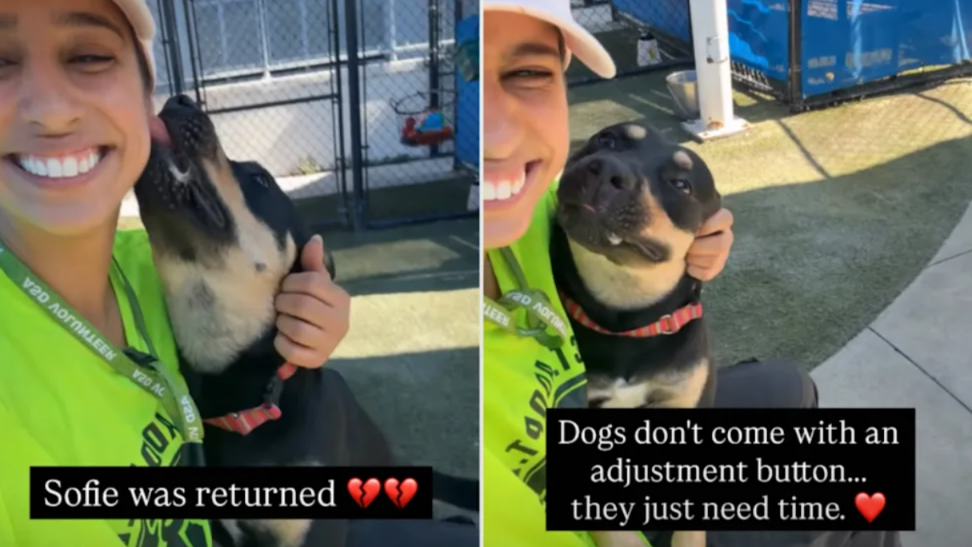
She had already done the hardest part.
She had been adopted.
For a shelter dog, that moment is supposed to mean everything changes—no more kennel noise, no more uncertainty, no more waiting for someone to choose you again.
But for her, the story didn’t go the way anyone hoped.
After leaving the shelter, the dog went to what should have been her forever home.
A place where she was expected to settle in, decompress, and finally learn what safety feels like outside of a kennel run.
Instead, she came back.
Returned.
The reasons weren’t framed in cruelty, but in mismatch—something that happens more often in rescue work than people realize.
Sometimes dogs behave differently once they leave the structured environment of a shelter.
Sometimes adopters aren’t prepared for the adjustment period. And sometimes, expectations and reality don’t line up fast enough for a bond to form.
Whatever the cause, the outcome is the same for the dog.
Confusion.
Loss.
A second return to the place she had just been told she was leaving behind.
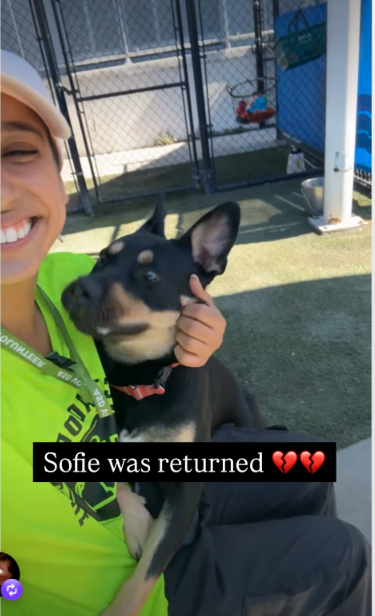
When she arrived back at the shelter, staff saw what so many dogs show in that moment: a shift in energy.
Dogs don’t understand the concept of being “given back,” but they do understand change.
They understand when a door closes again after briefly opening.
And that can shake them.
Some dogs shut down. Others become restless or anxious. Many simply wait—trying to make sense of patterns that don’t make sense at all.
For this dog, that waiting became her reality once more.
But shelter workers also understand something else: returns don’t define a dog’s future. They define timing. Fit. Readiness. Not worth.
And so, even after the setback, she was seen again—not as a failed adoption, but as a dog who still needed the right environment and the right person.
That distinction matters more than it sounds.
Because in shelters, labels can be misleading. “Returned” doesn’t mean “unadoptable.” It often just means “not this home.”
So the focus shifted back to what it always is in good shelters: stability, observation, and keeping her emotionally supported while she waited for the next opportunity.
She was given structure again. Familiar routines. Careful handling.
The kind of calm repetition that helps a dog reset after emotional disruption.
And slowly, as often happens, the sharp edges of that experience began to soften.
Her behavior stabilized. Her stress signals reduced. The confusion that followed her return didn’t disappear overnight, but it stopped defining every interaction.
Because dogs are not static.
They adapt.
They recalibrate.
And when given consistency again, they begin to rebuild trust—not just in people, but in the idea that change doesn’t always mean loss.
Stories like hers are uncomfortable because they sit in the space between hope and realism.
Not every adoption is immediate success. Not every first match is the right one. But that doesn’t mean the process fails—it means it’s still in motion.
And motion matters.
Because every return teaches something. Every mismatch narrows the path toward the right home.
Every reset is another chance for the dog to eventually land where they’re truly understood.
For this shelter dog, that second chance wasn’t taken away by the return.
It was delayed.
And in the world of rescue, delays are not endings.
They’re pauses before the right beginning finally arrives.