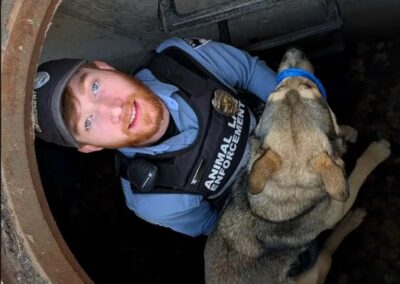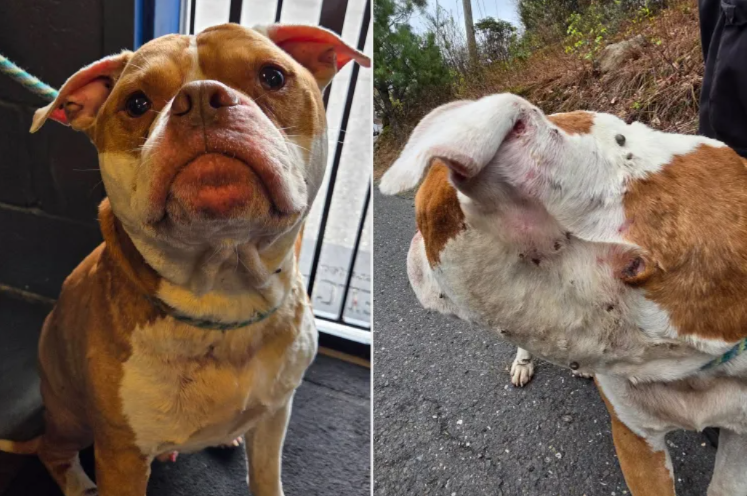
He was found lying still.
So still, in fact, that rescuers at first thought he was already gone.
There was no movement. No reaction. Just a fragile body in a condition so severe it looked like there was nothing left to save.
But someone didn’t walk away.
And that decision changed everything.
When they moved closer, they realized he was still alive—barely.
What followed was a discovery that made the situation even more urgent: his body was covered in parasites.
Over 800 ticks, draining what little strength he had left.
It was one of those moments in rescue work where urgency becomes everything.
There is no hesitation, no delay—just immediate action to try to pull a life back from the edge.
He was carefully taken in and given emergency care. Every step of treatment had to be handled with precision.
Removing the ticks wasn’t just unpleasant—it was medically critical.
His body had been under extreme stress for an unknown amount of time, and the damage ran deeper than what could be seen on the surface.
Dehydration. Exhaustion. Severe neglect.
His condition told a story of prolonged suffering.
But even then, something remarkable was still there.
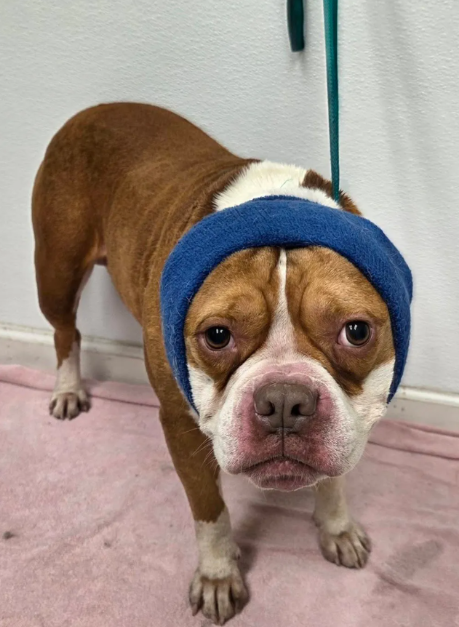
He was still responding.
Still fighting.
Still holding on in a way that made it clear he wasn’t ready to give up.
That small spark became the focus.
Because in rescue cases like this, survival often hinges not just on medical intervention, but on whether the animal still has enough strength to accept help.
And he did.
Slowly, as the ticks were removed and his body began to stabilize, things started to shift.
The immediate danger didn’t disappear overnight, but there was a visible change in him.
The kind that happens when a body is no longer actively being overwhelmed.
For the first time in a long time, relief became possible.
Recovery from cases this severe is never fast. It’s a process built on patience, consistency, and round-the-clock care.
His body needed time to rebuild what had been stripped away. His energy needed time to return.
And just as importantly, his trust needed time to form.
But he was no longer alone in it.

People who saw him through those first critical hours stayed with him through the next stages too—feeding, monitoring, treating, and slowly helping him regain strength.
Day by day, he began to change.
The emptiness in his expression started to fade. His body gained a little more stability.
His reactions became more aware, more present, more connected to the world around him.
He wasn’t just surviving anymore.
He was coming back.
Cases like his are difficult to forget, not because of the condition he was found in, but because of what they reveal: how close some animals come to the point of no return, and how much difference a single moment of intervention can make.
If he had been overlooked just a little longer, the outcome could have been very different.
But he wasn’t.
And because of that, a life that looked already lost was given the chance to start again.