When Heidi first met Whitney, even the gentlest touch was too much.
The six-month-old German Shepherd puppy had arrived at a shelter as a stray carrying a heartbreaking injury: a scar stretched around her entire muzzle.
Shelter staff believed her mouth had been bound shut for an extended period, possibly with something like rubber bands.
Her physical injuries could heal.
Her emotional wounds would take much longer.
Heidi was terrified of people, and every interaction had to happen on her terms.
That became especially clear when Whitney entered her kennel.
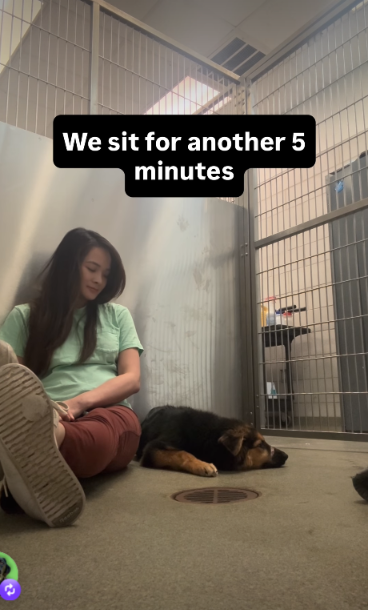
Instead of reaching for Heidi or trying to force an introduction, Whitney simply sat down on the floor.
She waited.
There was no pressure for Heidi to come closer.
Eventually, the puppy settled nearby, although she carefully maintained some distance. She wasn’t ready to be touched, and when Whitney tried a gentle touch, Heidi immediately startled.
So Whitney stopped.
That small decision mattered.
Rather than pushing Heidi past her comfort zone, she respected the puppy’s boundaries and allowed her to decide when she was ready for more.
A little later, they tried again.
This time, Whitney used the leash instead of reaching directly toward Heidi. The puppy was still uncertain, but she tolerated gentle scratches.
Then something remarkable happened.
Heidi began investigating.
First, she cautiously sniffed Whitney’s hand. Then she checked out her trousers and shoes, slowly gathering information about the person sitting beside her.
For a puppy who had every reason to be suspicious of humans, those tiny acts of curiosity were enormous.
Then Heidi took an even bigger step.
She stretched upward and gave Whitney a quick lick on the face.
It was brief.
It was simple.
But it represented a huge breakthrough.
Earlier, Heidi had struggled even to make eye contact. Now, she was voluntarily moving toward Whitney.
That didn’t mean she was suddenly completely comfortable.
Heidi still had boundaries.
When Whitney reached toward her head and the puppy became frightened, Whitney didn’t force the interaction. Instead, she returned to the kinds of touches Heidi had already shown she could tolerate.
Slowly, Heidi continued to relax.
Soon, she was sitting beside Whitney while receiving gentle pets along her back. Then came another beautiful moment: Heidi offered Whitney her paw.
For many people, offering a paw might look like an ordinary dog behavior.
For Heidi, it was anything but ordinary.
This was a puppy learning, perhaps for the first time, that a human hand could bring comfort instead of fear.
By the time it was time to leave, Heidi had made remarkable progress. She carefully allowed Whitney to carry her out to the car.
And once she arrived at home, she appeared noticeably more relaxed.
Her transformation wasn’t instant.
It didn’t need to be.
Trust doesn’t always arrive in one dramatic moment. Sometimes, it begins with a puppy sitting a few feet away. Then comes a sniff. A gentle touch. A paw. A tiny kiss.
Each moment builds on the one before it.
Heidi still has a long journey ahead, but she finally has something she desperately needed: a safe place where she can move at her own pace.
She doesn’t have to be brave all at once.
She doesn’t have to accept every touch.
She simply gets to learn.
And for a puppy who once feared even the gentlest human contact, that’s an incredible beginning.
Heidi’s story shows just how powerful patience can be. Sometimes, earning an animal’s trust isn’t about doing more.
It’s about knowing when to wait.
And eventually, letting the dog make the first move.